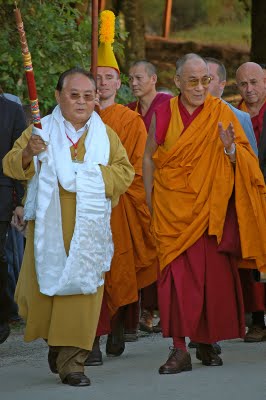
Näytetään tekstit, joissa on tunniste namkhai norbu. Näytä kaikki tekstit

keskiviikko 14. huhtikuuta 2021

Claims of Enlightenment Made by Ancient Dzogchen Masters


Claims of Enlightenment Made by Ancient Dzogchen Masters


Over the years I have repeatedly written about the principles of pragmatic dharma. Once again, here is Vincent Horn's article for those who are new to it. Last time I wrote about this was just a week ago in this text. This blog continues on the theme of claims of attainment, this time not made by myself or other contemporary teachers but by ancient masters of the dzogchen lineage.


Two days ago, for the first time ever, I opened a book entitled ”The Supreme Source, Kunjed Gyalpo, The Fundamental Tantra of the Dzogchen Semde”, translated by Chogyal Namkhai Norbu Rinpoche and Adriano Clemente. This book was first published in Italian in 1997 and in English in 1999.


Vairo Drabag


As I was reading the first few pages of the book I found a section entitled Vairo Drabag that gives brief biographical descriptions of the founding masters of dzogchen teaching, namely Garab Dorje, his direct students and those further down the lineage.


As I started reading these short stories about the lineage founders, to my amazement, I found most of them making claims of having attained buddhahood! In the text that is part of the traditional dzogchen semde-teaching, transmitted within the dzogchen-lineage, it states in plain words how many of the ancient practitioners, several of them direct disciples of Garab Dorje, who according to traditional sources is estimated to have lived soon after the passing of Shakyamuni Buddha, state to have attained buddhahood. What amazes me is their directness. They do not give vague hints of having perhaps attained something, nor do they shyly deny of having attained nothing, nor do they leave the question unanswered. They say exactly how it is. Not having read this book before I am stunned how direct the statements are!


1) Then Mañjuśrimitra perfectly understood the meaning of the primordial state and expressed his realization thus:

I am Mañjuśribhadra!

Continuing the practice started in previous lives,

I have realized my wish, cutting mind at its root:

Now I no longer have any doubts that the fruit of perfect enlightenment

Is not something other than my state!


2) Then Nāgārjuna perfectly understood the meaning of the primordial state and expressed his realization thus:

I am Nāgārjuna!

Beginningless dharmakāya, not being composed of aggregates, is happiness.

The voice that is without interruption and transcends the very concept of "voice", not having material

characteristics, is happiness.

The mind of wisdom that transcends the very concept of "mind," not having either birth nor death, is

happiness.

I have understood that bodhicitta is total bliss!


3) Then Nödjyinmo Changchubma perfectly understood the meaning of the primordial state and expressed her realization thus:

I am Nödjyinmo Changchubma.

Enlightened from the origin,

Mind itself is Bhagavan, the great spontaneously-arising state:

Samsāra has always been utterly pure.

Understanding mind, I have discovered the state of enlightenment!


4) Then Lui Gyalpo perfectly understood the meaning of the primordial state and expressed his realization thus:

I am Lugyal Gawo.

Without needing to be forsaken, the emotions are the five great wisdoms.

Without needing to be removed, the three poisons are the perfection of Body, Voice and Mind.

Without needing to be eliminated, samsāra is the path that leads to the bliss of bodhi.

Thus has the state of knowledge of the Buddhas of the three times arisen in me.


5) Then Rabnang perfectly understood the meaning of the primordial state and expressed his realization thus:

I am Khenpo Rabnang.

From the great emptiness of the nature of mind

Arise all animate and inanimate phenomena,

Nevertheless, mind does not increase or diminish.

I have understood that great dharmakāya is the spontaneous arising and abating of phenomena!


6) Then Atsantra Āloke perfectly understood the meaning of the primordial state and expressed his realization thus:

I am Atsantra Āloke!

Having perfectly mastered the method of "elimination," I have interrupted the flow of birth.

Having perfectly mastered the method of "union," I have severed the limit of cessation.

Having perfectly mastered the method of beneficial deeds, I have realized the absence of effort.

Having perfectly mastered the method of the siddhis, I no longer depend on the outside.

Having perfectly mastered the method of meditation, I remain in my state without correcting it!


7) The prince Thuwo Rājahati perfectly understood the meaning of the primordial state and expressed his realization thus:

I am Prince Thuwo Rājahati.

Understanding that bodhicitta is pure presence that has no origin,

I have become the holder of the transmission of Samantabhadra Vajrasattva.

Without undertaking the path, I have attained simultaneously the three levels of enlightenment.

My state is equal to that of the Buddhas of the three times!


Here's another account by Lingchen Repa, student of Kagyu forefather Phagmo Drugpa. It's from the book "The Supreme Siddhi of Mahamudra":


Homage to the precious guru!

Lord, you told me to meditate on the innate essence,

And meditate is what I did; It so happened that meditation and meditator simply vanished,

And there was no post-meditation to uphold.

Through the experience of the torch of samadhi,

I realized the mind as the dharmakaya, free of elaborations.

Thus, clinging to experiences simply vanished,

And there was no straying to eliminate.

Through none other than the mind resting as it is -

Without altering with remedies -

Doubts about is it" or "is it not" simply vanished,

And there was no sense of discomfort left.

Like meeting a person known from before,

By recognizing thoughts as the dharmakaya,

Grasping to them as faults or qualities simply vanished,

And there was nothing to reject or accept.

Like the sun dawning upon darkness,

Realization arose from within.

Thus, philosophical assertions simply vanished,

And there were no words to speak.

By realizing that the guru and the buddhas of the three times

Are not different from my own mind,

Ordinary perception simply vanished,

And there was nothing to long for.

The bubble of illusory body is always destroyed.

As I realized that the mind is unborn and immortal,

The fear of death simply vanished,

And there was nothing to grieve about.

If we meet, I am in the presence of the lord.

If we do not, I wander aimlessly through mountain hermitages.

If hungry, I go for alms without attachment.

If cold, I warm myself with the heat of tummo.

If sad, I sing a song of spiritual experience.

If sick, I balance the elements.

I slash experiences of happiness or sorrow on the spot,

And go about my everyday life as I please.


Apparently, the ancient adepts and masters of the lineage had no problem whatsoever in stating what they have attained. I cannot help wonder happened along the way because in the present dharma culture this very act would be and actually is seen as an indication of heightened delusion, ignorant boasting and charlatanism. I would assume the ancient practitioners neither would have had a problem stating if their attainments were lesser. What we see in these accounts is a marvellous display of pragmatic dharma.


I cannot speak on behalf of the ancient masters but it is good to ask why these accounts were given in the first place and included within the lineage teachings for many centuries. Surely the accounts would have been left out if they were meant to be kept only between teacher and student or small communities. Thinking about it, I am actually surprised that they had not been edited out.


Whether public statements about one's attainments was widely practiced in history I cannot say but it should be acknowledged that these people are the first ones to practice dzogchen in this time on Earth and that they are the lineage holders in most dzogchen lineages alive today. If they openly stated what they reaped from their practice, maybe we could consider following their example and think about the benefits of doing this.


As I have stated, we do this in Pemako Buddhist Sangha. Also Lama Daniel Brown has made public statements of realised buddhas in his sangha. Unfortunately, to my knowledge, there are not other examples of this in tantric/vajrayana buddhism.


Surely there are many people who would benefit immensely of open, unsecretive and transparent discussion about attainments for transparency itself is an expression of the buddha within and a sign of its realisation.


-Kim, 14.4.2021


Links


http://openheartopenheart.blogspot.com/2021/04/harvest-is-at-hand.html

http://openheartopenheart.blogspot.com/2017/02/the-core-features-of-pragmatic-dharma.html


perjantai 8. kesäkuuta 2018

An Illiterate Attains Rainbow Body

An Illiterate Attains Rainbow Body

When I went to my master Changchub Dorje, I was educated up to the hilt in the intellectual sense. My mind was filled with everything I'd learned in the monastic colleges. I thought that to receive transmission of the teachings, elaborate ritual initiations were essential and I asked Changchub Dorje to give me a certain initiation. I asked him every day for days and days, but he always refused.

'What's the use?' he'd say. 'You've already received so many of those initiations from your other masters; initiations like that are not the principle of the Dzogchen teachings. Transmission isn't only received in formal initiations.' But no matter what he said, I remained fixed on the kind of perfectly performed ritual initiations other masters had always given me. I wasn't satisfied with his replies, and I wanted him to put on a special hat, prepare a mandala, and pour a little water on my head, or something like that. That was what I really, sincerely wanted; but he always continued to refuse.

Finally, I insisted so much that he at last agreed. He promised that about two months later, on the day of Padmasambhava, the tenth day of the Tibetan lunar month1, he would give me the initiation I wanted, the empowerment of Samantabhadra and the peaceful and wrathful divinities of the Bardo. This initiation is actually not very complicated, and a master skilled in such things
could have completed it very quickly. But Changchub Dorje had never received a formal education, and he was not used to giving initiations. When the long-awaited day finally came, the initiation took him from about nine in the morning till midnight. To begin with, he had to prepare himself by performing a rite of self-initiation. This took him until mid-day to complete. Then he began the initiation for me. But, not being formally educated, not only couldn't he read the text himself, but on top of that I could see that he didn't know how to do all the ritual things he was supposed to do. He wasn't that kind of a master.

So Changchub Dorje had a disciple present as an assistant who was himself an expert teacher, and it was he who prepared all the mandalas and ritual objects. Then this disciple began to read the text to tell the master what he had to do next. But when he read out that a certain mudra, or gesture, should be done by the master giving the initiation, Changchub Dorje didn't know how to do it, so they had to stop while he learned it. Then there was a whole long invocation that was supposed to be chanted, invoking all the masters of the lineage, and while chanting it, the master is supposed to sound a bell and a damaru, or small drum. Someone who is used to rituals can perform all this very quickly, but Changchub Dorje wasn't used to such things, and the whole situation became outrageous, a complete farce.

First of all he worked out with his assistant what was written in the notes to the text. 'Ah!' he said. 'It says here that you have to sound the bell!' So he took the bell, and for about five minutes all he did was sound it over and over again. Then it was read out to him that you have to sound the damaru. So he sounded the little drum over and over for about another five minutes. Then he suddenly said: 'Oh, now I see! You have to sound the bell and damaru together!' So he did that. But by then he had forgotten what it was that he was supposed to chant, so he had to go through it all again with the help of the disciple who could read.

Changchub Dorje himself hadn't had the kind of education that involves study, but was a practitioner who had manifested wisdom and clarity through the development of his practice, and it was because of this wisdom and clarity that he was considered to be a master. So he hadn't received the kind of monastic training that would have prepared him to give all the various kinds of formal empowerment, and he stumbled through the initiation he gave me taking all day and a good deal of the evening to do it. By the time he had finished, I was almost in a state of shock, as, given my own background, I knew very well how an initiation should be done, and it was nothing like this.

But by then it was nearly midnight, and we were all very hungry. We sang the Song of the Vajra together many times. This is a short, slow, anthemic chant, characteristic of the way Dzogchen works with ritual, that leads the practitioner into contemplation through integration with its actual sound, the structure of its syllables and melody ensuring deep, relaxed breathing. Then we recited a short Gana Puja offering, and we ate. After the meal the master gave me a real explanation of the true meaning of initiation and transmission, and I realized that despite all the formal initiations I had received at my college, I had never understood or entered into the true meaning of them.

Then, without interruption, for about three or four hours, Changchub Dorje gave me a real explanation of Dzogchen, not teaching me in an intellectual style, but talking to me in a very straightforward and relaxed, friendly, conversational way. Despite all my education, this was the first time a master had really made such a direct attempt to get me to understand something. What he said, and the way that he said it, was exactly like a tantra of Dzogchen, spoken spontaneously, continuously aloud, and I knew that even a very learned scholar would not be able to speak like that. Changchub Dorje was speaking from clarity and not just from an intellectual understanding.

Copied from Crystal and the Way of Light by Namkhai Norbu Rinpoche.

Nyala Changchub Dorje was Dzogchen master renowned as the teacher of Namkhai Norbu Rinpoche. He was born in the Nyarong region of Kham and studied with Adzom Drukpa, Nyala Pema Dündul, his student Nyala Rangrik Dorje and the Bön master Shardza Tashi Gyaltsen (1859-1935).
Nyala Rinpoche led a community of Dzogchen practitioners in Nyalagar in the Dedrol area of Kham. He attained the rainbow body. Copied from here.


torstai 7. joulukuuta 2017

Why I Didn't Quit Guru Yoga

Why I Didn't Quit Guru Yoga

In the Winter release of 2017, the Tricycle magazine published Stephen Batchelor's article entitled ”Why I Quit Guru Yoga?”. This is my casual response to Mr. Batchelor's presentation.

I consider Batchelor a great contemporary voice of buddhist study. I think his work is a fresh breeze of reason and intelligence among the large and quite colourful field of buddhism. I have been a fan of Batchelor's work for several years. However, learning about his views of Guru Yoga lead me think that it was either presented to him in a mistaken manner or he misunderstood the instructions, or both.

Batchelor doesn't mention Guru Yoga with nonphysical masters, like Guru Rinpoche, as it's method. He only discusses his experiences with his living Tibetan lamas who he apparently was encouraged to be seen as living buddhas. Rightly, this should easily raise doubts. It is strange that he doesn't mention Guru Yoga with nonphysical gurus as their presence is widely invoked in various schools of vajrayana buddhism. I think there are big problems in the way this is practiced but that is another discussion.

I would like to expand on what is correct Guru Yoga.

Tantric Guru Yoga

Contrary to orthodox vajrayana buddhism, I do not think that a student needs to receive an empowerment or initiation in order to practice Guru Yoga with a particular nonphysical guru, such as Guru Rinpoche, Milarepa, Machig Labdron or any other. I am neither saying that an empowerment couldn't help. It's just that it isn't a requirement.

The principle is that minds vibrate. The mind, or energetic body, is a developed and complex organic machine which vibrates energetically. The difference between the mind vibrations of deluded beings and gurus is that the minds of samsaric beings are soiled with numerous habits while the minds of gurus aren't. Despite of the significant difference between these two, the point is that minds vibrate.

This is the reason why anyone at any time or place, can focus one's mind and tune in to the presence of any guru, say Guru Rinpoche. This can be done by calling the name of the guru (Guru Rinpoche... Guru Rinpoche... Guru Rinpoche), thinking his image, by combining name and image or by mere intention. What happens is that the mind of the one who invokes gets in touch with the mind of the guru's. This brings in a flood of blessings and fresh energy which greatly clarifies the mind and hence makes the dharmakaya aspect of the buddhanature, or awareness of the student pronouncedly evident and helps purifying the many defilements stored in the energy body. This principle applies to any mahasiddha guru, or an attained buddha. To do this, there is no requirement of empowerment, particular mantras or other specific practices. The principle is simple and straightforward.

When it comes to long prayers, mudras, rituals and whatnot else in Guru Yoga these are just a matter of technical and cultural elaboration based on the principle. However it should also be added that unfortunately the underlying principle of particular techniques quite often seems poorly understood.

By Great Transference we mean that the material body is
integrated with the substance of the elements and disappears
into the light. Those who have the capacity can continue to see it,
but for those who are limited to a common vision it is as if it disappears.
In short, those who manifest the Great Transference continue to live in light, give teachings and work for the benefit of all beings who have
the capacity to get in contact with them”
- Namkhai Norbu

It seems that Batchelor was not introduced to this underlying principle. If this is so in his case, it probably is so in the case of many others as well. Would be wonderful to get this clarification from Mr. Batchelor.

The Greatest of Gifts

I do not think there is a gift greater than helping a deluded being recognise his nature of mind (buddhanature). In my understanding, based on thousands of hours of tantric guru yoga, this is exactly how the nonphysical gurus want to help those still caught in the wheel of samsara. They want to help. But it needs to be asked first. Asking and receiving the charge is the practice of Guru Yoga. One outgrows Guru Yoga only when becoming a living buddha oneself.

I wanted to write this short text to clarify this point to that faulty views about Guru Yoga wouldn't spread and cause harm to beings who would benefit of correct Guru Yoga the most.

I was relieved to have recovered my own authority for living my life. I realized that I had been intimidated by a culture of fear. I no longer needed to ask my teachers’ permission for what I could and couldn’t do with my mind.” - Stephen Batchelor

This is precisely what true gurus help us to accomplish.

- Kim Katami, 7.12.2017

lauantai 22. heinäkuuta 2017

When Discrimination Fails Dharma

When Discrimination Fails Dharma

One of the biggest problems buddhism has is the strict authoritarian position of the teacher, or guru. As a tantric buddhist teacher myself I certainly do not deny the importance of guru but it is too often the case that the role of the guru becomes considered too widely than it should. Usually teachers are founders and directors of their own dharma organisations, on top of being the sole person who guides the sangha spiritually. Often teachers get way too much power. When this is combined with too little of an attainment of the teacher, all kinds of problems start arising.

Bad apples

Recently I read about Sogyal Rinpoche's extensive misconduct. A similar case of Lama Norlha Rinpoche was reported only two months prior. Reading stuff like this is like reading of the ancient Roman emperors who did all the crazy things they could imagine with the expense of others. I wonder how far it would go without any moderation. When someone with too small of an attainment and with too little motivation to attain buddhahood, becomes unchallenged and too comfortable, really bad things can happen. This happens because they don't continue their own practice (that would keep their minds clear enough to keep their conscience in the picture) and because they are not living buddhas (even though their followers often like to, or even insist thinking so).

We see unbelievably wild cases of abuse and harm in new age and other religions but it also happens in buddhism. In my view buddhism of all religions probably has the highest and clearest standards of training and yet we also have these disasters happen one after the other. I think this is the greatest harm a teacher can do. Such teachers will experience the karmic backflow of their actions but I also think they should be treated by the common law. If someone in high governmental position abuses his employees they get properly punished by law of their actions. Why should it be any different for spiritual gurus?

Sogyal's case is so extreme that I think he should not be allowed to enter any dharma hall anymore. I think it is unrealistic and stoopid to expect a book case narcissist with decades of physical, sexual and power abuse be able to come back to his senses and have a healthy mind. It's sort of like hoping that a mass murdering dictator would all of sudden become lucid of his horrible actions. It's not impossible but highly unlikely, very highly, because the negative marks that such very harmful actions weigh on the subtle nerves are so deep and compelling that even several lifetimes are not enough to neutralise them. Sometimes it is best to let go and go separate ways.

No matter what, always question

Buddhism is known for it's 2.5 thousand years of tradition. The definition of tradition is that knowledge and knowhow, dharma, is transmitted effectively from generation to generation.

However seeing cases like that of Sogyal Rinpoche, who is a venerated and highly regarded by his Tibetan buddhist teacher colleagues, makes me reason that being a recognised reincarnation of someone important in past life (tib. tulku) or having spent decades with the highest authorities and yogis of Tibetan buddhism (see photos 1., 2., 3., 4., 5.) actually might not mean anything at all. You don't become a movie star just by hanging out with movie stars, do you? To become a movie star, you have to learn how to act and act in famous movies.

I am going to get more unpopular than I already am by saying this but I recently saw someone online write of his guru:

... the man who became my master, Chogyal Namkhai Norbu, is a special kind of master. Everyone once and a while a master who is unbelievable comes around. This is Namkhai Norbu Rinpoche. For example, he is a living master who had two of his Gurus attain Rainbow Body, he is a terton, treasure revealer, and has revealed pure visions. He is a student of many great masters, including the famous female Dzogchen practitioner Ayu Khandro. His uncles were great masters. His grandmother had pure visions. He is the incarnation of Adzom Drugpa, a famous Dzogchen master... But he was also raised as a tulku of Adzom Drugpa in a Sakya monastery, so he has a very, very firm education in Dharma. He then went to go meet his tsawai lama, the incomparable Chongchub Dorje who lived to a ridiculously old age, and who introduced him to the real meaning of Dzogchen, which changed Rinpoche's life. He also received teaching from his other uncles, and many masters, and Dakinis.”

And yet, in the Summer of 2016 in a live webcast, Namkhai Norbu Rinpoche himself said that among activities his rigpa lasts for ”3 seconds” at a time. This was his response to people who came to him and claimed they they were aware at all times. I am sorry if saying this causes strong emotions but when anyone is in the natural state for few seconds at a time, that person is not a living buddha nor a dzogchen master because the definition of a master is that such person doesn't leave the natural state. This is a simple fact. This does not lessen or nullify the long lasting dharma work of the teacher in question in any way.

The conclusion is that no matter who you have studied with, unless you are a great practitioner yourself, 1. you will not become a living embodiment of the dharma, i.e. a living buddha and because you are not a living buddha 2. you might make bad mistakes, misjudgements and cause a lot of harm for yourself and for others.

No matter how long and impressive the teacher's resume or title is his validity as a dharma teacher should be weighed by the insight of his students, not by what he has achieved materialistically. All the decorated monasteries, dharma halls and centers mean nothing unless people are waking up and maturing in that insight. Students of buddhism should only take refuge on the enlightened principles, not samsaric beings.

Open Heart Bhumi Model

One big problem why mainstream buddhism suffers is that they do not have a concrete way to measure attainments, even though attainments is a major concern. I am saying ”they” because I am not part of the buddhist establishment, even though I feel like being in the same boat with them.

The Open Heart Bhumi Model is a genious measuring stick when it comes to spiritual attainments. By learning and applying it we can come to see exactly where we or our guru is at on the map of insight, from the initial awakening to the bodhisattva stages, to buddhahood and all the way to the full rainbow body. As far as I know there is no other system like it.

If we knew where our lama is at, whether far or close from buddhahood, this would help us to use our own discrimination and intelligence, instead of becoming blind believers. And this makes all the difference.

Let's not put buddhism to shame. Let's not become believers.

Yours In Dharma.

- Orgyen Pema, 22.7.2017.


tiistai 21. kesäkuuta 2016

Monopoly of awakening

Monopoly of awakening

There is one thing about traditional Tibetan buddhism and dzogchen, that I have exceedingly hard time to appreciate. It is the monopolistic aspect of their tradition.

Oath of secrecy

Vajrayana, as Tibetan buddhism is known, is usually sealed with an oath of secrecy (samaya) which the student is required to take before receiving teachings. This means that the student who has received any sort of teachings from his teacher (lama) cannot tell or share with others what he has learned. If the student does this, it is seen as a violation towards the guru, guru's lineage and the teachings concerned. It is said that by breaking samaya, one goes to hell realms etc. It gets medieval pretty quickly.

Myself being an unorthodox, nonsectarian teacher of both tantra and ati yoga (dzogchen) I appreciate the aspect of secrecy to some extent. It is a fact that empowerments of tantric deities or mind-to-mind transmissions, also known as ”direct introduction” in dzogchen cannot be validly delivered by a person who has no thorough understanding, know-how and personal experience of the teachings concerned. One has to be an expert to be able to deliver these things.

However, to me it seems that the way how vajrayana-students, both eastern and western, are bound with an oath of secrecy regarding the teachings they have received, is an exaggeration. The way how it is applied sucks. Big time. Secrecy is clearly an element that prevents dharma-teachings from really taking fire and hence people of the society at large remain in dualistic ignorance.

Does buddhism deliver?

Sometime ago I heard Tenzin Palmo, a widely respected Western Tibetan buddhist nun and lama, say with a frustrated tone*,

It would be nice if someone would come along and find a method by which people could awaken. Even the Buddha could't do that”.

*See the video here.

It is striking to hear this from a true yogini with lifelong practice who is a specialist of the buddhist tradition. Her tradition is the spiritual tradition of the world that is supposed to help people awaken. In my view buddhism, out of all religions has the greatest potential for waking people up... but it isn't happening.

There are many reasons for this, out of which oath of secrecy is one. It is a problem because it prevents from various enlightening techniques from being shared openly for the benefit of many. Only lamas and those who are initiated in specific traditions, have access to these teachings that are meant for every one, the whole humanity, not only to a priviledged few.

Tibetan buddhism being an old establishment, and largely a monastic one, it is clear that there is a motive of self-preservation, money and power there. No religion is above these human traits. What commonly happens when men in robes get together, and too comfortable without much responsibilities is that their dharma becomes diluted, watery. Nowadays, Tibetan buddhism, including the one which has been and is being imported to the Western world is like a pale ghost of dharma. There have lineages, temples, philosophies and the whole external show going on but rarely do lamas and rinpoches know first hand what emptiness etc. really means. There is no juice there. Largely, it isn't much different from what the Christian church has to offer. Many people buy into it, including westerners with high education but evidently endowed with only little of common sense.

I say this because I keep getting regular emails from people all around the world who for some time bought what their lamas, (who are often young men with buddhist academic degrees, without much or none experience of meditation, living very comfortable lives supported and served by their parishioners), kept telling them by reading books aloud.

This has been warned by gurus and masters through the whole human history. Never be fooled by titles, reputations, robes, fancy speeches or other externals. Judge a teacher by how his teachings actually work. Don't buy a pig in a poke.

Awakening and the two part formula

About two years ago when I was asked by a friend to help him awaken, I spontaneously came up with what now is called as the ”two part formula”. Over 95% of people who committed to use it as the basis of their existential analysis, got irreversibly awakened.

I have written about this extensively at the Open Heart-blog. There is also the free Awake!-ebook available at the Open Heart-website and YouTube-videos, if you are not familiar with the topic. Please look into it, if you haven't yet.

So, 65 people (out of 67 in total) got awakened with this formula, most in one-on-one guidance given by a teacher. Personally having spent years and doing literally tens of thousands of hours of various practices to get awakened, while not managing to do that, I think that this is very significant. The formula works. In some cases even without a dialoque with a teacher.

It works like a Swiss watch with anyone who has recognised his existential dilemma and has enough commitment to see thought it. As it works so well, I'd presume that it will, within some time frame, become a sort of a worldwide standard as a technique facilitating the awakening of people.

I wish to make clear is that this two part formula is not my property, my invention or trademarked by the Open Heart-method. I simply remembered it from my previous life.

It is free for everyone to use, to both seekers and teachers. Feel free to make it your own! Use it well.

Awakening and Tibetan dzogchen

After I had used the two part formula with about 15 people, I read from a dzogchen-book that these two principles, 1. I-less awareness and 2. I-based mode are used in a dzogchen tradition as a preliminary practice to generate awakening. As I forgot which book it was, I've tried to find a traditional dzogchen-reference about it. I just wanted to know if there is a real connection there, other than my past life memories.

An acquaintant, practitioner of Tibetan dzogchen and a student of Namkhai Norbu, wrote me:

”There are practices that are nearly identical to... "self-inquiry", in the practice of khordas rushan (korde rushen). But I'm a fairly hard-line traditionalist when it comes to practices and transmission and cannot discuss the specifics of rushan here.”

He admits that in their tradition, they have practices for separating (rushen) illusion (samsara) from reality (nirvana), that is concerned with the sense of self or me-ness, as is done also in vedanta-style self-inquiry. However, he stops from saying more by his oath of secrecy. With all respect, considering the topic and it's universal importance to all men, the otah of secrecy does not seem rational to me.

A better and more to the point reference about awakening as it is taught in Tibetan mahamudra and dzogchen, popped up when I was listening to a recording* by Daniel P. Brown, the author of the book ”Pointing out the Great Way”:

Now bring to mind your usual sense of self, your personal identity. You can evoke this and use it as an object of reflection. For example I would evoke Dan, Danness, and look squarely at Danness. The thing about self-presentation is that you can evoke it and you can observe it... So evoke your sense of self and observe it. Notice any personal characteristics you associate with that sense of self. Familiarise yourself with the target of your search... And now take your awareness... And let your awareness roam thought the regions of your body. See if you can find any thing in itself, any independently existing thing that is that personal identity, anywhere in the field of bodily experience. You have to actively search... And the more you search anything independently existing, any thing in itself, the more what you search for will be seen from your awareness as unfindable. Emptiness practice... is in the unfindability of the target... If you think you find the independent basis for that sense of self, if you find any thing that's substantial, roam around in that area and break it down to smaller units of analysis... OK, now evoke your sense of self, your personal identity once again... Familiarize yourself with the target of the search. Evoke your personal identity and notice any personal characteristics you associate with that sense of self... Now, take your awareness and let it roam through mental content. Do you find any independently existing thing that is that self?... As you continue to search at some point there is a shift in your basis of operation. What remains right here is the awareness itself, no longer obscured by the empty construction of the personal identity. You open up to the level of awareness that is cleaned up of the cloud of self. And you start operating from that instead of operating out of self-mode.”

*The recording can be found from this page, under: ”Meditation on Insight Training or ”Emptiness”.

This is the only recording that I've come across (in addition to those offered by Open Heart) which quickly but in reasonable clear way says what one should do to get awakened. It is better than most instructions out there. It is essentially the same as the two part formula.

Because of the way it is guided (pedagogy), a beginner without any exposure to what is being instructed will probably have difficulty understanding what Brown is talking about, and may not be able to apply the practice. In order to get the instruction properly, you'd have to join a retreat with him and they cost quite a bit of money. Anyway, for Brown's guided meditation to be public like that, him being a traditionalist bound by oath of secrecy regarding the practices, I think it's good they made it available.

To clarify what Brown is instructing people to do to gain insight of emptiness, is precisely what is being instructed with the two part formula, which is availabel in clear and understandable instructions.

Compassion

What I say are not the words of a buddha, fully awakened one. I am well aware of my immaturity as a yogi and as a teacher. But with all love and respect, neither are correct the words of many gurus out there. There is a need to burst some widely believed and practiced bubbles.

My motive for writing another critical text about the problems in the world of dharma today, is because I think that proper spiritual instructions should be available to all people. I hope from my heart that the humanity as large will someday be significantly more aware than it is now, even though various teachings have been around, kept in vaults, for hundreds and hundreds of years. It simply is not correct or fair to speak of ”compassion towards all beings” while holding to the medieval attitude of dharma monopoly.

May all beings be free!

With love,

- Kim Katami, 20.6.2016.