Näytetään tekstit, joissa on tunniste health. Näytä kaikki tekstit

lauantai 26. helmikuuta 2022

Importance of Physical Fitness


Importance of Physical Fitness


In late 2019, I found myself in a lousy physical shape. After having two kids, 3½ years of bad burnout and 6 years of bad insomnia had prevented me from working out and this resulted in weak muscles throughout the body and lots of overweight. I was 115 kg/250 pounds then.


In early 2020 I had rested a bit after my second divorce and felt like I both wanted and needed to start working out again. I had been, I would say, a pro athlete at points in my earlier life when I was practicing lots of martial arts and marathons so I felt bad being so out of shape. I started strengthening my body with basic exercises like push ups, sit ups, squats and dips, combined with stretching. I also started walking outdoors, from 45 minutes and increasing little by little up to 90-100 minutes. I kept that daily routine for about 6 months during which I lost a lot of weight and felt a lot better.


But then in late 2020, I lost my motivation. It felt strange because I knew I wanted to stay in shape but somehow I hit a wall. One affecting factor was the Winter that was much more severe than the previous one. It isn't much fun to walk in icy slush that soaks your shoes in minutes or walk on icy surface where you're slipping every second step. I loved severe conditions as a 20+ year old and ran half marathons in freezing temperatures without a shirt but at 40+ you're just too old for that shit. Several months passed by during which I kept practicing Vajra Body/Physical Dynamic Concentration exercises, which is an isometric workout but didn't do any cardio and therefore my weight began to rise again.


Then, the very day I finished my purification, March 15th 2021, I went out for a walk again but had to turn back after a kilometer because my back and legs were so stiff that it felt like they were made of bricks. I had to use all my mental and physical power to take a step and it wasn't fun. This is the point when a struggle that would last almost a year started.


Despite of icy slush, occasional sleeping problems or problems in my personal life I kept trying to take walks a few times a week for months but it was as if my body didn't want to do that. Every time when I started out for a walk, after 200-300 meters, it felt as if my body shut down saying, ”No, I'm not doing this”. My back and legs were not only hard as bricks but also painful, especially my lower back. I was both puzzled and very frustrated about the situation, and tried everything in my toolbox to get going. It was extremely frustrating for 10 months.


During this time I often thought about few of my students who had told me they had similar problems that prevented them not only from exercising but living a normal life when, for example, one can walk a short distance to a supermarket without any difficulties. Particularly I remember a male student who lost his ability to walk for some period of time due to an illness. I didn't loose my ability to walk altogether but if you had seen me walk at home from my kitchen to the living room, you'd have thought that I walked like an old man. It's alarming to experience that at 42 years of age.


Finally, this January I had enough of it. I booked an apointment to my trusted masseur who I knew could help with the all around stiffness in my body and started to do daily sessions with a Ryobi R18B-0 polishing machine to release those deeply ingrained tensions that would enable me to start moving more normally again. The polishing machine is made for polishing cars but it is basically the same as massage guns you can get nowadays. Massage and Ryobi helped!


Having defeated the stiffness, and already having strong muscles since 2 years back, I've gotten back into proper workouts, this time with much clearer motivation to take care of my body fo the rest of my life. I am grateful that this struggle is now behind me and despite of last year being one son of a bitch, I see meaning in this series of challenging experiences.


I work as a dharma teacher and I think that to be a really good dharma teacher one needs to have a wide array of both positive and negative experiences in life so that one can understand and relate to students and their situations. For example, if I hadn't experienced depression, panic attacks, being poor, heavy drinking, getting married, getting divorced, having kids, having 29 different jobs, burnout, insomnia, obesity and other things, I wouldn't know the nature of those experiences and therefore I could not relate to these typical human experiences.


Sorting out this recent physical problem, it has made it diamond clear how important it is to take care of one's physical body, if we only are able to, until the day we die. Of course, our Western culture tells us to exercise but you really don't know that until you loose the ability to do normal things. That's what hit it home for me.


In Asian buddhism at large, apart from Japan where martial arts are an extension of buddhism, and the Chinese Shaolin tradition, there is no emphasis on physical fitness, even though health is considered important. In Indian, Tibetan or Far East Asian cultures at large there is no concept of exercising for fitness and this, I think is due to the fact that historically there was very little time for leisure in people's daily lives. However, the same applies for yogic cultures and apart from few exceptions, we can say that yogic traditions at large were not involved or interested in physical fitness.


For years I have seen youtube videos, often from China, sometimes from the West, where aged people from 70 to 90 years of age display amazing physical fitness, and most importantly don't look or feel at all as if they were old! On the contrary, they feel and look very young, with straight backs, strong body, robust vitality and bright eyes.


For these reasons, to be able to live a truly happy and healthy lives for as long as possible, as well as from the perspective of dharma, I want to emphasize physical fitness in my work.


Much blessings,


KR, 26.2.2022


perjantai 15. toukokuuta 2020

Spiritual Carnivores - Buddhist Ex-Vegetarians Describe Their Experiences With Vegetarian and Non-Vegetarian Diets

Spiritual Carnivores

Buddhist Ex-Vegetarians Describe Their Experiences
With Vegetarian and Non-Vegetarian Diets


Kim's Account


I was a vegetarian for 15 years, until the age of 40. I became a vegetarian after being introduced to buddhism and yogic practice because it seemed like that was one of the things I was supposed to do. Back then it made sense to me that eating meat means killing animals which directly breaks the basic buddhist precept of nonharming. Now, I see that this kind of thinking is onesided but for several years vegetarian, or to be exact, dairy-egg-vegetarian diet worked fine for me. On the other hand, these years were ”easy” for me as I didn't have a lot of responsibilities.

I always ate a balanced diet of vegetarian food. However, for a period of 7-8 years at the end of my 15 years as a vegetarian, my life got really hard and stressful. I was badly burnt out for 3½ years, we had two children with my ex-wife, I had to work overtime every day and I was the one who had to earn enough money to pay the bills. During this time, which also coincided with metabolical change that comes around the age of 30, I had to eat big heaps of vegetarian food to meet the demand of energy but already an hour later, I was hungry. Veg food just didn't have the nutrition and energy my body needed so I was hungry most of the time. I was also going to the toilet 2-5 times a day. It just came through without providing sustaining energy. I got so much carbohydrates from grains (bread and pasta) that I gained a lot of weight. At the end of my vegetarian days (in 2019), I weighed 115 kilograms which is way too much for someone my height (173 cm).

By 2019 I was completely fed up having to eat so big portions while being hungry all the time, while getting fatter and fatter. I had taken iron supplements for 2-3 months that helped a bit but made not big enough difference. It was at this point when my good friend Lama Karl, who himself had suffered of constant tiredness and hungryness, told me that his problems stopped by eating meat. I was also aware of Dr Jordan Peterson's and his daughter's amazing accounts in favour of carnivore diet.

I started eating meat in July 2019. From my first burger, my energy levels went up to make me feel normal. I felt very natural, grounded, clear minded and well, and was surprised when I didn't need to eat but a third of the meal size I did before. I didn't feel constantly hungry anymore and I could, if necessary, stretch the interval between meals up to 7-8 hours. That was revolutionary! Meat was precisely what my body had needed for many years but my unquestioned religious ideas kept me from even considering eating meat.

I admit that in the beginning eating meat was a bit like the second challenge of Fear Factor where the contestants compete on eating gross things. But then I developed appreciation about the fact that a being, such as a lamb, pig or a cow had given their lives for me to get proper nutrition. I didn't (and don't) take that lightly.

Ever since my first meal of meat I have prayed for the animal or animals that have given their bodies. I always ask Buddha Amitabha's blessings for them and all production animals around the world. Everytime I do that I perceive that blessings reach these spirits and change their presence and future. Because I am a practicing tantric yogi, eating their meat is a great blessing that directly affects them. When it gets personal, me eating their flesh, the outcome of the prayer becomes much more powerful than if I just prayed for any or all animals without personal connection.

I believe it is for these both reasons, 1. proper nutrition for a layman with work and many responsibilities and 2. directly helping animals who are on the lower spokes of the realms of existence according to buddhist theory, that tantrics of history have typically eaten meat. Like some other things in buddhism, I think that vegetarian diet is something that the monastic establishment pushed into buddhism and by doing so made an idealistic disservice for those, who require more energy than monastics do.

Writing this, I am 41 years old. I eat meat on all meals and have never felt better. To finish my account I would like to share simple instructions about how to pray for the dead animals.

  • If you make your meal yourself, you can chant a mantra of your choosing for the animal while preparing the meal.

  • When you have the plate in front of you, look at the meat and try to sense a connection with the animal spirit who inhabited the meat before. Then in your mind or aloud, chant the mantra of Amitabha Buddha at least three times,
    ”Namo Amitabha, Namo Amitabha, Namo Amitabha”

  • You can do more than three but three repetitions is enough and gets the job done. Chanting of the mantra brings in or reveals Amitabha Buddha in your mind. This energy is then automatically projected through the meat into the animal spirit, and because of this, if you have the sensitivity, you can directly see or sense how Buddha Amitabha's blessing changes the whole karmic destiny of the animal. Now you have done a dharmic deed that greatly helps the animals and blessed your food.

Thank you for reading. May all beings be free,

Kim Rinpoche, 15.5.2020


Rorik's Account


My good friend Kim Katami has asked me to write a little piece about my journey to an ancestral diet . . . eating meat. I’ve never met Kim in person, but I have a strong feeling of kinship with him; we are very similar people, and I admire his work in presenting a practical Dharma system for Westerners.

Like Kim, I was a vegetarian for the better part of 15 years because of spiritual motivations, and the guidance of many great teachers, and most recently was a vegan for 3 years. Being a vegan simply destroyed me. You could say that the 3 years of veganism quickly finished off what few reserves I had left from the slow starvation of vegetarianism. I didn’t know it at the time, but 100% plant-based diets are worse than total deprivation of nutrients for people of my genetic heritage; I know this because I have found fasting to be very healing. I bought into all the happy feel-good propaganda of the Vegan SJWs and their Marxist vision of a world without suffering, where every animal is worshipped and divine, and humans are the monsters.

As a vegetarian I noticed that I tired more easily, and that I was always tired to some degree; low in energy, and placid in mind; the sort of placidness that tends to mental laziness rather than alert vigilance. This developed into chronic fatigue after some years. The first 6 – 8 months of 100% plant-based diet was relatively good; I got some positive results with weight loss, and a temporary boost of energy, but a year later the weight began to come back, the energy levels plummeted, and I began to have other problems such as sleep apnea and fibromyalgia, with high levels of joint and muscle pain. I also felt very smug in my new peak of ethical behaviour; oddly enough, I did not then draw a connection between my diet, and the flood of new health problems coming to me, or the constant mental fog.

Let’s be clear about mental fog . . . it is a physical condition caused by systemic inflammation and the deprivations of fatty acids, contributed heavily to by a gut-biome that is very unhealthy. It is also known as depression. Vegans have one thing in common across the world: more than half of long-term vegans have clinical depression and anxiety.

Some will question whether I did veganism properly. The answer to that is that I have a couple years of university level nutritional education, and that I have eaten what is commonly understood to be an almost ideal diet for most of my life. As far as veganism goes, I did everything right; I took supplements, ate nutrient dense foods, stayed away from the vegan faux-meat/cheese products, and took in plenty of greens, and whole vegetables in large variety. I had an ideal vegan diet, and had great discipline in maintaining it. None of this protected me from the consequences of veganism.

Earlier in my life, in periods that I was not fully vegetarian (but held it as the ideal to be attained) I noticed that whenever I consumed a large medium-rare steak, that for the next few days I would have more energy and zest for life. At the time I simply did not understand why this would be so. For me, my departure from veganism coincided with my discovery of the Marxist takeover of animal rights groups and the major Vegan movements. When I saw through all their propaganda and coercion, along with all the collusion and corruption coming from big Agra, I was fairly furious. It was then that I began to examine the facts about environmentalism and a traditional farming model. I quickly realized that almost nothing cited by the prominent voices of environmentalism and a plant-based diet were true. Sure, big factory farming meat production is horrendous and not as healthy as it could be, but even at that . . . meat from these sources is still far healthier for you than eating an Impossible Burger/Beyond Meat, or any of the other highly processed manufactured protein meat-imitations. I made a decision to put animal-based foods back into my diet. At this point a lot of things started to get better slowly. But then I began to pay attention to various voices talking about the ancestral diet, and why one simply cannot go against thousands of years of specific regional evolution.

Our ancestors ate specific foods that worked for their region and weather patterns for tens of thousands of years, and one person coming from a genetic stream is not going to change that in just 50 years of their life. One is literally trying to swim up a water fall, if you will. I would go so far to say that if you have a significant amount of genetic heritage from Northern Europe or Asia, you simply cannot be healthy without meat. During one of my elimination diets, used to determine food reactions, I found that I could handle butter, and cheese from Europe (but not North American cheese). This was odd. Why no cheese or milk from North America? (I can get into that later if anyone wants to know.) I found out that I could not tolerate any processed vegetable oils. I discovered that bread, pasta, or anything produced from wheat was completely intolerable. I found out that all processed sugar is slow suicide; and in the end I discovered that virtually any packaged (frozen, canned, in a box, or pre-prepared) food was uneatable. This brought me to an anti-inflammatory diet, composed of just whole, fresh prepared food from a limited list of options. At this point I was feeling much better, and I knew I was on to something great. Then I discovered that the more meat I ate, and the less vegetables, the better I felt . . . more energy, better mood, sharper mind, more strength, etc. Here is where I began to seriously listen to proponents of the ancestral diet, those who advocated for a keto-genic diet, and the carnivore advocates. I have adopted most of their guidelines. Now I eat mostly meat (beef, lamb, some pork, foul, and fatty fish) with some fermented vegetables and small amounts of well-cooked greens. During periods of several days when I eat nothing but meat I notice a big difference. Why is this true? I have no doubt that it is because this is the way my ancestors ate for eons of time. Humans were never plant-based eaters.

Humans evolved into what we are because they began to eat large amounts of animal fat; our brains evolved to have higher functions, and developed greater size and capacity because of heavy protein and fat intake. Humans are naturally carnivores, who in some scenarios developed the capacity to ingest limited amounts of plants as a survival strategy (for when wild game was scarce). For most of us Europeans and Asians, we have a surprising amount of Neanderthal genes, along with some Denisovan, and Homo Heidelbergensus genes (otherwise called “an unknown species”). All of these ancient ancestors were exclusively carnivores. One does not go against nature and win. Genetic science and paleo-anthropology trumps ideas held to be sacred. There may be people in the world who can be on 100% plant-based diet for many years and appear to do well, but most of us cannot. Vegans say you can survive on a plant-based diet, and that may be true for a period of time, but you cannot thrive on it. This does not even figure in all the chronic health problems that arise from nutrient deprivation, or the major diseases that can precipitate from inflammation and a glucose burning metabolism. Human metabolism is naturally a fat-burning metabolism, but we have developed the ability to shift to glucose burning, for survival during times of scarcity. Even at that, being in glucose burning metabolism is less than ideal, and is not conducive to exuberant vitality and long-term health.

Today, with the modern industrialised diet, systemic inflammation has become the root of all modern diseases. Some call it the S.A.D. (standard American diet) but the truth is that this is endemic to all modern industrialised nations. Most packaged foods have enormous amounts of refined sugar, unhealthy salt, and ridiculous amounts of processed vegetable oils. This appeals to human instinct because we are genetically programmed to go after nutrient rich food, with high fat and salt. Salt was often scarce in ancient diets, so much so that salt was as valuable a precious metals. Fruits, berries, and honey were seasonal treats, so sweet foods were coveted. This hunger for fat, salt, and sweet is the formula for all junk food; only now food is being produced using refined sugar and highly processed vegetable oil. Both are highly inflammatory to the body and generate disease. Now here is the conundrum: if you eliminate all processed foods, and eat only whole fresh foods that are seasonal and regional, what do you have left to eat that will build health, and heal illnesses? The answer is meat, and butter fat. Meat heals; butter and fat heals. Our bodies and especially our brains and nervous system craves high quality fat. Meat and animal fat is the only super-food there is. This presents a dilemma for someone who believes that abstaining from meat is required to live an ethical life in harmony with standard Dharma teachings, to attain enlightenment.

How did I reconcile the spiritual dimension of food, with the fact that my body requires animal fat? My reasoning may not satisfy the rigour of some people’s expectations or demands. I can only honestly present how I understand and approach it. First, it is a given for me that science trumps religious claims (yes, veganism is a religious cult). The facts of genetics and paleoanthropology are clear that up till the dawn of specialised agriculture (9,000 years ago) and the early appearance of cities, humans were dominantly carnivore; especially the human races who lived closer to the Arctic Circle, i.e. my ancestors. The genetic group that my body hails from were Mammoth hunters, and then moved on to auroch herd predation. Just at the beginning of the end of the Ice Age some of them moved north, and over the next 8,000 to 10,000 years became the people that we are now. This is where my genetic heritage comes from . . . from hundreds of thousands of years of eating mostly meat, probably with seasonal berries, some herbs and small amounts of non-cultivated fruit, some honey occasionally, and . . . 8 to 9 months every year with preserved and fresh meat during the long cold winters.

This is the body I was born with; it requires meat to be healthy and vital. A plant-based diet has proven to me that it does not work. It produces fatigue, low energy, joint and soft-tissue pain, low mood, and depression with anxiety. Proper meat intake healed those problems. As long as I eat plenty of fatty meat and offal (nose to tail), fatty fish, eggs and lots of butter, I have energy, I don’t get tired, depression fades away, and I have the mental clarity and sense of well-being to function as a normal human being. My meat based diet has also healed other serious chronic diseases that I’m not specifying, but could talk about later. My noetic practices (meditation) are richly benefitted, as I don’t automatically descend into a lethargic state of mind that I have to fight to rise above. The mental clarity and quality of awareness shining through my synapses now is brilliant!

From a Dharma point of view, is it immoral or unethical for a tiger to eat only meat? No. A tiger is designed to eat the deer and gazelles. I was designed to also eat like a tiger. The wolf is the same. Interestingly, by categorisation humans fit the definition of a cursorial predator; with our eyes set forward (like wolves and large cats), and our capacity to run prey down – our ancestors used to hunt just like wolves, running the animals in large circles, tag teaming them until the prey was exhausted and then taking the game. Our so-called closest cousins by genetics, the chimpanzees and bonobos also hunt, and require meat, and they hunt in teams just like we used to.

I recognise that my body is a part of Samsara, that it is an integral aspect of the endless cycle of relativity, that has arisen through dependent origination, and that its nature is not changeable to a more ideal standard set by beliefs. It is what it is. I also recognise that the samsaric nature of suffering is not effected by anything that we do, no matter how ethical or pure we think it may be. We can only eradicate the sources of suffering in ourselves, and act with the hope that we can aid other suffering intelligent beings who have made themselves receptive to our aspirations.

Being a part of the cycle of nature, I understand that the animal’s body is given to me for sustenance, because that is its purpose. Its death is not in vain, or meaningless, or even a tragedy, but fulfils its own dharma, or reason for being. If we understand the cycle of life and nature, accept it as it is, if we honour and value the animals we eat, if we give thanks for their lives, appreciate the depth of the cycle of nature, and pray for their liberation, there is no moral or ethical issue at all. The sin/error is in being mindless consumers devoid of any thoughts about the ethical, and with no regard to optimising our bodily health. People who follow the ancestral diet contribute positively to the health and balance of the planet’s ecology, and diversity of species in ecosystems. Ruminates prevent soil-erosion, contribute to diversity of species in their ecosystem, and restore land to health – they even effect weather patterns positively.

For all the SJW types out there who will be outraged by what I have said, there are only a few solutions that will work to heal the earth from the devastation of the industrial revolution, and mass consumerism: 1) encouraging grass-fed, free-range ruminates for food; 2) a massive campaign to plant trees of all differing species across the earth, and planting industrial hemp in the arid regions; 3) and the intelligent and compassionate decision to bring human populations down to manageable levels, to live in perfect harmony with our ecosphere – not by systematically destroying ourselves with an unnatural diet of just plants.

The irony of veganism is that it is only highly privileged first-world people who can meet their ideal of an animal free diet, and most of them do it by filling their guts with faux foods made with intensive industrial processes (anything but natural). Their primary sources of food such a beans, rice, and soy products are derived from industrial agricultural operations that are highly destructive to the environment. They fill their stomachs with exotic fruit and vegetables that do not grow where they live, but have to be transported by aeroplane. The greatest destruction is from the sugar and oil industries. But the person who eats close to the land, produces his own food, and raises his own beef, pork, lamb, and foul is actually helping to regenerate the environment. I think at this point that the most ethical and positive thing we can do for the world is to embrace our true biological nature and requirements, and to eat what our bodies are meant to eat, and insist that our food comes from grass-fed ethically farmed sources.

Finally, years ago, I remember one Buddhist teacher saying in response to a question about eating meat, that these animals we eat, came into the world with this purpose, and that they fulfil their dharma by giving their lives for us, and thus move toward liberation. I agree. There is no ethical problem at all . . . unless we fail to appreciate this, and offer thanks and gratitude. The stories about high Lamas and Rinpoches having a special fondness for double-cheese burgers, and washing them down with vodka comes to mind. Many of them publically teach the necessity of a vegetarian life for serious practitioners, but in private life they don’t believe it at all. It’s no wonder . . . Tibetans for tens of thousands of years have depended on a diet composed mostly of yak meat and butter. There’s not much that can grow in Tibet besides a few herbs and animals. One cannot go against nature and win. Even Guru Rinpoche had no compunction about eating meat, drinking wine, and . . . a few other practices we “moral” people consider as vices. Did this negatively affect his outstanding achievement, and the attaining of the Rainbow Body? No. Case closed.


Matt's Account


Matt: I'm half-Finnish and was vegetarian for ~2.5 years total due to my Buddhist practice. I no longer wanted to eat factory-farmed animals, which are raised in conditions of extreme cruelty, or even any living thing that had been killed for meat. I was careful to get enough protein and other nutrients. During my vegetarian phases, I generally gained weight, felt bloated & slightly nauseous, and was never completely full or satiated no matter how much or what types of vegetables I ate. These symptoms would disappear as soon as I ate meat. I have greater mental clarity when eating meat as well. I finally came to the conclusion that I’m constitutionally best suited to an omnivorous diet. It was easier to accept this knowing that the Dalai Lama is apparently the same way--he had health problems that only abated when he stopped practicing vegetarianism. I primarily eat meat and vegetables with no starches and few carbohydrates in general. I also incorporate long periods of fasting (with appropriate electrolyte supplementation). This diet has produced the best mental and physical health for me overall.


Lucy's Account


I'm glad this has been raised. I don't think all vegetarians suffer from low energy. Some people are suited to it but I wasn't.   My daughter and her partner are vegans and persuaded me that eating meat was unethical. I also went off the texture of meat and felt giving it up was the right decision at the time.  

I only did it for a year and got severe anaemia. I lived on iron tablets and extra spinach and kale, all the while having mad cravings for red meat, usually steak. I even dreamt about eating red meat, steak pies covered in gravy, or oxtail stews where the meat falls of the bone.  Much to my disgust, at the time.

I had brain fog and just limped through that year. I was tired all the time and put it down to age. On my days off I could sleep in and still nap again in the afternoon then sleep through the night. I thought my days of high energy levels were over. I went to stay with Lama Karl at the sangha house in Birmingham.  The smell of pork chops grilling made me salivate and cravings for meat were at an all time high.  I'm certain my body knew what it was lacking, just as it did when I was pregnant.  I would crave certain food types that my body required and reject others.

Once I made the decision to eat meat again, a few weeks later, my energy levels rose really quickly. I wasn't tired all the time. Consequently my skin improved. I no longer had dark shadows around my eyes.  The ideal diet for me includes meat, fish, vegetables and full fat dairy. My digestive system is at it's best then. 

Carbohydrates also have a negative impact on my body, although I still eat them.  I try to listen to my body though. I was sick for a year.


Karl's Account


By Lama Karl Eikrem: I have been interested in spirituality, meditation and yoga for about a decade. For most of that time I have also believed that there was something “unspiritual” about the practice of eating meat. Looking at the spiritual scene with its widespread focus on plant-based diets and black and white interpretations of the principle of non-harm, this isn’t very shocking. Thus for the past decade I have periodically avoided eating meat, and during the periods I have eaten meat for various reasons, the idea that it was “bad” somehow kept lingering in the back of my mind ultimately directing me back to the kingdom of plants.
In fact, the idea seemed so to me so integral to spiritual practice that I would probably never have questioned its validity if it hadn’t been for the fact I am a long time sufferer of various chronic health problems. These problems include digestive issues, more specifically IBS, as well as systemic inflammation of the body manifesting most notably as an array of skin problems. 
 
I have always believed these problems to be related to diet somehow, and therefore I have experimented with many different ways of eating throughout the years. Diets I have experimented with range from high-meat/low carb, such as the Paleo diet, to fruit-based raw veganism. Because of this experimentation with a wide selection of diets, I have gained a pretty good picture of what works for my body and not. Nevertheless, I must admit that despite my personal knowledge, the ideology of the “spiritual” plant-based diets skewed my thinking for years, leading me to go back to diets I knew were not optimal for me. 
 
In fact, it was quite early on in my experimentation that I realised the benefit of a high meat diet. Regardless, it took me years and years of going back and forth between eating meat and not eating meat until I simply had had enough and started trusting my own experience. 
 
I remember driving back from the Pemako Buddhist Spring Retreat of 2019, dealing with severe bloating and stomach pain, as well as badly inflamed skin, having eating the high-carb vegetarian diet that was the standard for our retreats back then (ironically I was the cook!). It was then, in the midst of my physical pain, that my teacher casually mentioned something about tantric practitioners always having eaten meat. 
 
Now, a few weeks prior to this I had come across a particular diet called The Gut and Psychology Diet (GAPS), which had seemed promising in dealing with my particular ailments. The only problem was of course that it was highly meat-based, including very little plant foods at all. Nevertheless, when I heard my teachers comment something clicked in my mind and I said to myself: “Fuck it! I am done with this veggie bullshit!” 
 
So when I got back I started the diet. Now, the GAPS diet is an elimination type diet where you eliminate all foods but bone broth, meat and maybe one or two vegetables for up to a week. Then over a longer period you introduce more and more foods like eggs, fermented dairy, some veggies and fruits until you have a relatively normal diet that is high in nutrient dense ingredients that are supposed to be healing for the gut. 
 
The reason I mention that is that during the first few weeks of primarily eating bone broth soups with meat and a perhaps a carrot or squash, I saw major improvements. This was especially the case with my digestion but also to a certain degree regarding the skin problems. However, interestingly enough, as soon as I started introducing more plant foods into my diet my problems started flaring up again. It was then that I started wondering whether perhaps plant foods were a major contributor to my worsening health. 
 
Subsequently, I went full carnivore, eating a diet consisting only of meat, fish and eggs, salt and water. What happened after I made the switch was way beyond my expectations. Not only did my IBS completely go away within a week, but my skin healed fully as well. No more itchy eczema on the face, no more dandruff, no more weird red dots on my forehead. 
 
Furthermore, after a few more weeks a whole array of problems that I didn’t even know I had started lifting. My frequent headaches, my bad breath, flaky skin on hands and feet, the body odour, all went away within a month. Even my mood swings balanced out and my energy levels improved. When working out I felt like I had an extra gear that I hadn’t previously been aware of and my body’s ability to deal with lactic acid build-up improved greatly. In short I felt great for the 4-5 months were I strictly ate animal products only. 
 
Importantly, I saw absolutely no adverse effects on my meditation practice from eating meat. On the contrary, the positive effects it had on my body and mind actually made me better able to practice due to having more energy and a clearer mind. 
 
Unfortunately, because I travel a lot and because I am not the most disciplined person in the world, I eventually started cheating here and there, eating “normal food” at restaurants etc. This would always lead me into a spiral of eating more and more carbohydrates as they are highly addictive by nature. Interestingly, what happened whenever I did this was that my symptoms come back right away. On the bright side, as long as I eat enough meat, it doesn’t get as bad as it used to be, but nevertheless, the carbohydrates and plants in general seem to affect me very negatively and I always start healing again when eating animal foods only. 
 
In short, over the past year it has become obvious to me that “spiritual” vegetarianism/veganism is little more than ideology. Unexamined beliefs passed on from one person to another, spreading like a virus. And while I have nothing against people who eat in this way or that way, I believe it is highly problematic when certain diets are presented as being more in accordance with spirituality than others. To me, such notions are nothing but religious fundamentalism and, as such, quite contrary to authentic spirituality. Thank you.


sunnuntai 14. heinäkuuta 2019

Tantric Yoga: Safe or Dangerous?

Tantric Yoga: Safe or Dangerous?

Question: Do you think tantra is “safe” for mass practice? I would imagine it could induce states of mania or psychosis and confuse many.
The clinical definition of mania is not sleeping for seven days (hypomania is four days), experiencing heightened energy that is often directed toward a multitude of tasks that are not finished, having rapid speech that cannot be interrupted, having flight of ideas of rapidly evolving tangential thoughts, sometimes self-grandiosity, and usually accompanied by a feeling of euphoria. Mania is part of the bipolar spectrum disorders but can be drug induced or accompany psychotic episodes.
I would define safe parameters for the masses as that which requires the least experience in order to practice without risking undue harm or confusion. My sense is that concentration meditation or shamatha is relatively safe with few “side effects” whereas tantric technology can offer immense progress but may not be suitable for everyone to manage “safely.” What are your thoughts and experiences regarding this?

Kim: Thank you for asking. It is a very good and interesting question, since tantra is quite often described as a ”dangerous” path. First, we have to hit a few reset buttons, to get the basic view of samsara and the purpose of practice right.

Dharma and its various teachings are paths to liberation or enlightenment. Liberation of what? Self-delusion, duality and confusion. Teachings of dharma, through ethical guidelines and yogic practices, help us to get out from confusion. They do not take us into confusion or increase it, unless there is something very wrong with the teaching or practice. Since buddhism is very clear with what is correct and incorrect this is not really a problem in buddhism, despite of its great variety. So, by definition, practice does not increase confusion, pain or misery because when correctly applied it doesn't increase our self-based habits and patterns but decreases them. This means that through steady practice, one's mind becomes more and more liberated, or in common terms, less attached, less selfish, more alive and more spacious, that is, natural and sane. Terms such as basic sanity and basic goodness are often used as synonyms for our innate buddhanature.

The Process and Dark Nights

Fortunately, it is becoming better known that all paths include rough patches, or the so-called dark nights. We can define dark nights as periods of emotional or depressive hardship. In the world of meditation, buddhist or otherwise, dark nights are too little discussed about. Meditation practices are sold to people with peacefulness and happiness, without explaining that serenity and increased mental freedom doesn't come without hardship. There should be a warning sign on the first page of every dharma book available.

From the first page of Garchen Rinpoche's Vajrakilaya-training manual

Carl Jung, one of the historical key figures of Western psychology, hit the nail on the head by saying,

”One does not become enlightened by imagining figures of light, but by making the darkness conscious.”

Jung wasn't buddhist but it is evident that he understood the basic mechanism of human liberation well.

So, the main idea of buddhist meditation is to seek and look into all and any dark corner of one's bodymind where the light of awareness doesn't yet shine. It is in these dark corners where the fuel for successful practice is hiding. However, if one doesn't have a basic understanding what it is that buddhist practice sets out to do, there is a chance of becoming more confused and overwhelmed. When learning how to drive a car, we first have to have a solid theoretical understanding about what driving is and how a car works. Without it, it is not intelligent to jump behind the wheel and hit the gas. Anyone with common sense can understand that that's potentially harmful and dangerous, and yet this is exactly what happens in the world of meditation.

It is known that unexpectedly challenging silent meditation training can trigger strong anxiety and outbursts of psychosis in people who are perfectly healthy and stable. People end up sinking down into the mud of their minds but are not told that this could happen and are offered no means for digging themselves out. Commonly, when such difficulties arise, students are simply told to continue the practice without teachers' explaining (or understanding) what is happening to them. In a sense this is correct but this is also highly insufficient on behalf of teachers. Consequentially, some people end up becoming mentally ill, instead of psychologically and spiritually illuminated. Such accounts are many.

To prevent beginners from getting into trouble, many (not all) teachers have a policy of not accepting beginners for long and intensive retreats. This is because one is required to have some familiarity with practice, some sparring experience, if you will, to do many hours of daily sitting. In Open Heart, we have a rule that if people with mental illness wish to join teachings they are required to give a detailed outline of their condition, medication and ongoing treatments beforehand. As the head teacher, I also want to have some sense of newcomers; their life situation, prior practice and social relationships, before accepting them for retreats. Open Heart-retreats are very versatile and contain recitation, musical singing, various physical exercises such as walking and dancing meditations indoors and outdoors on top of sitting meditation. At our retreats, people are also encouraged to talk with others, and eat and rest well.

It seems that it is somewhat common for people to have psychological trouble on vipassana, specifically Goenka-style, and zen buddhist retreats. There are many accounts indicating this. This also happens in tantric practice but the numbers are a lot less. I am aware of less than five people who had some sort of mental illness for an extended period of time. One of these cases was mentioned by Culadasa John Yates, a well known author and buddhist teacher, in his webcast in 2018 (sorry, no link available). He stated that, 40 years prior, his ex-girlfriend became ill with schitzophrenia when she practiced Tibetan buddhist tantric preliminary practices (tib. ngondro). He also stated that she suffers of this illness up to this day. I do not know any specifics of her case, about the type of practices she did and how severe her illness is but this is the most severe case of mental illness related to tantric practices I am aware of.

Sutric and tantric methods are very different by nature. Both emphasize practice and, should I say, deep forging but I would say that the tantric approach is much more relaxed in terms of effort because one doesn't need to generate the practice on one's own. Blessings from one's guru, lineage and the deities make the practice much easier and relaxed. As discussed above (dark nights), this doesn't mean that it's always easy, just that it is easier. That has certainly been my personal experience.

Sutric meditation retreats, incl. Goenka and zen, put a lot of emphasis on silent sitting, with limited rest and sleep, simplified vegetarian diet and have very little, if any, social interaction with others. Reason behind these features come from the sutric view of renunciation which in many ways looks exactly like asceticism. Tolerating physical pain or sitting through pain, for example, is a common instruction in zen buddhism. You don't move, even if you have great physical pains. In some training halls you get scolded or even physically hit, if you move during periods of sitting.
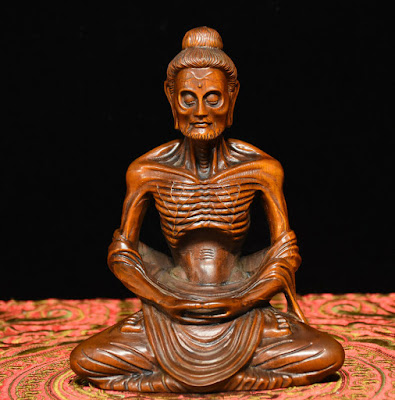
Shakyamuni as an ascetic, before he found the middle way between extremes

Looking at these features of sutric training, it seems very odd that so many of these traditional forms of sutric buddhism forget Shakyamuni Buddha's example. He didn't become awakened through ascetic practices but by taking a good care of his body, after he realised that the ascetic approach was just postponing solving his existential issues, while physically killing him.

Tantra is not based on the view of renunciation, so on tantric retreats for laypeople one can usually talk with others, get enough sleep and more options for food. Tantric retreats for professional practitioners is a different matter but that's a whole different context. Tantra is about transformation which means that one doesn't necessarily need to change one's lifestyle at all. One illuminates one's mind within the life and lifestyle one has. For this reason, I feel that tantra is much better suited for Western laypeople. It is not part of the tantric view to renounce family, work or anything else. Sutra renounces the world and keeps distance to it, tantra embraces and embodies it.

I've heard of many people who had emotional trauma come up in sutric training without receiving fitting instructions from their teachers and therefore having no way to deal with it. In Japan, I knew a zen monk with few years of monastic practice under his belt, who hit a rough patch. As the master in charge of the training (apparently) didn't have extensive enough understanding what the student was experiencing, and had no other tools in his toolbox other than the ones transmitted by the tradition, eventually, as the anxiousness grew, the monk ended up leaving the monastery and in fact, his whole career as an ordained monk. With correct know-how the monk's dark night would have been entirely manageable and possible to overcome. It is a classic example where the tradition failed the teacher, and the teacher failed the student. It is crucial to realise that the student did not fail.

That this happens in one way or the other all the time, is one of the reasons why I am a fan of the Western innovation of combining sutric methods with Western psychology. However, as I have written before, I do not think buddha dharma lacks anything. Rather, it is the fixedness of traditions and level of expertise and open-mindedness of teachers that are lacking. I say lack of open-mindedness because commonly, traditionalists do not seek answers outside of their tradition. They trust that as their lineage is historically authentic (although in many cases this has been debunked by scholars) and time-tested, it couldn't lack anything. Whether training systems can be perfected is highly questionable. Excessive self-sufficiency of buddhists is an issue. This has been discussed in this blog here: Jetsunma Tenzin Palmo & Kim Katami: About Awakening

In 2017, we heard the sad news of a young American lady, who committed a suicide after a Goenka retreat, apparently because she experienced what I describe above, sutric practice without proper support. This is the only dharma practice-related suicide I've ever heard of. It is one too many but at the same time considering the amount of anxiety, depression, trauma and suicidal thoughts practitioners I have wondered why the number is not higher. Perhaps this has something to do with subtle protection coming from Three Jewels: Buddha, Dharma and Sangha. Needless to say if people went killing themselves after retreats, there wouldn't be any sort of buddhist tradition existing.
So, dark nights are periods when dark corners of the mind are revealed, and just like when cleaning a dusty storage room, in the process of cleaning, the dust momentarily fills the air and blocks one's airways. That is not a comfortable experience but it is an unavoidable part of cleaning. Since all buddhist paths are about cleaning, there is no buddhist path entirely without discomfort. The sooner one becomes comfortable with the idea that at times practice stings, the easier it becomes. Suffering and discomfort (dukkha) is typical for existentially confused mind, and so any path that aims to sort it out, must go through it, rather than around it. Buddhist meditation is not about bypassing suffering. It is about suffering voluntarily, not for the sake of enduring suffering but for the sake of releasing the root cause of suffering which is always, without exception, in selfing. To accomplish this we need to, as Mr. Jung suggests, go in the midst of darkness. That's what the path is.

I tell my students to prepare for the worst when it comes to dark nights. I once heard of a Danish practitioner who got depressed for 15 years after his awakening. It took so long to sort out itself because he had no access to suitable yogic knowhow. I recently wrote, ”What is Depression and How to Heal It”.

Types of Mental Illness

Psychosis and schitzophrenia prevent the person from distinquishing between reality and fantasy. One can still practice with these illnesses, but close supervision of both a skilled dharma teacher and doctor are required. As long as the illness persists, I do not think it is a good idea for a person with these illnesses to practice without the supervision of both professionals. Depression and anxiety do not make one lose sight of the reality and for this reason people with these predicaments, expect in severe cases, require no medical supervision, when practicing meditation.

As a tantric teacher, I have the requirement that those with any mental illness need to discuss with me before learning Open Heart Yoga, the main tantric practice of the Open Heart-system.

Yogic Take On Causes Behind Mental Illnesses

All mental illnesses are in the mind. Although there is evidence that genetics (typically associated with the physical body) play a part in some mental illnesses, these are conditions that prevail in the mind. For this reason they have to do with energetic circulation and karmic records stored in the energy body. This means that like all other states of mind, such as trance and concentration (skt. samadhi), mental illnesses have to do with the state of one's energy body. This means that, since all beings have buddhanature as their ground of being, all states of mind are momentary and are necessarily caused by life force (skt. prana, tib. lung) flowing through certain kinds of karmic records, hence creating some momentary bubble of illness.

Lifestyle without responsibilities, as often in the case of young people with no jobs, study or regular sleeping times can induce depression. One's lifestyle momentarily creates a certain kind of way how the energy circulates in the bodymind. Use of intoxicating substances, such as alcohol and various types of drugs can induce depression, anxiety and psychosis.

I have myself, for brief moments (up to 1 hour in duration), experienced psychosis caused by mixed use of alcohol and cannabis (1), physical overtraining (2) and overtraining in pranayama (3), or yogic breathing practices. In all three, the mental state was same or similar. In all of them life force circulated in same or similar manner, strangely and unnaturally, producing convincing ideas and thoughts that afterwards, when normal circulation was returned through rest, healthy food and healthy lifestyle, were seen as weird and unrational. These are examples of momentary mental illnesses caused by lifestyle.

Sometimes practitioners of buddhist meditation, both sutra and tantra, come up with psychotic illnesses that persist. In my limited understanding, these are caused by one's harmful actions in the past. In this connection it is logical for one to question if it is the practice that causes it but like stated above, correct dharma practice based on ethics, does not increase bad karma. Because our mental states are directly related to our karma, it is actually the seeds of karma, revealed through practice, that causes it. We really need to understand that practice brings stuff up. To nullify negative karma, one really needs to exercise ethics, wisdom and compassion, through whatever instructions one's teacher gives. Needless, to say students should only choose and learn from teachers who they trust and respect for these is no point learning from bad teachers. It is common for tantric teachers, including myself, to give specific advice and practices when problems arise to quicken their resolve.

That one might reveal karmic seeds that cause psychotic illness is of course an unexpected and unpleasant surprise. However, we can also look at this in the expanded timeframe longer than a single life and understand that perhaps one is fortunate to have these outbreaks as a dharma practitioner, being guided and protected by the Three Jewels, which are the common source of refuge for all buddhists, as well as Guru, who is the main refuge for tantrics. The other option would be to suffer of one's bad karma without this protection and without any guidance. That these negative karmic causes are brought into the open in the context of dharma practice, is good in the long run, although it might ruin one's plans in this life. In such situation one should find a tantric lama who has some realisation and is able to give specific instructions for sorting it out. If one has very bad karma without guidance and protection of the Guru and the Three Jewels, we could end up being insane for many lifetimes.

The history of humanity is horrible and very dark. In this samsaric realm of human beings, good people have turned into killers, murderers, rapists, robbers and tyrants. We have done extremely bad things to other people, animals and the planet. We are deluded if we think that we couldn't do what people at their worst, in deep distress have done. To see what people do to other people, all we need is today's newspaper. Dharma is a way out of this.

Going Round and Round in the Wonder Wheel of Pain

Samsara is hell of a pressure cooker, abound with immense pain and suffering. Here countless beings inflict harm on themselves and others, not even knowing the difference between honesty and lying or violence and non-harming. For this reason, for those who understand the theory of reincarnation, it is logical to expect that we, now having the extremely fortunate opportunity to practice the dharma, have in the past caused tremendous hurt and pain for others. If not because of genes, because of our past actions, we are deluded, lost and ill.

When sorting out our karma, we don't get to choose what our karma is because it is already recorded in our subconscious mind. For this reason, if by ”safety” we think of the path as something comfy without much psychological challenges, I'm sorry to say that such a buddhist path doesn't exist. Whether we choose to do the big cleaning with sutra or tantra, or combination of both approaches, is up to us. But again, whatever path we choose or don't choose, or if we choose to not practice at all, it is best to be prepared for great hardship. From there we do our practice and little by little bring the dark corners to light.

Vajrayana For The Masses?

Recently Mr. Brad Warner published a wonderful short video discussing big dharma organisations vs. small ones, in the context of abuse in buddhism. I highly recommend watching it.

I think that vajrayana or tantric vehicle, explained in common sensical, de-mystifying, down-to-earth, practice-related manner with solid basic pedagogical skills from the teacher's side, is the best option for the people of our time. The tantric study also includes sutric study and yogic psychology, so it makes a profound path. The reason why I think that tantra, combined with teachings of the natural state (skt. atiyoga, tib. dzogchen) is the best of paths, is because tantric practices accomplish more with less effort. Sutrayana is slow because the practitioner has to do so much more heavy lifting by her- or himself. Plus, I think sutra is unsuitable for laypeople because of the view of renunciation, as discussed above.

In tantra, students are empowered by the guru or guru's representative. It is because of these empowerments and one's personal practice afterwards what makes it so much more easier. By cultivating an enlightened archetype of the mind, i.e. deity or deities, the practitioner automatically and inevitably recognises the nature of mind correctly and returns to the basic state of wakefulness on daily basis. Again, I wish I didn't need to say this but I think it is questionable whether sutric practices actually enable practitioners to recognise their true being because in sutra-teachings distinction between substrate conciousness (skt. alaya vijnana, tib. kun gzhi) is almost never made. In consequence, most followers of sutrayana confuse the samsaric state of subtle dullness with the natural state of wakefulness. It is incorrect. If you cultivate a dull blank stare for a lifetime, where do you think you're heading next? Incorrect cultivation also creates karmic causes.

As an additional point, I personally think that all paths that do not discuss knowing awareness (tib. rigpa, skt. vidya) from the beginning and start with concentration practices (skt. shamatha), have it backwards. Besides, those who have their hair on fire wishing to wake up, they don't have much if any use for shamatha training.

Buddhist practitioners really need to begin to correctly distinquish between liberated (skt. nirvana) and confused (skt. samsara) states from the beginning because if they don't, they'll just make their paths unnecessarily longer, numerous lifetimes longer. For those who are seeking complete liberation, this matter is very very serious. Buddhists trust their ”time-tested” traditions way too blindly. I did too, until I started realising that most traditions and teachers don't have the full picture or methods from deluded to fully liberated state. Traditions, like everything else in the world, age and when they do, they loose their essential message and meaning.

Despite of trust towards my gurus and their teachings, I don't think tantra is suitable to be taught through big organisations. Both teachers and students need to know each other personally and have one-on-one access. That's impossible if retreats are attended by more than few dozen people, not to mention hundreds or thousands. If you never even had a chat with the lama, you are not a student, though you can be a follower of a certain system. Sure, it is possible to disseminate teachings of tantra and dzogchen in mass events but it is far fetched to say that people would really get the essential meaning that way. Tantra and dzogchen are best transmitted in intimate setting.

My answer to your first question is that, yes, tantra is suitable for masses but it is not suitable for one teacher to teach masses for other purpose than very basics which is coincidentally what is taught at mass events. A lot of beneficial points can be shared, of course. Both mahayana and vajrayana paths of sutra and tantra are aiming at full enlightenment or buddhahood, though, so this is important to keep in mind.

Hope this helps. Thanks again for asking.

-Kim Katami, 14.7.2019
Open Heart Sangha,


sunnuntai 26. kesäkuuta 2016

Posture of Meditation, Part 2: Standing

Posture of Meditation, Part 2:
Standing

Posture of Meditation Series:
Posture of Meditation, Part 3: Eyes

Standing meditation

Considering that standing posture is one of the four main postures of buddhist meditation, it has not been widely practiced as main method of it's own in other buddhist countries than China. It comes as a bit of a surprise when you think of it. Why not? In China both taoists and buddhists have practiced it throughout the centuries, and still today, although often from purely secular point of view, separated from larger philosophical context which may or may not be a good thing. In China standing meditation, often in connection with inner martial arts and self-healing, is known by many different names. Here, I'll refer to it simply by ”standing meditation”.

Meditation is a multilayered practice. Considering all the things that happen in the mind space, it is comparable to juggling. A beginning juggler is able to juggle for a brief moment until due to limited skills, balls fall to the ground. To manage all the different elements of the mind, such as thoughts, ideas, emotions and energies together with sensory information of the physical body, including the possibility of becoming distracted or subconscious, is not that easy and simple.

When meditation is practiced in a standing position or positions, it is an art of it's own. It is different from sitting meditation for the obvious reason that the body is an active element of the meditation. In sitting meditation, body is also central but in this case body has a more passive role in the meditative process.

Personally I think that standing meditation can be a great help in one's meditation when one has 1. recognised open awareness and has become familiar with it, 2. when one wishes to put more emphasis on how open awareness is embodied and 3. how the abstract mind-awareness functions relate to the structure of the physical body.

Of course standing practices can be done to begin with, without nondualistic insights and without any physical preparation such as rushen, but pursuing standing meditation as a primary method from the beginning, is hindered by many problems. I don't recommend it.

Perhaps this is the reason why the yogic traditions of India or Tibet never dove deep in standing meditation, although their traditions of sitting meditation have been exemplary. Perhaps masters and yogis didn't see it that important after advancing in their sitting practice.

The view from the top of the mountain

What is essential in all forms of meditation, is to recognise knowing awareness (first gear). By knowing awareness I refer to open awareness. It is our mind without dualistic content, without the sense of separation. Please refer to many texts on awakening and purification of the mind found from this blog, if you are not familiar with what this means.

So, whatever type of meditation we are talking about, it is the recognition of knowing awareness what makes the practice a ”meditation”. Concentration practice where intention is cultivated to attend the body-space, or the movement of the breath or made to act according to a mental image, is not really meditation.

So, the principle of open awareness should be clearly understood.

Training of standing meditation

When the recognition of open awareness is effortless and common, it is possible for the practitioner to put more emphasis on the embodying aspect of meditation. This is the meeting point of the third and fourth gears of ”Four Gears of Open Awareness”.

In sitting posture, the third gear, where open awareness (related to the primary sense organ) is met with the heart-space and the whole body, can already be thoroughly studied. However, when this is applied in standing posture, it takes on a different, physically more concretical spin. The connection of awareness in relation to action (based on intention/focus) can be studied and realised in a ”fleshy” way. Mind and awareness becomes flesh and bones. It becomes concretic because our physical bodies made of physical elements, are more actively looked as a central theme of our meditation. Here the dualism between non-physical absolute, open awareness, and physical relative body evaporates. ”Form is emptiness, emptiness is form”, as the Heart sutra says.

I find that it is absolutely crucial to stick with the panorama that opens from ”the top of the mountain”, referring to the first gear, because it is that open mind space, also termed as attention, bare attention or naked awareness which puts the whole practice and the method in a context that it actually is.

Nearly all inner martial artists have deficiency regarding this essential requirement. Without the first gear, and nonduality, standing meditation cannot and does not result in thorough understanding, traditionally called as wisdom and compassion.

- Kim Katami, 26.6.2016

Open Heart,