Näytetään tekstit, joissa on tunniste zen. Näytä kaikki tekstit

torstai 23. maaliskuuta 2023

Connected Field of Aliveness


Connected Field of Aliveness


So, you are this energy and this energy is connected, it is a connected field that moves when your body moves and keeps still as a connected field of energy when your body doesn’t move. When you stay still, this field of energy radiates like a star. It shines light or subtle energy just like a star. There’s countless little processes happening there but the main thing is that it is utterly alive, present and there is no sense of me, as an individual entity there so it is devoid of self. So you just sit there, totally alive, totally present, there is no ”me” having the experience and it feels great because it’s perfectly natural. Because it is natural is why it feels right and because of that it answers so many questions to those who need to get answers. But basically this aliveness happens by itself, is there or here by itself and that’s all. It’s not a big mystery or a thing that only sages on mountain tops have or are able to understand, no, all of us share it but it needs to be discovered though.


When we take this connected field of aliveness without self into movement and start expressing things artistically, oh there is nothing more delightful because it is our true undefiled being or true me expressing itself purely. This is ”zen art”. This is the view of zen art or spiritual art. And you can take it into anything from East Asian arts to sports to painting to writing poems; anything form of expression, any art.


As a unified field you play, move, bounce, draw a line, sing, dance, walk and simply exist without a self or a center. Awake and aware, nothing lacking, enjoying it all, without the notions of win or loss, victory or failure.


- Amrita Baba, Amrita Mandala Sangha


sunnuntai 22. tammikuuta 2023

Night Sitting and Opening of Meridians


Night Sitting and Opening of Meridians


About the opening of meridians. You know that feeling of tiredness after you've been active? You feel like you want to lie down and maybe take a nap. It almost feels as if the energy of tiredness forces you to lie down. That's one type of sensation coming from clogged meridians. I am not recommending anyone to harm one's body and practice should always be nonviolent and nonharming but one very efficient way to get through the stuffyness is to sit through it.


You sit upright and remain aware through the motions. This is much easier to someone who has established the basic state in comparison to someone who hasn't. For the latter type of practitioners it will be difficult to remain aware through the four phases of falling into sleep, remaining asleep and coming out of sleep. If your body starts falling over soon after the sleepiness comes over you then you're probably not ready to sit through sleep and be able to use this practice as a way to open the meridians (that eventually leads to lightbody).


If you have the needed stability though, sitting through sleep is not a problem. Maybe your body nods once or twice but mostly you're able to remain perfectly aware and do not get affected by sleep and sleep hormone, even if your system is completely under its influence. You sit with dream images and dreamless sleep and it feels like enjoying the bright night sky over mountains. And you come out of the session feeling very light and refreshed. You don't come out feeling tired or exhausted but the opposite.


This "night sitting" or sleep sitting is one way to unclog the meridians by bringing basic awareness into the midst of samsaric sleep which is one, if not the main samsaric refuge.


Again, to be able to do this one's mind needs to be firmly rooted in recognition. If it isn't, being excited and enchanted by the romantic idea of replacing sleep with meditation, can really do damage to your body. I know many examples of this from my zen days. We need to know where our limits are and not be dumb to pretend that they're not there. If you're a samsaric being it is foolish to try to do the same things as fully enlightened buddhas are capable of. If samsaric beings don't get enough sleep it can lead to severe health problems and even death. So this kind of practice is not for beginners but it is for practitioners with some experience.


Try sitting through your daily nap. Perhaps sit in the night before you go to bedor in the middle of the night when you wake up for toilet. Try, experiment and see how it goes.


Baba, 22 Jan 23

torstai 1. heinäkuuta 2021

Doing nothing. Just stand.


Doing Nothing. Just Stand.


Kim: The most difficult thing in (chi gong, zhan zhuang or yiquan) practice is to remain perfectly and yet effortlessly aware. To apply intent (yi), whether gentle or explosive, is momentary. Yi is started, it is kept and it is let go. This is yi.


We can compare this to any kind of concentration exercise and as anyone who has ever tried to keep one's focus (yi) on a single task for anything longer than few seconds, the various thoughts, ideas, memories and impressions make the mind distracted. This is also the case in yiquan. Although not all yiquan methods use this, typically an yiquan practitioner uses certain mental visualisations to learn about (1) the necessary correct alignment of the body, where the body is unified and joints are open and (2) to study the mechanics of well aligned body by applying gentle or forceful visualisations. This whole methodology is based on the principle of concentrated focus and being mindful of both the visualisations as well as sensations in the body.


For a long time in my own yiquan as well as meditation practice, I was interested to find the kind of ”basic mind” that is always present, always clear and never distracted. For a long time when I tried to stand zhan zhuang or sit in meditation without doing anything, without yi, I would sooner or later get distracted by different mental fluctuations. Then as my practice kept progressing, I started having longer and longer periods when this undistractable basic mind was there. This in turn made it possible to really ”just stand, doing nothing”. Little by little, I could just stand, without using yi, without getting distracted.


To me personally as I have been a ”spiritual seeker” as well as a martial artists since I was a child, it has been a great relief to finally, after decades of searching, lots of practice, study and experimentation, to be able to ”just stand” without getting distracted. I have met and studied with a number of yiquan, chi gong and tai chi teachers but it is very difficult to find a person who would be able to discuss this (which is why I began this thread here now, in case others have this issue too). Anyhow.


My inner martial art practice has been on and off as I realised pretty early on that if I wanted to find and establish this ”basic mind” in my practice, I would need to focus on meditation first, and then only after that take it into martial arts.


I don't actually feel like a ”martial artist” anymore, not for a long time because I don't have any interest in fighting or match skills, not really even push hands.


Kim, 1.7.2021

perjantai 28. toukokuuta 2021

New and Fresh Zen!

New and Fresh Zen!


Today, I am reminded of my past training in zen buddhism and zen art. Due to many past lives as a zen buddhist, I always felt at home with zen, and I miss it. I miss that spirit.


Few years ago I sketched a zen method, basically a new zen tradition, and today I felt like writing a book about it. Well, a booklet since I'm not much of a writer but anyway. Terayama Sensei asked me to continue teaching after him but like he didn't continue the traditional syllabus of rinzai zen, I definitely would not use or write about the practices of traditional zen, because they weren't that effective for me or for Terayama Sensei. Sensei didn't teach koans because he didn't think they were that effective in relation to time and effort that you have to put into it. Later, he actually took up Amitabha practice and I can very well understand why. I always felt it would have been much better if Pure Land Buddhism had first spread to the West instead of zen... but anyway.


It is not diffcult to have recognition of buddhanature (j. kensho, satori) if we know how the mind works and how we can strike through it, to make the original face show up. While quietive methods don't work so well, dynamic concentration, together with bodhicitta, works in excellent manner. Many zen teachers say the same, that it is not difficult to have kensho but it takes a lot of time to integrate them. In a sense that is true but I have a different take on this.


Photo of Terayama Sensei and me in 2005, in front of Yamaoka Tesshu's Tiger and Dragon at Tsukuba Dojo, Chiba, Japan.


There is no buddhist practice other than recognising oneself as a fully enlightened buddha. In other words, kensho is the one and only practice. In other words, all the time spent in non-recognition is nothing else than samsara. 


Practitioners need to do practices that enable them to have this recognition at *every session* of practice. Practitioners need to do practices that enable them to have short momentary glimpses, and small and big breakthroughs (kensho) on *daily* basis, not just every now and then, or years apart. The training need not take decades but can be done in years through dynamic practices. This is the correct and the only way to understand samadhi for there is no other samadhi except wisdom (skt. prajna) and compassion (karuna) of the buddha.


This is a point that is hammered hard by the ancestors. One after the other they make it diamond clear that the practice of zen is the practice of recognising ourselves as buddhas. I know from my experience as a teacher and treasure revealer of tantra and atiyoga that this is possible from beginners to advanced bodhisattva-practitioners.


There are very different types of methods with very different types of practicing experiences than the ones we are familiar with. Like the masters of the old times, I am just making my voice being heard for those who have ears to hear. Maybe I should write that book.


I send my love and appreciation to Terayama Sensei. You encouraged me to ask questions that others didn't dare to ask. For that I am ever greatful.


Kim


perjantai 12. maaliskuuta 2021

Visceral Study of Spiritual Martial Arts


Visceral Study of Spiritual Martial Arts

I'd like to share something about hitsuzendo - the way of the zen brush - body movement and Yamaoka Tesshu Sensei's calligraphy. If you take this as a practice, it might change the course of your bodily (martial or healing) practice. My zen calligraphy and zen master Terayama Tanchu Sensei's main practice close to the end of his life was kusho (
空書, lit. empty writing) - writing in the air with one's hands and body. He would hang up a calligraphy or painting on his wall, study the movement of the brush and then trace it in the air with his hands and body movement. The idea is not to study Chinese language but to study the bodily movement of the past masters to better understand how they moved which in turn reveals something really interesting of their state of mind, or realisation. The basic idea of kusho is very simple. You could for example write your own name or some piece of text in plain block letters or cursive handwriting to try it out. The idea is to use one's whole body while applying different kinds of intensity of intent (c. yi/j. i, ) into the writing. What I mean by different kinds of intensity is that we could use our hand to write very lightly in the air, like writing with a finger on the surface of water (without making the water splash) or we could imagine tracing our finger one inch inside mud. With mud we would have to use more intention or concentration to get the thing written. Our writing could also be a combination of both light and heavy, combined with slow and fast. From here to enter the realm of "zen" we would have to be able to recognise the most basic state of mind or basic awareness, commonly called buddhanature (佛性) in mahayana buddhist schools.

In the case of a professional zenman this buddhanature should be present at all times and one's writing, whether in the air or on paper, becomes a play of intent, where intent isn't based on mindfulness (
) but on effortless basic awareness. Because of this fundamental difference in the degree of realisation (見性), the meaning and result of intent is not the same but becomes non-intent (無意) because mindfulness does not appear and disappear. This very point separates "zen calligraphy" or zen art from ordinary art. Anyway, the point of kusho is to write in the air or to trace the movements of masters' works with one's body. I am sharing here one of Yamaoka Tesshu Sensei's calligraphies. The large characters on the left read Namu Amida Butsu, which venerates Amitabha Buddha. The small characters on the right are a part from some sutra or poem. I don't know what it says but it's not important either for our purposes.

Tesshu is one of the most respected spiritual martial artists of all times in Japan. He died in 1888 so he is quite recent and this is why there are many of his works available. Tesshu was a martial artist of the highest kind who held several lineages of kenjutsu and kendo and started his own Muto/No-Sword school. To understand Tesshu's uniqueness, we need to know the order of the strokes in calligraphis characters. Generally, calligraphes are written in vertical lines from right to left. The strokes in characters are written from up to down, left to right, from outside to inside. The piece below is wrotten in cursive or "grass" script and doesn't look except distantly to what people associate with kanji, Chinese characters. Anyway, with these few instructions you can understand that you begin from the top right corner and how each character is formed. It would really be important to get the order right to get the point that I'm trying to make. When you do know the right order, then trace through the whole piece. Do it several times. Get the angles right. That is very important... because it shows exactly how Tesshu, the legendary spiritual martial artist, moved...

Now, I have analysed thousands of calligraphies but among all of them Tesshu is unique. No one out there moved like he did. People move like block letters but not Tesshu... It must have puzzled the heck out of his students and opponents who came to challenge him! If you study how he moved, you will see that because of his exceptional free flowing shapes, you can't predict his movements and that is the treasure to be found from Tesshu's works. Copying him opens up a whole different realm of bodymind movement that I have not seen elsewhere in my 35 years of study of the field.

-Kim Orgyen Pema Rinpoche Katami 

https://www.facebook.com/photo.php?fbid=10158901778078136&set=g.257852984267435&type=1&theater&ifg=1


perjantai 30. lokakuuta 2020

About Bhumis and Prejudice


About Bhumis and Prejudice


I've taken a long break of bhumi work. I haven't done bhumi analyses for... at least a year. I did so many of them, literally around 5000 during the past several years, so I got fed up and needed a break. Then, this past week I've noticed myself thinking of doing bhumi analyses again and today I thought of publishing a series of bhumi analyses of well known teachers. That didn't go well back in 2016... at all... For those who don't know what happened back then, I'll tell you.


In late Summer of 2016 I published couple of dozen photographs of well known buddhist and other spiritual teachers, all very public figures, with my bhumi analyses according to the Open Heart Bhumi Model. I've discussed this model with great detail in my freely available book What's Next? On Post-Awakening Practice.


I published the photos in my blog each with a bhumi measurement. The series included for example, His Holiness the Dalai Lama, other leaders and Tibetan buddhist teachers, Thich Nhat Hanh, Ramana Maharishi, bunch of zen teachers, theravadans and so on. I'm trying to come up with the most fitting description how my "Bhumi Study Series" was received by the internet. The word that best describes it, is: shitstorm.


I had never witnessed aggressive religious fundamentalism before but I sure witnessed it back then. It came to me as a total surprise. My point of view was that I felt I was trying to make sense of the path and stages of the spiritual path from unawakened state to fully enlightened state, also known as buddhahood. Even though buddhism offers a number of path maps with stages, these are not used by anyone so the whole discussion about shifts or awakening experiences is a completely grey area. Out of many millions of meditators in buddhism, not to mention other systems, few know where they are on the map or whether they even are on the map. I had received this bhumi mapping system (that I've explained in my book) from my gurus, so I knew I had a solution. I was simply trying to help and offer a solution that worked for anyone, regardless of their chosen methods or paths. I really thought I was doing everyone a big favour. Fundamentalists didn't see it that way and a massive shitstorm broke. They hated it and instantly rejected it. In their mind, I had crossed a sacred line and discussed the levels of attainment of their precious gurus. That was something they weren't going to tolerate. It was too much for them so they instantly called it bogus, branded me crazy and banned me from their discussions.


I'm not going to lie and say that it didn't hurt. It hurt a lot. That was real aggression and I got lots of it. Had I been on sight, I'm pretty sure I would have been chased and attacked. At the same time these emotionally charged reactions confirmed to me what I had analysed in my thousands of analyses. Bhumi openings or their closedness, and the degree of purification of mind (i.e. bhumi perfection), is reflected in the actions of men, and since I was treated very meanly, it was and still is an indication that my analyses not only about the various spiritual leaders but also their students, were correct. For some time I tried to have a dialogue with these people, explaining how it worked etc. But as they weren't capable of it, I decided to remove the analyses from my blog and find a hole to lick my wounds.


I still find it hard to believe how and why(!) would anyone be so offended about 1. differences in view which in this case meant that even if attainments are not traditionally openly discussed, they still can be discussed, and 2. things that could be empirically tested, tried and learned. To me, who am a bit of an engineer, it was mind boggling why would anyone get mad about a thorough explanation how it all works... But that was exactly what I didn't understand about the samsaric mind before, at least not well enough, so I stepped right into it...


See, when you've invested all your life into any form of religion or spirituality that you think is going to take you ”all the way”, even if you don't know exactly how and when, and then comes in some bastard who maps your favourite religious leader very low on the spectrum, it can piss people off!!! Because of the time-money-energy-investment and religious belief, very few people who have been following this or that method for many years, are willing to admit that they've wasted their time-money and energy. Samsaric mind, even that of ”practitioners”, gets attached and attachment as dharma teaches us, makes people angry.


I can and do symphatize with that, as I feel I wasted most of my 8½ years of continuous retreat doing practices that were only distantly relevent, or actually not very relevant at all with my wish to get awakened. I wasted my best years because I believed as blindly as so many out there. I thought I was open minded the whole time but really, I was fixated, I was attached, I was a believer... I trusted without the slightest doubt training systems that ”had been passed down in an unbroken lineage since the founder of buddhism to our generation” and taught ”practices that were time tested” and therefore offered very reliable tools. I heard that sales pitch so many times and bought it without questioning... until several years and literally twenty-four-thousand hours of practice later... No, it didn't work as promised... My time-energy-and money was mostly wasted. I was pissed off about that for years myself!


Later when I started to talk about this with others, I met many people who had been disillusioned about the ”tradition” like myself. It was clear that there was something very wrong with how the basics were or weren't taught by the traditions. I say traditions in plural because the same problems exist everywhere. I base this not only on my own bhumi analyses but also in discussions with hundreds of practicioners and many teachers of various incl. Tibetan buddhism, zen, theravada, advaita and so on. It is actually interesting how some come to see the issues or problems in training methods, their teachers, their communities and their culture, while others don't. I think this has a lot to do with readiness or merit as it is commonly known. If you really want the truth, you can't settle for poor answers. A lot of people start with that pure need for knowing the reality but get distracted along the way, usually with all the externals such as forms and rituals, authorisations, hierarchiesand stuff like that, and end up fundamentalists, usually subtly.


So, anyway, that is what happened back in 2016 and that's behind me now. However, now that I've taken a break of bhumi work and feel refreshed about it, I cannot help thinking about the benefits of the 13 Bhumi Model. It is not particular to Pemako Buddhism or me. It is universal. We all have bhumis because we all have the same energy body with channels and centers. We all have bhumi centers that can be perceived. We all have bhumi centers that are either closed or open, and if they are open, they are on their way to be entirely purified, or perfected. Open Heart Bhumi Model is an excellent model, an excellent path map. It matters not what people think about it because it works... And it applies to everyone out there...


I wouldn't want to start another shitstorm but I do wonder how could I represent the bhumi model in a way that is attractive and interesting to people.


Much love and blessings. You are the real deal.


Kim Katami, 23.10.2020


tiistai 15. syyskuuta 2020

Pure Land Buddhism and the Philosophy of Honen and Shinran By Mark Unno


Pure Land Buddhism and the Philosophy of Honen and Shinran
By Mark Unno


Pure Land school.


Advocates of the Pure Land teachings can be identified quite early in Chinese Buddhist history, but Pure Land Buddhism emerged as a major force in the T'ang Dynasty along with Zen. While both arose partially as a reaction against the metaphysical excesses of the philosophical schools, Zen focused on awakening through monastic practice, while Pure Land focused on attaining birth in the Pure Land of the Buddha Amitabha through practices that were accessible to lay people.


Pure Land Sutras.


Three of the most prominent sutras of the Pure Land schools of East Asian Buddhism are The Larger Sutra of Eternal Life, The Amida Sutra (Smaller Sutra of Eternal Life), and The Meditation Sutra. Like many other Mahayana Sutras such as the Lotus, Flower Ornament, and Vimalakirti, these sutras were compiled near the beginning of the Common Era. At the center of these sutras is the story of the Bodhisattva Dharmakara, a former king who decides to set out to seek enlightenment. In the process of doing so, he establishes the Western Pure Land; when sentient beings accumulate sufficient virtue, they are born there, and due to the ideal conditions, immediately attain enlightenment. In later developments, especially in Japan, the Pure Land becomes virtually synonymous with ultimate reality, emptiness, nirvana.

Practitioners aspiring to birth in the Pure Land visualize the jewelled paradise of the Buddha Amitabha, where the evil karma of his or her past is transformed into the Pure Land and the virtue of its Buddha. Ultimately, even the Pure Land is transcended, and the practitioner attains awareness of the non-origination of things, a virtual synonym of emptiness.


Amitabha Buddha.


Bodhisattva Dharmakara eventually becomes the Buddha Amitabha, the Buddha of infinite light. Amitabha is also known as Amitayus, the Buddha of Eternal Life, hence the title of the Larger Sutra. In China and Japan, these two names, sometimes referring to distinct Buddhas in the Indian context, are referred to singularly as A-mi-t'o in Chinese and Amida in Japanese. Furthermore, although male in the Indian context, Amitabha becomes increasingly referred to in female, maternal terms in East Asia. The distinctive characteristic of Amitabha is compassion.


The Name of Amida Buddha.


In the Meditation Sutra, it is stated that, for those who are unable to achieve the meditative visualization of the Pure Land, the recitative invocation of Amitabha's name is sufficient to attain birth. In China, and especially Japan, this becomes the most widespread form of practice, known as the nembutsu, in which the repetition of the name, Namu Amida Butsu (I take refuge in Amida Buddha), is the very manifestation of Amida. Philosophically, to take refuge in Amida Buddha is to abandon ego-centered, attached thinking and to entrust oneself to the infinite wisdom (light) and infinite compassion (life) of Amida. Since the ultimate body, or dharmakaya, of Amida is formless, one attains formless reality through the name.


Kannon.


Kannon, the bodhisattva of compassion, is an emanation of Amida. Originating as a male bodhisattva in India, Avalokiteóvara, this bodhisattva became female in East Asia and has been one of the most popular deities of devotion.


Honen (1133-1212).


Exponent of Pure Land Buddhism. Honen broke with the traditional views of other Buddhists who looked to a variety of teachings and instead advocated the single-minded recitation of the nembutsu, Namu Amida Butsu. Honen was known for his broad and deep philosophical understanding, the purity of his observance of the precepts, and his ability to cultivate various states of meditation including visualizations.


Self-power and other-power.


However, he abandoned ritual observance of all of these practices at the age of forty-three and turned his attention solely to the nembutsu. His conclusion was that, no matter how skillful he may have appeared outwardly, inwardly it was impossible to become free from thoughts of attachment, conceit, and insecurity. The failure of this self-effort or self-power (jiriki) opened up the realm of other-power (tariki), the formless reality of the highest truth taking shape in the wisdom and compassion of boundless light, Amida Buddha, embodied in the name. The two ideas of self-power and other-power are complementary. Without seeing the one, the other cannot be seen; they are like the clouds and the sun that shines through them.


Foolish being.


Honen states, "In the path of the Pure Land one attains birth by returning to an ignorant fool." One aspect of this indicates the foolishness of sentient beings, the other aspect the wisdom of one who is aware of foolishness, a kind of beginner's mind. Thus the same being who attains awareness of his or her foolishness is also regarded as "equal to the buddhas."


Pure Land beyond form.


The Pure Land no longer refers to a jewelled paradise here; it refers to the realm of emptiness in which all beings and phenomena are grasped in their suchness. When a disciple asked Honen near the end of his life, "Master, what is the importance of visualizations," Honen replied, "At first I, Honen, also engaged in such frivolities, but no longer. Now I simply say the nembutsu of entrusting." "Even if one is able to see the jewelled trees [of the Pure Land], they could not be more beautiful than the blossoms and fruit of plum and peach trees [found in this world]."

In a sense, the Pure Land can be understood to be the realm of emptiness. Honen taught that the unfolding of Amida's compassion and wisdom was felt in this life, but birth in the Pure Land in the next. This parallels the relationship between nirvana and Parinirvana in the life of Sakyamuni. As long as one has attachments, it can be misleading and dangerous to say that emptiness is already present. However, at the very end of is life, when a disciple asked Honen if he would be born in the Pure Land, he replied, "Since I have always been in the Pure Land, that will not happen."3


Shinran (1173-1262).


Exponent of Pure Land Buddhism who studied with Honen. His form of Pure Land Buddhism is often referred to as Shin Buddhism, reflecting his expression, Jodo-shinshu, the true teaching of the Pure Land. Like his teacher, he emphasizes the awareness of the foolish being who, endeavoring to free him or herself from the cycle of ignorance and attachment, sees more and more clearly his or her own foolishness.


Shinjin.


Like Honen, Shinran advocated the recitation of the nembutsu. Whereas Honen emphasized simply repeating the name constantly, Shinran emphasized the simultaneous awareness of foolishness and the awareness of boundless compassion. The term for this is shinjin, which is often rendered as true entrusting, a letting go of all attachments which enables the natural unfolding of compassion and wisdom. One who attains the wisdom of true entrusting is regarded as the equal of buddhas. Since the heart of the nembutsu, as is the case in all forms of practice which are thought to embody highest truth, is beyond distinctions, Shinran states, "In the nembutsu, no meaning is the true meaning."4 At the same time, Shinran cautions, "If you talk about [this] too much, then 'no meaning' will appear to have some kind of special meaning."5


Naturalness.


The foolish being is always contriving or calculating to reach a goal dualistically, whether that goal is material, such as worldly success or health, or is spiritual such as enlightenment or birth. The one who becomes aware of this foolishness and is receptive to the compassion of Amida is led beyond this contrivance to a realm of spontaneous freedom. This spontaneity, in contrast to the contrivance of the foolish being, is called jinen honi, the suchness of spontaneity, or more simply, naturalness.


The Vow of Amida.


Shinran understands Amida Buddha in terms of two aspects of the dharmakaya, or dharma-body: dharmakaya-as-emptiness and the dharmakaya-as-compassion. The awareness of dharmakaya-as-compassion leads to the realization of dharmakaya-as-emptiness. The process of being led to the life of spontaneity through the dharmakaya-as-compassion is expressed as entrusting oneself to the Vow of Amida, the vow to lead all sentient beings to buddhahood by awakening them out of their foolishness


maanantai 10. elokuuta 2020

Introduction to Awakening and The Two-Part Formula for Awakening by Lama Karl Eikrem

Introduction to Awakening and 

The Two-Part Formula for Awakening


By Lama Karl Eikrem


In this text I will be approaching the topic of awakening from a Buddhist perspective. This is because the Buddhist framework is what I’m most familiar with, and not because Buddhism has any special claim to the phenomena of awakening as such. Awakening as defined below is universal in that can happen to people of any culture, age and spiritual orientation. It can come about by applying specific tools, such as the Two-Part Formula for
Awakening presented in this text, or it can happen by “accident”; where a practitioner is either using a meditative tool not specifically designed to induce awakening, or that they are doing something completely unrelated to spiritual practice and just happen to spontaneously awaken to the true nature of that which is commonly labeled “I” or “me”.


One of the basic tenets of Mahayana Buddhism is that all beings have buddha-nature. This does not mean that all beings carry around something that they can point to and call buddha-nature, but that the very nature of existence, of being itself is Buddha; basic wakefulness. Ironically, this basic wakefulness is so ordinary and obvious that it makes it profoundly difficult to recognise for most beings. But if we look at our surroundings and feel into the very experience we are having right here and right now, the basis of it is always basic wakefulness.


This basic nature of ours has three main qualities: (1) it is self-cognisant; free of any “knower” and “known” and simply aware of itself as timeless presence, (2) it is brilliantly alive; full of richness, positivity and love, and (3) it is perfectly stable; never changing. Furthermore, in being the nature of being itself, basic wakefulness is always-already present. It can never not be, and it can never be different from what is. Thus, recognising and actualising the basic nature of our own being is the purpose of spiritual practice.


The main hinder we have on the spiritual path is what we call the selfing-mechanism. The selfing-mechanism refers to the conceptual filter that confused beings see reality through, and it can be divided into three parts. First of all there is (1) the subject-self; the feeling of being “me”, an entity residing within the body, (2) object-selves; self-based thoughts, emotions and feelings, and (3) substrate consciousness; the subtle veils of existential confusion that give rise to self-based mind states such as depression or gross bliss.


The term “awakening” in the broad sense of the word refers to the process of deconstructing the entire selfing-mechanism and awakening to our true nature. Seen this way awakening is a gradual process that moves through several distinct phases until the ultimate freedom from “self-identification” is completely actualised. However, when it comes to the topic of this text “awakening” refers only to the inner shift that takes place in the mind of practitioners as the core of the selfing-mechanism, the “subject-I” is permanently deconstructed. This can be said to be to starting point of the Buddhist Path.


The Buddhist way of deconstructing the selfing-mechanism is through direct exploration of its constitution (Skt. Vipashyana). The basic principle of this approach is to recognise the basic clarity of mind and then bring that clarity to the confusion, i.e. “selfing-mechanism”.


The Two-Part Formula for Awakening, as taught in Pemako Buddhism, embodies this principle by first instructing the practitioner to release tensions in the physical body and recognise the basic openness that reveals itself when doing so. When we keep releasing tension this way, eventually we arrive at the recognition of the basic open space that permeates all of experience. But we cannot stop here. It is equally important that we use this basic clarity as a baseline for further investigation into the existential confusion in question.


Therefore, the Two-Part Forumla for Awakening guides us to mentally reaffirm “I, I, I!” or “Me, me, me!” and then study the sensations that arise within the body. These sensations include gross and subtle contractions, uncomfortable feelings, buzzing sensations, movement of energy and so on. Whatever arise within the body-space we simply study the strongest sensation from the perspective of basic wakefulness. This way, we can naturally dis-identify from the sensations of the “I” and study it like just another object of mind.


By alternating between the two modes; (1) relaxing into basic openness, and (2) reaffirming the sense of subject-self, we are able to dig deeper into both modes, seeing the two modes with greater and greater clarity. Eventually we come to a point where the distinction collapses and the “I” is seen to have not substance, no basis in reality. This is what we call (initial) awakening.


While awakening doesn’t offer anything new in terms of fancy experiences or abilities, it is absolutely crucial for spiritual practitioners to awaken as soon as possible. Without awakening to the emptiness of the subject-I there is no hope of progressing effectively on the path of deconstructing the whole self-based psyche. Rather, it is likely that the practitioner will unconsciously use spiritual practice to strengthen the sense of self – the complete opposite of what the practice is designed for! - as the “I” attaches itself to every aspect of a life spent in full identification with “me”.


As the great Zen master Hakuin Ekaku said,

Anyone who would call himself a member of the Zen family must first of all achieve kenshō — realization of the Buddha's Way. If a person who has not achieved kensho says he is a follower of Zen, he is an outrageous fraud. A swindler pure and simple.


Therefore, do not postpone awakening to the way of basic wakefulness!


May all beings be free!


Further reading:
How to Become Awakened:

https://www.pemakobuddhism.com/113

Awake! Handbook of Awakening:
https://www.pemakobuddhism.com/114

tiistai 30. kesäkuuta 2020

Subtle Ignorance in Zen Buddhism

>>I saw you post about how many Zen folks sit in a very cursory level of Shamatha and call it a day. I thought it was hilarious. There are ALOT of unqualified Zen teachers out there for sure.


--I trained in rinzai zen where there is great emphasis on shamatha/samadhi. Then when a rinzai student has a meeting with roshi, the roshi shouts or hits the student with a stick and bang, it breaks the samadhi... to make the natural state appear, and this makes the student have kensho, proper recognition of the natural state. In dzogchen, they figured out that you don't need to develop samadhi by countless hours of concentration practice. You can just shout syllables yourself and have the same benefit. This means that by shouting or what we call Dynamic Concentration in Pemako Sangha, anyone can have instant release of the samsaric body and instant access to their buddhanature. This is why I do not teach shamatha at all because why would you want to put your time in something that is not it?

But yeah most zen groups I've seen over the past 20 years, just cultivate shamatha and a lot of them confuse that for the natural state or as they say shikantaza, or how I like to call it buddha nature sitting. They waste their time for years and years, even decades and think that that's it. Sometimes they might get lucky and have a glimpse or even a shift but then it doesn't ring their bells to make them question their views and methods. They think that that's how it is supposed to be, that you sit for ten thousand hours, have a moment of kensho, then you sit another ten thousand and have a kensho and so on... It is incredible waste of time. Again, this is something that dzogchen masters such as Longchenpa have made clear for centuries, that one should not confuse shamatha or samadhi with rigpa or the natural state. According to masters, this actually creates a karma that is very detrimental to real dharma practice. I actually have story about this but will save it for later. This is not what dharma professionals do.

Yes, there are many zen teachers with papers in order, all right. Unfortunately, most suffer of these basic problems and since they have so much faith for their tradition, I don't see it will change any time soon. The greatest masters like Hakuin or Linchi make it perfectly clear that kensho is the way and that there is no other way. Ugi sent me a message yesterday and said, "Not of lineage holders, not of Lamas, not of Tibetans, but of liberated beings." I think that there are very few people who really wish to know themselves fully, wish to become buddhas, because so many practitioners are so attached to the external paraphernalia of traditions. It is an awful trap to be in... Anyway, having said that, this problem of subtle ignorance is very very common at all places.

-Kim Katami

Pemako Buddhism, 

perjantai 18. lokakuuta 2019

Bits Missing in Christian Tradition By Reijo Oksanen


Bits Missing in
Christian Tradition

By Reijo Oksanen

However, as an Orthodox Christian I did find myself in quite a strange situation for exactly 50 years (1961 - 2011). The tradition of the Prayer of the Heart is part of the Orthodox tradition. Who is teaching it? I thought that one should find someone among the priests, but, and this is in spite of meeting many spiritually advanced people, I I did not come across any such priest. Where were those people who could teach me how to pray continuously?

Jesus Christ
From the time I started my 'search for truth' there has been a popular tendency in the western world to look for spiritual teachers (and also teachings) from among the many 'gurus' from the East; earlier more from the Far East (Buddhism, Yoga, Vedanta), and now also from the Middle East (Sufism and Kabbalah). No doubt this tendency is also fully justified as the spiritual teachers in our time in the West have been few and far between. Moreover, is Christianity not also a teaching from the Middle East?

In our time teachers of all sorts can be found also in the West. For example within the Catholic Church there is a strong 'movement' to fetch knowledge and practice from Zen Buddhism, and this seems to continue. It is quite common that instead of a priest, we have a Zen Master whose prior education is Christian theology. Why does a priest not learn what he should learn - like how to pray, and also to teach others in how to pray? This is a confirmation of a sad state of affairs: Christian practice is not taught in the Universities! What are taught are morality, psychology and theory; what are not given and taught are the tools and the ability to be able to apply them into practice.

As the education of the average Christian priests does not include the learning of the 'art of arts' (although Orthodoxy is an exception) it is not possible by any even superhuman efforts for a priest to teach others how to pray; both the knowledge and the ability are lacking. This is why those who are in the position of 'educators' (priests) in the churches need to go to other religions and find their 'gurus' to learn the basics of spiritual practice. In other words they have a need to fetch the 'know how of spiritual life' from outside Christianity.

This search for the 'know how' is highly necessary.”


maanantai 30. syyskuuta 2019

About Lower Belly - Hara

About Lower Belly - Hara

I started to watch a video presentation about buddhist meditation given by a well known American teacher. The presentation was introduced by an American lady who as she described felt very fortunate and quite emotional to have the teacher give the talk. She gave the introduction with a voice that I could describe as weak and windy, rather than clear and settled. Also the composure of her spine wavy and her breathing was up in the shoulders. Watching this I was reminded of the lower belly which is known by the names of hara or tanden in Japanese arts.

Hara is all over Japanese arts from meditation to martial and fine arts. In popular language there are many terms that use the word hara which means belly, such as hara guroi, lit. dirty/black belly, which means dishonesty. That one's posture and inner composure is built on the belly is something very important in Japanese culture.


Living in Japan many years ago I saw how Westerners would share something emotional with Japanese but there was this cultural gap between the two and the latter seemed to feel awkward about emotional sharing. It seemed like they just didn't feel it was right. When one's breath is settled on the belly, one simply doesn't go off the rails emotionally. When one is emotional on the other hand, vital energy (prana/ki) is up in the shoulders and head. We all know about the headache after a big argument.

I didn't spend that long in Japan but it seemed to me that Japanese people couldn't trust or take seriously those who had their vital energy up, even if they were sincere in Western terms. When I think about it, it makes sense too because it is difficult to know and trust people who are over-emotional, whose mind flutters like a leaf in the wind.

There are downsides to lower belly cultivation too. It develops inner power so those who have charisma can end up on ego trips as leaders. I've seen this a lot in zen buddhism and martial arts. For meditators, too much emphasis on the belly can be a cause of spiritual bypassing.

Tibetan or Indian systems of yoga and meditation do not talk about the hara, only Chinese and it's derivatives do. The only lama I've heard talk about it is Tsoknyi Rinpoche who said he learned it from his Chinese qigong teacher. Nevertheless, being physically well composed and being settled is very much part of all systematic paths, and this, even without knowing about the theory of the hara, is what hara means.

In Open Heart and dzogchen-teachings in general, groundedness, which is one of the three characteristics of the natural state, is what refers to "hara".


maanantai 2. syyskuuta 2019

Dharma Porn

Dharma Porn

For those who don't practice or who practice too little, views and ideas can turn into porn. Buddhists like to roll over in the thought of emptiness. Emptiness this, emptiness that, emptiness, emptiness, emptiness... people go on and on talking and thinking about emptiness, as if they had fever. It is even more pleasurable when one's favourite teacher or lama talks about emptiness. It is like our fantasies becoming true. People associated with dzogchen, find pleasure and delight in words such as rigpa and dzogchen. That's their favourite thing, so they keep repeating these terms. Advaita folks get goose bumps and shiver in pleasurable delight through all those catchy phrases like I am That, I am That, I am That and oohh... how it turns them on. 
 

This kind of thing is very common. People mistake the finger that points to the moon, for the moon. Instead of practicing and finding the moon of buddhahood within themselves, they start sniffing the finger and develop a liking for it. It is OK for someone who is new but sometimes you see people who have practiced for a long time who still look at teachings very superficially like it was porn. Zen porn, dzogchen porn, advaita porn, emptiness porn, lama porn, rigpa porn, stream entry porn, kensho porn, guru porn, secular buddhist porn, wearing robes porn, being a monastic porn, compassion porn, enlightenment porn, purity of mind porn, nonduality porn, Dalai Lama porn, Karmapa porn, my favourite lama porn, being a servant of all beings porn, being awakened porn, taking refuge porn, getting a dharma name porn and so on.

There is a big difference between those who talk and those who walk. In my view, most people associated with spirituality talk much more than they walk. Some even want to remain as fans of dharma and never become practitioners of it.

Getting enchanted by ideas is a sign of immaturity. Getting enchanted by ideas is samsara. 

- Kim Katami
Open Heart Sangha,
 

sunnuntai 14. heinäkuuta 2019

Tantric Yoga: Safe or Dangerous?

Tantric Yoga: Safe or Dangerous?

Question: Do you think tantra is “safe” for mass practice? I would imagine it could induce states of mania or psychosis and confuse many.
The clinical definition of mania is not sleeping for seven days (hypomania is four days), experiencing heightened energy that is often directed toward a multitude of tasks that are not finished, having rapid speech that cannot be interrupted, having flight of ideas of rapidly evolving tangential thoughts, sometimes self-grandiosity, and usually accompanied by a feeling of euphoria. Mania is part of the bipolar spectrum disorders but can be drug induced or accompany psychotic episodes.
I would define safe parameters for the masses as that which requires the least experience in order to practice without risking undue harm or confusion. My sense is that concentration meditation or shamatha is relatively safe with few “side effects” whereas tantric technology can offer immense progress but may not be suitable for everyone to manage “safely.” What are your thoughts and experiences regarding this?

Kim: Thank you for asking. It is a very good and interesting question, since tantra is quite often described as a ”dangerous” path. First, we have to hit a few reset buttons, to get the basic view of samsara and the purpose of practice right.

Dharma and its various teachings are paths to liberation or enlightenment. Liberation of what? Self-delusion, duality and confusion. Teachings of dharma, through ethical guidelines and yogic practices, help us to get out from confusion. They do not take us into confusion or increase it, unless there is something very wrong with the teaching or practice. Since buddhism is very clear with what is correct and incorrect this is not really a problem in buddhism, despite of its great variety. So, by definition, practice does not increase confusion, pain or misery because when correctly applied it doesn't increase our self-based habits and patterns but decreases them. This means that through steady practice, one's mind becomes more and more liberated, or in common terms, less attached, less selfish, more alive and more spacious, that is, natural and sane. Terms such as basic sanity and basic goodness are often used as synonyms for our innate buddhanature.

The Process and Dark Nights

Fortunately, it is becoming better known that all paths include rough patches, or the so-called dark nights. We can define dark nights as periods of emotional or depressive hardship. In the world of meditation, buddhist or otherwise, dark nights are too little discussed about. Meditation practices are sold to people with peacefulness and happiness, without explaining that serenity and increased mental freedom doesn't come without hardship. There should be a warning sign on the first page of every dharma book available.

From the first page of Garchen Rinpoche's Vajrakilaya-training manual

Carl Jung, one of the historical key figures of Western psychology, hit the nail on the head by saying,

One does not become enlightened by imagining figures of light, but by making the darkness conscious.”

Jung wasn't buddhist but it is evident that he understood the basic mechanism of human liberation well.

So, the main idea of buddhist meditation is to seek and look into all and any dark corner of one's bodymind where the light of awareness doesn't yet shine. It is in these dark corners where the fuel for successful practice is hiding. However, if one doesn't have a basic understanding what it is that buddhist practice sets out to do, there is a chance of becoming more confused and overwhelmed. When learning how to drive a car, we first have to have a solid theoretical understanding about what driving is and how a car works. Without it, it is not intelligent to jump behind the wheel and hit the gas. Anyone with common sense can understand that that's potentially harmful and dangerous, and yet this is exactly what happens in the world of meditation.

It is known that unexpectedly challenging silent meditation training can trigger strong anxiety and outbursts of psychosis in people who are perfectly healthy and stable. People end up sinking down into the mud of their minds but are not told that this could happen and are offered no means for digging themselves out. Commonly, when such difficulties arise, students are simply told to continue the practice without teachers' explaining (or understanding) what is happening to them. In a sense this is correct but this is also highly insufficient on behalf of teachers. Consequentially, some people end up becoming mentally ill, instead of psychologically and spiritually illuminated. Such accounts are many.

To prevent beginners from getting into trouble, many (not all) teachers have a policy of not accepting beginners for long and intensive retreats. This is because one is required to have some familiarity with practice, some sparring experience, if you will, to do many hours of daily sitting. In Open Heart, we have a rule that if people with mental illness wish to join teachings they are required to give a detailed outline of their condition, medication and ongoing treatments beforehand. As the head teacher, I also want to have some sense of newcomers; their life situation, prior practice and social relationships, before accepting them for retreats. Open Heart-retreats are very versatile and contain recitation, musical singing, various physical exercises such as walking and dancing meditations indoors and outdoors on top of sitting meditation. At our retreats, people are also encouraged to talk with others, and eat and rest well.

It seems that it is somewhat common for people to have psychological trouble on vipassana, specifically Goenka-style, and zen buddhist retreats. There are many accounts indicating this. This also happens in tantric practice but the numbers are a lot less. I am aware of less than five people who had some sort of mental illness for an extended period of time. One of these cases was mentioned by Culadasa John Yates, a well known author and buddhist teacher, in his webcast in 2018 (sorry, no link available). He stated that, 40 years prior, his ex-girlfriend became ill with schitzophrenia when she practiced Tibetan buddhist tantric preliminary practices (tib. ngondro). He also stated that she suffers of this illness up to this day. I do not know any specifics of her case, about the type of practices she did and how severe her illness is but this is the most severe case of mental illness related to tantric practices I am aware of.

Sutric and tantric methods are very different by nature. Both emphasize practice and, should I say, deep forging but I would say that the tantric approach is much more relaxed in terms of effort because one doesn't need to generate the practice on one's own. Blessings from one's guru, lineage and the deities make the practice much easier and relaxed. As discussed above (dark nights), this doesn't mean that it's always easy, just that it is easier. That has certainly been my personal experience.

Sutric meditation retreats, incl. Goenka and zen, put a lot of emphasis on silent sitting, with limited rest and sleep, simplified vegetarian diet and have very little, if any, social interaction with others. Reason behind these features come from the sutric view of renunciation which in many ways looks exactly like asceticism. Tolerating physical pain or sitting through pain, for example, is a common instruction in zen buddhism. You don't move, even if you have great physical pains. In some training halls you get scolded or even physically hit, if you move during periods of sitting.
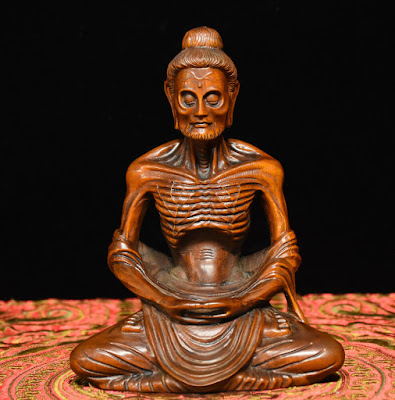
Shakyamuni as an ascetic, before he found the middle way between extremes

Looking at these features of sutric training, it seems very odd that so many of these traditional forms of sutric buddhism forget Shakyamuni Buddha's example. He didn't become awakened through ascetic practices but by taking a good care of his body, after he realised that the ascetic approach was just postponing solving his existential issues, while physically killing him.

Tantra is not based on the view of renunciation, so on tantric retreats for laypeople one can usually talk with others, get enough sleep and more options for food. Tantric retreats for professional practitioners is a different matter but that's a whole different context. Tantra is about transformation which means that one doesn't necessarily need to change one's lifestyle at all. One illuminates one's mind within the life and lifestyle one has. For this reason, I feel that tantra is much better suited for Western laypeople. It is not part of the tantric view to renounce family, work or anything else. Sutra renounces the world and keeps distance to it, tantra embraces and embodies it.

I've heard of many people who had emotional trauma come up in sutric training without receiving fitting instructions from their teachers and therefore having no way to deal with it. In Japan, I knew a zen monk with few years of monastic practice under his belt, who hit a rough patch. As the master in charge of the training (apparently) didn't have extensive enough understanding what the student was experiencing, and had no other tools in his toolbox other than the ones transmitted by the tradition, eventually, as the anxiousness grew, the monk ended up leaving the monastery and in fact, his whole career as an ordained monk. With correct know-how the monk's dark night would have been entirely manageable and possible to overcome. It is a classic example where the tradition failed the teacher, and the teacher failed the student. It is crucial to realise that the student did not fail.

That this happens in one way or the other all the time, is one of the reasons why I am a fan of the Western innovation of combining sutric methods with Western psychology. However, as I have written before, I do not think buddha dharma lacks anything. Rather, it is the fixedness of traditions and level of expertise and open-mindedness of teachers that are lacking. I say lack of open-mindedness because commonly, traditionalists do not seek answers outside of their tradition. They trust that as their lineage is historically authentic (although in many cases this has been debunked by scholars) and time-tested, it couldn't lack anything. Whether training systems can be perfected is highly questionable. Excessive self-sufficiency of buddhists is an issue. This has been discussed in this blog here: Jetsunma Tenzin Palmo & Kim Katami: About Awakening

In 2017, we heard the sad news of a young American lady, who committed a suicide after a Goenka retreat, apparently because she experienced what I describe above, sutric practice without proper support. This is the only dharma practice-related suicide I've ever heard of. It is one too many but at the same time considering the amount of anxiety, depression, trauma and suicidal thoughts practitioners I have wondered why the number is not higher. Perhaps this has something to do with subtle protection coming from Three Jewels: Buddha, Dharma and Sangha. Needless to say if people went killing themselves after retreats, there wouldn't be any sort of buddhist tradition existing.
So, dark nights are periods when dark corners of the mind are revealed, and just like when cleaning a dusty storage room, in the process of cleaning, the dust momentarily fills the air and blocks one's airways. That is not a comfortable experience but it is an unavoidable part of cleaning. Since all buddhist paths are about cleaning, there is no buddhist path entirely without discomfort. The sooner one becomes comfortable with the idea that at times practice stings, the easier it becomes. Suffering and discomfort (dukkha) is typical for existentially confused mind, and so any path that aims to sort it out, must go through it, rather than around it. Buddhist meditation is not about bypassing suffering. It is about suffering voluntarily, not for the sake of enduring suffering but for the sake of releasing the root cause of suffering which is always, without exception, in selfing. To accomplish this we need to, as Mr. Jung suggests, go in the midst of darkness. That's what the path is.

I tell my students to prepare for the worst when it comes to dark nights. I once heard of a Danish practitioner who got depressed for 15 years after his awakening. It took so long to sort out itself because he had no access to suitable yogic knowhow. I recently wrote, ”What is Depression and How to Heal It”.

Types of Mental Illness

Psychosis and schitzophrenia prevent the person from distinquishing between reality and fantasy. One can still practice with these illnesses, but close supervision of both a skilled dharma teacher and doctor are required. As long as the illness persists, I do not think it is a good idea for a person with these illnesses to practice without the supervision of both professionals. Depression and anxiety do not make one lose sight of the reality and for this reason people with these predicaments, expect in severe cases, require no medical supervision, when practicing meditation.

As a tantric teacher, I have the requirement that those with any mental illness need to discuss with me before learning Open Heart Yoga, the main tantric practice of the Open Heart-system.

Yogic Take On Causes Behind Mental Illnesses

All mental illnesses are in the mind. Although there is evidence that genetics (typically associated with the physical body) play a part in some mental illnesses, these are conditions that prevail in the mind. For this reason they have to do with energetic circulation and karmic records stored in the energy body. This means that like all other states of mind, such as trance and concentration (skt. samadhi), mental illnesses have to do with the state of one's energy body. This means that, since all beings have buddhanature as their ground of being, all states of mind are momentary and are necessarily caused by life force (skt. prana, tib. lung) flowing through certain kinds of karmic records, hence creating some momentary bubble of illness.

Lifestyle without responsibilities, as often in the case of young people with no jobs, study or regular sleeping times can induce depression. One's lifestyle momentarily creates a certain kind of way how the energy circulates in the bodymind. Use of intoxicating substances, such as alcohol and various types of drugs can induce depression, anxiety and psychosis.

I have myself, for brief moments (up to 1 hour in duration), experienced psychosis caused by mixed use of alcohol and cannabis (1), physical overtraining (2) and overtraining in pranayama (3), or yogic breathing practices. In all three, the mental state was same or similar. In all of them life force circulated in same or similar manner, strangely and unnaturally, producing convincing ideas and thoughts that afterwards, when normal circulation was returned through rest, healthy food and healthy lifestyle, were seen as weird and unrational. These are examples of momentary mental illnesses caused by lifestyle.

Sometimes practitioners of buddhist meditation, both sutra and tantra, come up with psychotic illnesses that persist. In my limited understanding, these are caused by one's harmful actions in the past. In this connection it is logical for one to question if it is the practice that causes it but like stated above, correct dharma practice based on ethics, does not increase bad karma. Because our mental states are directly related to our karma, it is actually the seeds of karma, revealed through practice, that causes it. We really need to understand that practice brings stuff up. To nullify negative karma, one really needs to exercise ethics, wisdom and compassion, through whatever instructions one's teacher gives. Needless, to say students should only choose and learn from teachers who they trust and respect for these is no point learning from bad teachers. It is common for tantric teachers, including myself, to give specific advice and practices when problems arise to quicken their resolve.

That one might reveal karmic seeds that cause psychotic illness is of course an unexpected and unpleasant surprise. However, we can also look at this in the expanded timeframe longer than a single life and understand that perhaps one is fortunate to have these outbreaks as a dharma practitioner, being guided and protected by the Three Jewels, which are the common source of refuge for all buddhists, as well as Guru, who is the main refuge for tantrics. The other option would be to suffer of one's bad karma without this protection and without any guidance. That these negative karmic causes are brought into the open in the context of dharma practice, is good in the long run, although it might ruin one's plans in this life. In such situation one should find a tantric lama who has some realisation and is able to give specific instructions for sorting it out. If one has very bad karma without guidance and protection of the Guru and the Three Jewels, we could end up being insane for many lifetimes.

The history of humanity is horrible and very dark. In this samsaric realm of human beings, good people have turned into killers, murderers, rapists, robbers and tyrants. We have done extremely bad things to other people, animals and the planet. We are deluded if we think that we couldn't do what people at their worst, in deep distress have done. To see what people do to other people, all we need is today's newspaper. Dharma is a way out of this.

Going Round and Round in the Wonder Wheel of Pain

Samsara is hell of a pressure cooker, abound with immense pain and suffering. Here countless beings inflict harm on themselves and others, not even knowing the difference between honesty and lying or violence and non-harming. For this reason, for those who understand the theory of reincarnation, it is logical to expect that we, now having the extremely fortunate opportunity to practice the dharma, have in the past caused tremendous hurt and pain for others. If not because of genes, because of our past actions, we are deluded, lost and ill.

When sorting out our karma, we don't get to choose what our karma is because it is already recorded in our subconscious mind. For this reason, if by ”safety” we think of the path as something comfy without much psychological challenges, I'm sorry to say that such a buddhist path doesn't exist. Whether we choose to do the big cleaning with sutra or tantra, or combination of both approaches, is up to us. But again, whatever path we choose or don't choose, or if we choose to not practice at all, it is best to be prepared for great hardship. From there we do our practice and little by little bring the dark corners to light.

Vajrayana For The Masses?

Recently Mr. Brad Warner published a wonderful short video discussing big dharma organisations vs. small ones, in the context of abuse in buddhism. I highly recommend watching it.

I think that vajrayana or tantric vehicle, explained in common sensical, de-mystifying, down-to-earth, practice-related manner with solid basic pedagogical skills from the teacher's side, is the best option for the people of our time. The tantric study also includes sutric study and yogic psychology, so it makes a profound path. The reason why I think that tantra, combined with teachings of the natural state (skt. atiyoga, tib. dzogchen) is the best of paths, is because tantric practices accomplish more with less effort. Sutrayana is slow because the practitioner has to do so much more heavy lifting by her- or himself. Plus, I think sutra is unsuitable for laypeople because of the view of renunciation, as discussed above.

In tantra, students are empowered by the guru or guru's representative. It is because of these empowerments and one's personal practice afterwards what makes it so much more easier. By cultivating an enlightened archetype of the mind, i.e. deity or deities, the practitioner automatically and inevitably recognises the nature of mind correctly and returns to the basic state of wakefulness on daily basis. Again, I wish I didn't need to say this but I think it is questionable whether sutric practices actually enable practitioners to recognise their true being because in sutra-teachings distinction between substrate conciousness (skt. alaya vijnana, tib. kun gzhi) is almost never made. In consequence, most followers of sutrayana confuse the samsaric state of subtle dullness with the natural state of wakefulness. It is incorrect. If you cultivate a dull blank stare for a lifetime, where do you think you're heading next? Incorrect cultivation also creates karmic causes.

As an additional point, I personally think that all paths that do not discuss knowing awareness (tib. rigpa, skt. vidya) from the beginning and start with concentration practices (skt. shamatha), have it backwards. Besides, those who have their hair on fire wishing to wake up, they don't have much if any use for shamatha training.

Buddhist practitioners really need to begin to correctly distinquish between liberated (skt. nirvana) and confused (skt. samsara) states from the beginning because if they don't, they'll just make their paths unnecessarily longer, numerous lifetimes longer. For those who are seeking complete liberation, this matter is very very serious. Buddhists trust their ”time-tested” traditions way too blindly. I did too, until I started realising that most traditions and teachers don't have the full picture or methods from deluded to fully liberated state. Traditions, like everything else in the world, age and when they do, they loose their essential message and meaning.

Despite of trust towards my gurus and their teachings, I don't think tantra is suitable to be taught through big organisations. Both teachers and students need to know each other personally and have one-on-one access. That's impossible if retreats are attended by more than few dozen people, not to mention hundreds or thousands. If you never even had a chat with the lama, you are not a student, though you can be a follower of a certain system. Sure, it is possible to disseminate teachings of tantra and dzogchen in mass events but it is far fetched to say that people would really get the essential meaning that way. Tantra and dzogchen are best transmitted in intimate setting.

My answer to your first question is that, yes, tantra is suitable for masses but it is not suitable for one teacher to teach masses for other purpose than very basics which is coincidentally what is taught at mass events. A lot of beneficial points can be shared, of course. Both mahayana and vajrayana paths of sutra and tantra are aiming at full enlightenment or buddhahood, though, so this is important to keep in mind.

Hope this helps. Thanks again for asking.

-Kim Katami, 14.7.2019
Open Heart Sangha,