Näytetään tekstit, joissa on tunniste mantra. Näytä kaikki tekstit

lauantai 9. joulukuuta 2023

How to Heal Trauma


How to Heal Trauma


>What types of practices are best for those who want to heal trauma but have only 1 or 0 bhumis open?

The process of healing trauma heals but not without becoming aware and accepting one's subconscious pain. It is very demanding to remain willing to face and surrender to one's psychological pains. These pains come from our blindspots, they come from the dark, like the punches of a boxer that you don't even see and before you know it you're remembering all the bad and difficult things that happened to you. To remain engaged with this process, you definitely need willingness to be surprised by the punches of the hurt stored in your subconscious and at the same time understand that it's just pain coming up. It might make you feel really awful at moments but it won't kill you and because it won't you can learn to work with it, and this is how the path to healing appears.

Now, for someone who truly understands that accessing and remembering all that stuff is a way to become free of it, it's an immense blessing to have tools and practices that enable you to do that but to someone who isn't really ready, it can be a living nightmare. The purpose of all practices that we have is to return our bodymind into its natural state but we need to understand that just like Jung said, the path to light goes through darkness. There is no way to the light around darkness, only the way through it which means that light is found in the middle of darkness. Profound peace and joy is found in the middle of fears but only for the one who understands how the practice works and how the practices are correctly applied. Of course, everyone gets momentarily overwhelmed when working with traumas but the right view and application bounces you right back on track, and this is what being protected means.

I recently changed the system with our Path of Wisdom and Clarity, the way how new practitioners of Rainbow Body Yoga get empowerments. Since the last empowerment new students only get a Guru Yoga empowerment of Guru Padmasambhava and Guru Yeshe Tsogyal and practice RBY with them for 2 full years before given the first 12 deity empowerment. The reason for this is in preparation, acclimatization. It's like a protected cocoon with the gurus and taking couple of years to ponder on the meaning of bodhicitta and bodhisattva activity. At the same time, they'll have bhumi events because of the dynamic practices practiced together with bodhicitta.

Now that I think of it it is a good preparation formula for the Path of Healing and Light as well, which is largely concerned on healing of trauma. Get used to sitting and working with yourself. Pray for yourself and for others. Turn to our gurus for blessings. especially the ones coming from the hindu tradition; develop loving devotion and take those blessings in. Take refuge in the gurus, their teachings and offer yourself at their feet. Doing this will not only heal your traumas but light up a sacred light in you which will change your life and give it a meaning that you didn't have before.

People used to know the meaning of having spiritual masters and gurus in their live but modern people have forgotten this so we need to remind them, especially for the fact that modern medicine and methods fail to such a large degree. I am not telling anyone to try to fix their aching tooth or broken leg solely with the help of spiritual masters but the fact is that just like Dr Gabor Mate, the leading trauma therapist said, he still hasn't fully healed of his psychological trauma at the age of 75. So, again, secular and sutric methods have deficiencies.


Dr Gabor Mate


People simply need to bring spiritual energy and light back into their lives. The minds of people of our time are marked with suspicion and cynicism towards anything that cannot be measured or explained with technology. People need to be shown that there is so much more to life than they know. It is the sacred in them that needs to be lit up so that they can heal and change the direction their lives are going. The best way to do that is with the help of masters who are specialists of this kind of human problems. Depending on how badly they need help, some will shed tears of gratitude learning about these things while some will keep looking for solutions from places where they cannot be found. Both are fine but there is a way to full healing and ceasing of confusion. As many people as possible should know this.


Of course there is much more to say about the trauma healing practices of Amrita Mandala. People who are interested should study our materials and join our retreats.


Blessings,


-Baba, 9.12.2023

keskiviikko 1. maaliskuuta 2023

How can a Guru be this excited and honored to make connection with me?


How can a Guru be this excited and honored to make connection with me?


Q: Yeshe Tsogyal is the guru calling to me the strongest at this time. I have been chanting her mantra a little bit every day this week. She rushes into me, and feeling her enthusiasm and gratitude for connecting with me is actually greater than my enthusiasm and gratitude for connecting with her. This was astounding to me in the beginning. How can such a powerful being be this excited and honored to make connection with me?


Baba: Yeah, isn't that astounding... For centuries, the masters have been telling the humanity to turn to them but they don't do that. I've been saying for 15 years that they're just waiting for people to call for their help. Literally, just waiting (tick tock tick tock) for people to do that. Their presence is literally hanging in the atmosphere right outside the aura of each individual and they won't come in unless they're invited. The personal blessings of all the great masters of all religions and contemplative traditions are available to anyone anywhere. All we need to do is ask. This single thing is one of the most basic building blocks in Amrita Mandala that to a large degree defines whether the practice develops or not. 


Yeshe Tsogyal


lauantai 25. helmikuuta 2023

Psychological diagnoses meets the Divine Mother


Psychological diagnoses meets the Divine Mother


Simha: I named it diagnosis shopping not only because I see other people doing it, but because that was what I was doing myself. And yes, it is not just driven by a subconscious drive to label, but by sheer desperation for an explanation and solution.

Reading your history of self-diagnosis is like reading about my own. First being convinced of bipolar, then adhd, then borderline, then back to adhd, then bipolar again, before thinking I might just be a narcissist or even antisocial (sociopath)..

Complex Post-Traumatic Stress Syndrome/trauma makes so much more sense, and also explains the chaotic, always changing nature of the symptom patterns that made it so damn difficult to figure out in the first place.

Anyway, embodied sitting and embodying Divine Mother seems to be healing it like nothing else I’ve experienced.


Baba: It is understandable that people do diagnosis shopping when one feels that life's not working. For some reason, though, I never did that. I would even say that for a long time after I found and started practicing the dharma, I didn't even take western medicine, incl. psychology at all seriously. I have since changed my view but from the moment I met the dharma, I felt so strongly that this is it, that this is the medicine to *whatever* is wrong with me or with others.


Though not at all skillfully, I have communicated this to you Simha as well since many years ago. I am sure it sounds arrogant to the reader but seeing Karl's struggles and his diagnosis shopping I felt like it was bullshit from beginning to the end, and I told him so. It must have been extremely difficult and unpleasant for him to hear that. I thought he was fooling himself. What a dangerous way to look at things... I admit that, and especially from someone like me who has very limited knowledge about these things, and yet look where we are now...


A dozen sangha members who started practicing Divine Mother as Amrita Sundari have told me it was exactly what they needed and what hits the right spot in terms of healing of trauma and whatever diagnoses they might have. I am not saying that Divine Mother practice can solve any mental/mental health problems but it clearly targets and begins to heal a whole bunch of issues that are stored in the meridian system.


And to remind the reader, I have spoken about the energetic difference between hindu and buddhist blessings for many years. They are similar yet different because they are designed differently. It's not black and white but this can definitely be stated.


To be specific, buddhist meditation is mainly focused on transforming self-based ignorance to embodied selfless wisdom. This process takes place in the so-called nadis and chakras of the subtle body, or the bhumis as they are also known. Hindu dharma and its blessings, on the other hand, are more visceral and can be felt more physically because in hinduism the separation between healing and existential wisdom (skt prajna) was never made, like it was in buddhism. Both paradigms have pros and cons but as we are discussing healing, it takes place in the meridians which is a different type of subtle body and the closest system to the physical body. That's why guru yoga with any hindu guru or Divine Mother practice, for example, have different effect than buddhist wisdom practices, be they in sutric or tantric form.


True peace, mental health, sanity and knowledge through Jesus


True peace, mental health, sanity and knowledge through Jesus


(continued from: http://openheartopenheart.blogspot.com/2023/02/is-it-possible-to-heal-trauma-fully-yes.html)


Uma: I don't entirely agree that Psychology is a totally Sutric method, as research has shown that it is within the relationship between the person and the therapist that healing can take place. So giving someone your respect, undivided attention, understanding, care and love is what helps, and therapies that work best have this relationship as a basis.

Having said that, it is true that due to constraints placed on National Health Service Psychologists related to economics, the best that they can do is to 'stick a plaster on it' and help the person to live as well as possible with the trauma. Healing takes time, and time is money. Not many people can afford lengthy private treatment.

It would be great though if Psychologists could use tantric methods, in addition to the energy created within the therapeutic relationship


Baba: In sutra dharma there is also relationship between teacher and student so that is not what separates sutra from tantra. Empowerments and transmissions do but as you know guru yoga, for example, can be practiced without an empowerment.

That is an interesting point because even most of us western non-practicing christians learned some basic prayers in childhood that invite the blessings of God and Jesus Christ. Inviting Jesus to us *is* guru yoga, so most westerners are already somewhat familiar with the concept even if they weren't taught anything more specific about it.

It is a pity that the christian establishment messed things up so bad. It started quite soon after Jesus resurrected and continues to this day. Consequentially, like I've seen over the years, western yoga meditators get upset even by the mentioning of Jesus's name because they associate him with all the bad, immoral, wrong and dogmatic things exercised by the religious establishment.

From a different perspective, it is very fortunate that the christian establishment exists because of the baptism of babies, and sometimes adults. When a person is baptized it creates a direct karmic connection with Jesus. That is extremely precious even if people have no clue about its effect or are non-practicing christians. It is like taking refuge in buddha, dharma and sangha. These things have a huge impact but to get back to our topic, this karmic link or seed needs to be taken care of and embraced in a non-dogmatic way. In general terms, spirituality needs to be brought back and specifically through Jesus because he's the greatest and best known world guru (skt. vishwa guru) ever.

I think this is the way to bring true peace, mental health, sanity and knowledge (skt jnana) to many people. In the context of psychological therapy, this could be something for therapists to look into. 


keskiviikko 22. helmikuuta 2023

Is it possible to heal trauma fully? Yes!


Is it possible to heal trauma fully? Yes!


Mani: Hi! I wanted to share this channel on youtube, she has some great videos for people who has trauma from childhood/teenage years. It's always good hearing someone talk about something they themselves have been through/worked through, and so has solid advice. Be it trauma in the form of neglect, ongoing stress over years, episodes at school, illness etc. She speaks mostly from a psychological and physiological perspective, and not so much spiritual, but it still has been super helpful. For the longest time, as I wrote many times in my log thread here in the group, I genuinely thought I had autism or some other mental/neurological duagnosis. ? Turned out it was childhood traumas, which I am working through with the wonderful practices Baba has taught us.
Now she says in one of her videos that childhood trauma can never fully 100% heal, which I don't think is true, but that just seems to be the general perception for mental health, that it is difficult or impossible to fully heal.


Baba: I never bought that you'd be autistic. Misdiagnoses have been a nuisance in your family...


Mani: Yeah, I am so glad I didn’t settle for that diagnosis and know what the cause is now. It makes all the difference. My sister also got a misdiagnosis of bipolar disorder, but it turned out to be PTSD from childhood and of being failed by the medical community.
I am so glad to know now about the subtle bodies and how tantra can heal...


Baba: We had a discussion with Amrita Uma (who is a psychologist) at the recent retreat about the common perception about the heal-ability of trauma among professionals of psychology. Gabor Mate who is a very influential trauma specialist said what I've heard from a number of others (the ones I've listened to) that "you can learn to live with trauma but you can't (fully) heal it". But Uma enlightened me by saying that that is not a prevalent opinion, that some psychologists and psychoterapists have the opposite view, that it is possible to heal it fully.


Even without the methods to heal it fully I find it very problematic and disempowering to say to patients that it can't be healed. We all probably know someone with trauma or some other illness who's been said that they can't heal and that they just have to suffer with it for the rest of their lives. Of course if we are talking about tetraplegia it is a different matter but my point is that just like in dharma you have teachers who give really poor, insufficient and actually completely wrong instructions backed up by a lineage, the same happens in medicine where doctors go too far in their statements and diagnoses.


Having worked my a*s off with my own trauma with very specific energetic practices, I am highly doubtful if it is even possible to become fully aware of one's early trauma by psychological means (that are basically sutric/non-tantric) and consequentially if psychology really even understands what full healing of trauma means. That might sound like a very arrogant thing to say and I am happy to be told/proven otherwise but having seen the regular shallowness of non-tantric methods I am doubtful, though really hope that there'd be tons of efficient methods and techniques out there available to humanity. But even for those few who have the priviledge to live in wealthy circumstances and have the access to psychotherapy, that extremely few in the world have, the actual results don't look too good, even after years of regular therapy. Little benefit is much better than no benefit at all but just like in dharma, it's just not good enough.


Childhood trauma being misdiagnosed as bipolar or as a million other things doesn't surprise me at all, though it is of course quite tragic. The understanding of trauma and how thoroughly it affects people is very poor among medical professionals from what I know.
All people should go back to their religions to find answers to these problems. Not the dogmatic belief rubbish but the practices; prayers, chanting, meditation, service, contemplation and above all to receive the grace that heals. You know, being healed by the spirit that dwells in all of us is not a fairytale, it is real.


Linking a short documentary from Finnish tv (swedish with finnish subtitles) from 2019 that testifies about the power of prayer. It's very impressive, especially the testimony given by the doctor. https://areena.yle.fi/1-4598175

perjantai 1. heinäkuuta 2022

My Experience with Tinnitus


My Experience with Tinnitus


Dear Rick,


Thank you for telling about your tinnitus and how it has affected you over the last 10 years.


I was a musician and a music producer until 2002 until few reasons put an end to my music career, one of those was slight hear loss and tinnitus. Since then, I've had permanent slight hear loss (that would make it impossible to work professionally in a production studio) and occasional tinnitus that at times have lasted up to few days at once, and completely scared the heck out of me.


I left my career in music 20 years ago to pursue another career, that of yoga and meditation. Over the last two decades I have practiced lots of meditation (roughly 30 000 hours of sitting meditation) and the so called yogic practices that involved doing physical postures, breathing practices and mantras, that are kind of prayers chanted or recited in Sanskrit, Tibetan, English or my native Finnish languages.


The Eastern view of the human body and its energy system is I would say radically different from the view of Western allopathic medicine. To someone unfamiliar with Eastern medicine or healing arts or meditation it is easy to brush it off as woo-woo or belief-based but the fact is that these arts and really, sciences, have been practiced for thousands of years at a very high level in systems such as Traditional Chinese Medicine (TCM) to cure or to help people with all the same ailments and illnesses that people everywhere around the world suffer of. I'm saying this just to point out that there are age old traditions behind these basic ideas and ways how the body and the mind is looked at in Eastern view.


I've done quite extensive training in various traditions of meditation, yoga and mantra, and have made many discoveries about the human body, mind and psyche, including tinnitus. I could describe and explain exactly what tinnitus is and why it causes the ringing in the ears but for now to save some time, I'll just say that, in my experience the ringing is caused by overstimulated energy currents in the head. I say this based on microscopic meditational study and occasional ringing of the ears over the past 20 years. It is logical that musicians who use ears as their main working instrument can get too much stimulation in the ears and in the energies flowing through the head, to then develop these health problems. What is unfortunate that many musicians are forced to stop making music and yet the imbalance in the energies doesn't go away. That it doesn't (necessarily) go away is kind of like when shoelaces that have been tied too tightly, don't unwind by themselves. This situation requires tools that can fix the situation, and in my own case I have been able to do that.


So, in my experience, it is possible to fix this. I have been a professional yoga and meditation teacher fo the past 15 years and I have never worked with anyone with tinnitus problems but like I've said several times by now, in my own experience, it is possible to fix this.


Feel free to contact me if you'd like to know more.


Kim Rinpoche,1.7.2022


tiistai 1. maaliskuuta 2022

The Art of Blessing


The Art of Blessing


Blessing is an energetic charge of pure energy. Pure means selfless and selfless is natural. This pure energy from a guru, is transmitted to the one who's requesting to be blessed. Because selfless pure energy is released into the energy system of a person who has unnatural egocentric constructs and whose energy is dirtied by it, is the reason why blessing feels like a relief. The blessing makes the psychological burden drop so natural state can be felt, experienced and recognized. All kinds of people who pray and request blessings, be it from Jesus, God, the Buddha of Light (Amitabha) or some guru know how meaningful and powerful this is and sure enough all world religions have this at the heart of their teaching.


From a bit more technical perspective a blessing is a medium to transmit and point out the natural state of all beings or in other words *to bring out the basic goodness in us*. Because blessing is not egoistic is why it is a way to transmit and communicate the empty nature of mind (dharmakaya) and natural joyfulness (sambhogakaya) to others. I realize this all sounds unnecessarily complex so I'll try to make this more down to earth.


Blessing is an outburst of pure love, kindness, being present and supportive to other people's hardships, understanding, encouraging and acceptance. Without having a clue about the technicalities or mechanism behind this, many people do this naturally because that's how people act if they are in touch with who they really are. If there is respect and love between people in any type of relationship, there are definitely blessings, good energy, involved. On the other hand, egoistic people do the opposite and transmit bad vibes, negativity and traumas often unknowingly to others which makes relationships (of any type) go bad. We all know this already and yet often don't really act accordingly to make our lives and the lives of others a joyous experience.


Blessings from fully enlightened masters like Jesus are special only because there is never a moment when the transmission has the slightest dirt in it. Also, masters transmit higher volume of blessings meaning that the blessing can be so strong that one joyfully disappears into it, i.e. one's ego drops off completely. All kinds of people from Finland to Mongolia, to China to US and back to Europe have practiced like this. Christians, buddhists, hindus, taoists, shintoists and muslims, not a single religion is an exception to this rule, though having said that there is more to all religions than this.


Anyone can wish good and transmit blessings to others because underneath all the self-based pain and ignorance there is our soul or wakeful nature that is always pure. Go ahead and try it.


1. Sit down and take a moment to relax the muscles of your body.

2. Then think of someone you know and wish her/him good, for example, "I wish my friend James much happiness, peace, safety and health. May he be happy, healthy and enjoy his life in full. May James have great friends and success in all ways in his life". You can verbalize your blessing in any way you like as long as you're wishing good and beneficial things. Put some energy and emotion into your blessing, put power and meaning into it.

3. After you've prayed for a few minutes, sit silently and see how the blessing made you feel. In what way do you feel the same or different than before the session?

4. You can do this to all your friends one by one, to your family members, relatives, people of you town/city, country, planet, animals, all life forms and so on, if you like.


This brings out the inherent good in us. Blessing is the art of that.


KR, 1.3.2022

tiistai 26. lokakuuta 2021

Universal Dharma with Jesus, Padmasambhava and Krishna

Universal Dharma with Jesus,

Padmasambhava and Krishna


The last couple of days have been interesting to say the least.


I've been meditating some and found out that my memory is perfect. I can remember the smallest details of life events and places anywhere from my past, including past lives. For example, yesterday, as I was seeing my past life as a monk on Mt Koya in Japan, I could vividly remember the atmosphere and the scent of the four seasons. I can remember everything from my body and outlook, to the light of lanterns in the evening, to the footpaths, to the splendour of life itself, how it was back then, and how it is now... I looked at my hands and feet and the reflection of my face. They look different and yet I know it's me, the same man, the same person. A different lifetime, different place, but the same purpose. Also, my ability to visualise has become perfect. It is effortless and entirely without flaws or distractions. What a delight... What a stunning perfume arising from the wild strawberries!


From a bit different perspective, recent days have made me come a full circle, in a sense. I remember countless times as a little boy, sitting on the edge of my bed alone, praying for my family, the villagers and for all living beings. I remember when doing this by myself the room became filled with the radiance of pure light and the air became thick with blessings. Countless times Jesus and other masters* came to soothe and support me. I remember being a small boy, in my small body in the middle of people and circumstances where there was immense heartbreak and pain. My eyes become filled with tears knowing how my masters from past lives kept me afloat, above the surface that I wouldn't become heavy and sink into the depths of pain.


*those of the mahasiddha family


A number of Pemako Sangha members have told me about their meaningful experiences with Jesus recently. Few received healings from him, one devoted buddhist friend made a connection so strong with Jesus that it made him a bit startled, and he wasn't sure how to deal with it. To me personally, after hundreds of sessions of guru yoga transmission from him directly, Jesus Christ, is as much a master of dharma as Padmasambhava, Vimalamitra or any other of the mahasiddhas. Historically, Jesus lived in the time when the continent of India, from north to south, to east and west was abound with tantric temples - shakti peethas –, practitioners and masters. And then, after years in India, he brought the gifts of yoga to his home land. The rest is history, unfortunately.


Anyhow, my point was to say that I have made a full circle from my early childhood to this day, understanding the role and importance of Jesus in my personal life as well as in the life of my students, and our dharma work together. As you know I have contemplated Jesus-centered method for several years but it dawned on me now that the solution is not to shift from one master to another. What will be done though is to give JC his own place in the limelight, so to speak, together with Padmasambhava, as well as Krishna, to form a trio who've not only had great impact on me and our sangha but who are also known by the world and who are therefore masters who many can relate and feel close to. Also, as a dharma universalist, I love the fact that having these three masters together – Jesus, Guru Rinpoche and Krishna – who most people regard as ”a christian, buddhist and a hindu”, completely shatters religious dogmatism. And that is what the world needs now.


The history of human spirituality is that no matter how hard they tried to keep the teachings ”original and pure”, they always ended up creating narrow minded dogmatic religions. When our basic nature is that of freedom and free expression, the samsaric mind of men always end up making it a tight cage filled with rules and regulations. It is like the classical saying that the way to hell is paved with good intentions. This is what needs to change because, we, the humanity, can't keep fucking up every given opportunity to bringing true peace and harmony on Earth. We need to learn to distinquish between pragma and dogma, between yoga and religion, between practice and belief, and with the heartmind of clarity and true love, keep shedding unnecessary limitations. The mind of men needs to change from thinking in terms of ”us and them” to ”all of us together”. This is true bodhicitta. This is yoga and only yoga can be a true religion that gives freedom, rather than takes it away! So, I think that our little group, should become an example of this and actively practice guru yoga with Jesus, Padmasambhava and Krishna, all three.


Remember, you are the real deal. You are not less or more than all the buddhas and mahasiddhas of the past, present and future. Potentially, you have the mind, heart and vitality of all the enlightened ones! So, please, for the sake of all beings, crack your coconut, split it in half and let the perfume of natural love spread to your loved ones.


-Kim, 26.10.2021


tiistai 12. lokakuuta 2021

Meeting Amma, the Hugging Saint


Meeting Amma, the Hugging Saint


Fb memories reminds me that 12 years ago I lived in a private house in Helsinki where Amma, the Hugging Saint, had stayed several times during her visits to Finland. I remember going to this house the first time and it felt like being imported to a different realm, that of incredible joy, clarity and bliss. I lived in that place for few months before going to India to her ashram.


Ah, I another thing I remember from that trip to Amma's ashram is that she gave a blessing to a method of yogic healing that I had learned from my gurus. I gave those yoga healings to clients as my volunteer work there in the ashram. Folks got rid of chronic pains in a single session and so on. Proper stuff.


I used to teach yoga healing too. I've had forms of healing and massage in my life since I was a little boy so all that is very natural to me but as I have focused solely on teaching and practicing tantric yoga for the past 10 years, I just haven't had time to do that. But I definitely want to transmit this art and set of skills to my students. It is a wonderful way to help others, practice active compassion and earn a living all at once.


So, Ammachi... I've spent hundreds if not thousands of hours in her physical presence, since 2003. I've received direct introductions into the nature of mind - darshans - from her from her through hugging countless times both at events and informal situations such as airports and I've sat next to her, literally 1 meter from her, many times until I could not sit no longer. I've had her bless objects to me that changed in energy in few seconds of her attention. I've received a mantra empowerment from her in 2006 and she has given me a spiritual name in 2009. I've had visions of her and I know perfectly well that she is a living and fully enlightened mahasiddha. Unique to her is her motherliness and embodiments of Devi, the Divine Mother. There is no doubt in my mind that she is one of few authentic masters alive in the world today.


I remember one time at her ashram when I went to get a hug from her. I had a shirt on that had a open collar so that part of my tattoos were visible. She started ripping my shirt off to see them better! For a moment I thought I had gotten into a wrestling match with the divine mother! LOL.


Thank you Amma for your compassion and for being there for me and for countless others. Your presence has been an indispensable source of yogic study for me during all these years.


-Kim Ashwin, 12.10.2021 


tiistai 1. kesäkuuta 2021

Pemako Morning Coffee - Tips about Dynamic Concentration


Pemako Morning Coffee

- Tips about Dynamic Concentration


Ben: Got another question, this time regarding DC shouting. Trying to figure out the most effective way to practice shouting GR mantras.

I don't remember where but I saw Kim say recently to shout a couple hundred repetitions of a guru mantra every day (I think that's what he said??). I have been trying this but my question is, is it better to shout them for like 15 minutes or more straight and then rest in ati to feel the blessings, or is it best to do shorter periods and then spend some time in ati before shouting again to recharge. I hope I am phrasing this question ok.

I think the answer might be to try them out and see what works best, but would like to confirm if anyone has hints on this. It seems that for me, when I shout for a long time straight, like say 20 minutes, the blessings still do not last all that long. So I think doing it the way we do Pemako coffee, with 50 hung phets followed by ati, then another 50, then another 50, seems like it might be the best way. Is it ok or preferable to do GR shouting this way, doing 50-100 reps then rest, then another set to recharge the blessings, and so on? For me it feels like I really need to yank on it to get the blessings at an intensity where I can feel them properly.
I also remember Kim talking about the shinto, I think, initiation where they had to shout all day long. What do you all think about longer shouting sessions, like say doing an hour+ of GR mantra?

Thanks in advance for your assistance.


Kim: Pemako coffee style is nice and compact. 50 reps at once makes a nice hole when you put some punch into it. It's a good formula. What I meant with few hundred reps is that you can increase the 50 to hundred at once. Doing more than what one is used to is good because doing DC for longer lets you forget that you're doing it while you're doing it and it teaches you how the body, when you let it, produces sharp loud sound in a beautiful almost effortless manner.


At Ichikukai Dojo we would shout for 3 days straight, with short breaks and 6 hours of sleep. Loved the shouting, absolutely hated the rest of it because you actually got punched by the seniors while you were shouting. Not kidding.


But longer shouting sessions, similar to longer chanting sessions, there is something really powerful about them. We've had 12 hour chantings of NGR and GR hoped few years ago that we would have 24's but we haven't had good opportunity for that yet. Actually I think we should just start doing it  


What you can do at home is to use the coffee formula for 1 hour, or 2, or 6, with short breaks for toilet and meals, and see how it works. Even when you put some punch into each syllable, you can manage it without getting (that) sore throat :)


Pemako Morning Coffee, guided practice: https://youtu.be/s-B0JMYOgvM


tiistai 25. toukokuuta 2021

Dark Night of the Soul


Dark Night of the Soul


Dark nights is something we talk in our sangha a lot. Our teachers and instructors speak about this in regular basis because one of the problems out there is that people are taught practices of various types but they are not told about how rough practice can be, i.e. the dark night phenomena, and so they get into trouble, scared, overwhelmed and so on. Rough periods in practice are actually a good sign and a sign that the practice works but when people don't know this and they don't know what to do and what not to do, they usually draw mistaken conclusions. They think that there is something wrong with them, with the practice, with the teacher and so on, some even quit practicing because they get so scared.


However, the real reason for dark nights is one's own subconscious mind and the core meaning of the practice is to illuminate the subconscious. What is under the lid is being purposefully shed light on and stirred with different practices so that this material can then be used as fuel for insight/vipashyana practice.


It should be understood that actually doing this is not a fun ride but... doing this correctly leads to freedom and happiness that does not depend on circumstances. This is the only way to know ourselves as fully aware and awakened beings, as buddhas, as christs... What practitioners should learn is their limits. This is very important. They should know what they are doing and how much they can do without getting overwhelmed.


In tantra, we use guru yoga to keep things balanced as the presence of the guru brings calm and clarity, and doesn't stir things. During dark nights, we have the instruction not to practice wrathful deities because if you do, they keep stirring up the subconscious and bringing more stuff to the surface. How much one can take and use for insight practice depends on the individual. Those who are ready and understand how the practice works can take big leaps very fast. Those who aren't that ready or don't have a clear view have hard time making sense of it all and practice feels like a burden. Regardless of which type of a practitioner one is, there should be instructions how to go about it.


As a general note that I have said over and over again, there are great differences between sutris and tantric methods. It seems to be the case that those who practice sutric forms end up with problems like insomnia, psychosis, digestive and typical dark night emotions like anxiety and depression much more often than those who practice tantra. Tantric retreats also have much more natural expression in the form of chanting, singing, dancing, talking and socialising than quietive systems where you are to keep your gaze low, not talk and socialise and just do a lot of silent sitting. I think that unless one is very advanced in practice and insight, you shouldn't do quiet retreats that contain a lot of silent sitting because this is not a normal situation.


Kim, 25.5.2021


sunnuntai 28. maaliskuuta 2021

How to Help Children with Panic Attacks and Scary Situations


How to Help Children with

Panic Attacks and Scary Situations


OK, gotcha. This is nothing unusual, though I'm sure it is troubling and concerning to see it in a young boy. You should surround him with guru's blessings, and/or the blessings of the refuge jewels. Ask blessings from GR and YT to him, also mother should ask. And you chant on his behalf. He is a small child and cannot chant in the way an adult can, so you two chant for him. As you chant guru mantras, NGR or NYT or both at the same time, imagine that the blessings surround and engulf him. This can also be done by combing, where you chant and with your hands put the charge into his body and aura. Having guru's presence in his bodymind, he will be able to relax and let go for a moment but it might only last for a short time. Then you do it again, and again, whenever necessary.


You should also play mantra music at your house or where the boy lives. Dosn't matter which mantras, whether Deva Premal or artists like that, Hare Krishna, hindu deities (there are relly good musical recordings of those) or buddhist mantras. The idea is to fill the atmosphere with pure energy and blessings.


You should also bless his food by asking guru's blessing and/or chanting few mantras for his food.


Fill him and his life with pure and safe energy. You simply pray for him and wish him good. That will check all the boxes and you will see a change in him. The important thing is to keep doing it. He will also learn many things from this as he sees and feels the effects of these practices. Maybe he starts chanting himself.


You can and should tell him about gurus who he can always invite to him to feel safe and comfortable. Children in general are very open and pure so they can actually see GR or YT coming to them. He will see and feel the light radiating from the guru so he will feel good about it in an instant.


You can also explain him about basic emotions of fear, panic, anger etc. in a manner that a child can understand it so that he can use the knowledge when he experiences it. Teach him how to see these scary experiences and visions in a down-to-earth manner. Tell him that he need not be afraid and that many people experience same things. It is important for him not to feel abnormal about strange experiences.


Finally, it is as important for you two adults to understand that these things happen and they are not uncommon. Children, like many adults, see these things. It will be easier for you to approach this situation and the child when you establish guru's presence in yourself, when you discuss these things with him. In other words, when you don't know what to do or are lost, call the guru to yourself, everytime, over and over again.


You'll be alright and can grow together three of you. It'll be alright :)


Kim, 28.3.2021

tiistai 6. lokakuuta 2020

Open Secrets of Tantric Yoga


Open Secrets of Tantric Yoga


This is a short note about tantric yoga.


In tantric yoga, there are three aspects of practice: external, internal and secret.


External


External aspect refers to techniques used, such as singing of mantras or prayers, doing visualisations and mudras, or performing breathing exercises. These are all ”ways to come in contact with” but with what? With the internal and secret. External, as the name suggests, is the most external aspect of tantric yoga. Without internal and secret, tantric practice is entirely insufficient. External practice should always be understood as a way to come in contact with the internal and secret because then and then only it serves a purpose.


This can be compared to learning how to use a machine or a gadget, like a smart phone, for example. To be able to make calls with it, send messages or use the social media, we first need to learn what to do, where to go, what to press and what not to press. To use a phone, we need to know the basics to be able to use it. When we know the basics, we no longer need to keep studying the basics. We can make phone calls, send messages and do whatever we like with this simple knowledge. Knowing the technical basics allows us to use our phones in a way that meets with our needs. We might see how our friend uses his phone in a much more technically elaborate way, knows shortcuts and whatnot. Fancy and more evolved tricks can be done but learning of the basics meets with our needs perfectly.

This is a perfect analogy of tantric yoga. In a similar way, we should know from the beginning what is the primary purpose of tantric yoga. That purpose always is to know ourselves without dualistic confusion. This very point, by the way, always without exception, makes the nonphysical bodies of ours, namely awareness and mind, more important than the physical body, in the context of removing self-based delusion.


The way how tantric yoga accomplishes this is through various tantric exercises that are always learned from a valid teacher, often with empowerment. We learn how to pronounce the mantra, the meaning of the mantra, mudras for different mantras, different visualisations, how to use our breath and so on. Some tantric methods, such as Pemako Buddhism, use relatively simple techniques. Our mantras, visualisations, mudras and breathing exercises are all very simple. However, these practices meet with our demand of clarifying the natural state and becoming fully enlightened buddha in this life, perfectly. Some other styles of tantra might use much more elaborate techniques. Simple or elaborate, the main purpose is the same.


For a beginner, who is still learning the basics, lots of repetition is the way. Repeate the mantra a lot so that little by little you become to know or to feel the guru or the deity behind the mantra (without repetition). Through repetition, we learn the basics of tantric yoga. We come to understand the principles, how it all works. It is important to do as many repetitions that is necessary but mere repetition as pastime has no purpose.


External technique should always lead out of the technique, to felt sensation which is the internal aspect of practice. If we keep repeating when there is no need for it, we'll postpone undrstanding and relief coming to us.


Internal


Internal aspect of tantric yoga means to become aware and work with energy and the energy body. External technique is like using a telephone and typing in the number. After typing of the number, you wait for the phone call to be answered. You don't keep typing the number over and over, endlessly and pointlessly. So, after you type the number, guru in guru yoga or deity in deity yoga, picks up the phone. You might have been doing the external practice anything from one second to an hour but eventually you are to stop making the call and shift into receptive and attentive mode. You shift from talking and doing, to being, feeling and receiving. At this point you drop the mantra, the visualisation and so on. You begin to feel the energy of the guru or deity. You feel it with your whole being and take it in. In this way, you unify your whole mind and body that is marked with samsaric traits with the energy or blessing of the tantric practice. Then you simply keep feeling it, you ride the waves of blessings that come to your samsaric body from the perfectly enlightened archetypes of the mind, deities or nonphysical gurus. You take it all in, you feel it in muscles and bones, in your whole body and aura.


When practicing internal tantra, you mingle and blend with the guru or the deity. You unify with it, so that not a trace of your habital self remains. In order to accomplish this, you need to surrender. At least, you need to relax. If you don't relax or are not in receptive mode, you won't notice anything because the blessings stay outside of yourself. Guru yoga is practiced in all major religions by hundreds of millions of people everyday, so you don't need to worry or be afraid. If you can't relax because you're scared or are traumatized by bad human relationships, understand that the guru is not someone who has bad intentions. The sole purpose of gurus is to offer their assistance and help us out from existential pain and trauma. They are healers and liberators, so don't worry. You can take all the time you need to relaxing and opening up, no one forces you. If you have this problem or are simply sceptic, you can simply be curious about it and you'll feel something. If you stay shut, however, the guru cannot and will not force in.


In a way, you could say that you let yourself be embraced and held in the presence of the guru or deity. When you do this it feels magnificient. It is like you're healed and liberated on cellular level. It feels like that because your usual sense of self that is filled with dualistic distortions and habitual mistakes, becomes illuminated and removed, and your true being comes forth.


That is a crucial point to understand, that in tantra, the guru and deities are practiced and worshipped, not for their sake but our own. The meaning is always to know oneself but in tantra because there are seemingly external beings involved, one can be confused if one doesn't understand that it's all done to know oneself, to become fully enlightened, for the sake of all sentient beings.


Guru or deity yoga is a type of transmission or re-establisment of your own completely wakeful being, in the place of your self-based confusions with myriad expressions. Mingling or unifying with guru or deity, reveals our true being and purifies the self-based notions from our subtle body. Mingling with the object of the tantric practice, removes dirt from our system, from the organs (chakras) and channels (nadis) of our subtle body. This takes time and repetition but each session brings a relief because it is so healing, supportive, loving and liberating. Tantric practice is pleasant and joyful by nature.


To be succesful in this, one really needs to understand that tantra is a lot about internal yoga, feeling the guru or deity. External technique is just a way to generate and to come in contact with the internal. For an advanced practitioner, external technique can last only a second and then in an instant she or he shifts to internal.


Depending on one's stage of purification or bhumi perfections in our 13 Bhumi Model, one either,


  1. only generates the guru or deity without realising that the guru and deity is oneself as fully liberated being, or

  2. generates the guru or deity, while recognising partially that the guru and deity is oneself as fully liberated being, or

  3. recognises entirely that the guru and deity is oneself as fully liberated being.


From internal, the domain of the secret is entered.


Secret


Secret aspect of tantra is one's basic nature. This basic nature is lucid and aware in effortless manner. This basic nature that is also the secret aspect of tantra, is effortless natural presence, clear mindedness, sober, fresh and selfless existence. It is without contraction or duality because it is not a thing, or a self. This basic nature is the foundation of all existence. It is the bedrock of goodness and only good things grow out of it, in the form of thoughts, emotions and actions. Because it is entirely good and without contracted selfing, it is a very different kind of existence than samsaric existence. There is no contraction and thinking processes in terms of me and other. Simultaneously it cannot express itself in ways that hurt others. Our basic nature is liberating and the very reason why existential liberation is possible in the first place. Us humans and some other kinds of beings have the opportunity to recognise this basic nature of ours and through doing so, we can change. In this way we can become enlightened, through the process of transformation.


The purpose of yoga is to offer a way, techniques and methods, how self-based contraction can be removed and natural condition of peace, freedom and true selfless joy is re-established. The easiest way this can be accomplished is through tantric yoga, whether in the form of guru yoga or deity yoga. Again, guru or deity is not exercised for any other purpose than our own knowledge.

So, after external and internal comes secret, this basic nature, and in that there is no duality. All dualities such as self and other, or doing and being cease. We enter a world within us where there is no self-based views at all. There is only equalness, that is seen to be the same in everything. There is joy of deepest kind where there is no me claiming or attaching to it. Neither in this natural condition, there is pain or confusion. The whole samsaric engine that spits out sorrow, envy, jealousy, anxiety, depression, hate, panic, nervousness, dullness, fogginess, fear and distortion ceases to exist. In tantric yoga, there is no guru, because you have become the guru and there is no deity because you have become the deity. There is no contracted self or subtle distortions because the samsaric mind no longer exists, it has been released. Tantric practices enable this momentarily and over a long period of time, self-based notions are ground to disappearing dust.


In this way tantric yogas make the natural state or ourselves as buddhas appear. Our mind becomes clear like the sky, fresh like wild mint, joyous like children playing, strong like a lion and caring like a grandmother. This is who we are.


Kim Katami, 1st October 2020

Pemako Buddhism,

www.pemakobuddhism.com

Become a monthly supporter or make a single donation here: https://www.pemakobuddhism.com/34566


torstai 24. lokakuuta 2019

Happy fool! About Drubwang Konchok Norbu Rinpoche

Happy fool!

I first heard of Drubwang Konchok Norbu Rinpoche from the documentary Yogis of Tibet. I felt in an instant that this would someone I would like to follow but unfortunately by then he had left his body. Here is someone's brief account of this magnificient yogi. Copied from here.

I met him and have an old friend that was his student. His style of teaching in public was very simple, unsophistacted. The one I was present at he was talking about the benefits of reciting the Mani mantra. Then suddenly he sung a song going something like "I rather have a mani than a cow" and so on. I heard that when he was in Nepal up in the mountains people had a lot of faith in him a offered him big stacks of money. When it got cold in the evening he just throw them on the fire. My friend say that he talked with the protectors and asked them questions like they where present in the room. It was quite difficult to get proper teachings from him I remembered my friend said.

I also participated in a group interview that I thought was quite interesting. We presented ourself and he asked if we had any questions.
Long time practitioner: "Rinpoche, could you explain how to rest in the natural state during everyday activity?"
Drubwang Konchok Norbu Rinpoche: "I can't tell you that. First you have to find a genuine master. Then you have to apply the teaching he give you step by step. If you go around asking teachers this kind of questions, one will tell you "do like this" and an other will tell you something else and you will just get really confused and have no idea what to do." 


sunnuntai 14. heinäkuuta 2019

Tantric Yoga: Safe or Dangerous?

Tantric Yoga: Safe or Dangerous?

Question: Do you think tantra is “safe” for mass practice? I would imagine it could induce states of mania or psychosis and confuse many.
The clinical definition of mania is not sleeping for seven days (hypomania is four days), experiencing heightened energy that is often directed toward a multitude of tasks that are not finished, having rapid speech that cannot be interrupted, having flight of ideas of rapidly evolving tangential thoughts, sometimes self-grandiosity, and usually accompanied by a feeling of euphoria. Mania is part of the bipolar spectrum disorders but can be drug induced or accompany psychotic episodes.
I would define safe parameters for the masses as that which requires the least experience in order to practice without risking undue harm or confusion. My sense is that concentration meditation or shamatha is relatively safe with few “side effects” whereas tantric technology can offer immense progress but may not be suitable for everyone to manage “safely.” What are your thoughts and experiences regarding this?

Kim: Thank you for asking. It is a very good and interesting question, since tantra is quite often described as a ”dangerous” path. First, we have to hit a few reset buttons, to get the basic view of samsara and the purpose of practice right.

Dharma and its various teachings are paths to liberation or enlightenment. Liberation of what? Self-delusion, duality and confusion. Teachings of dharma, through ethical guidelines and yogic practices, help us to get out from confusion. They do not take us into confusion or increase it, unless there is something very wrong with the teaching or practice. Since buddhism is very clear with what is correct and incorrect this is not really a problem in buddhism, despite of its great variety. So, by definition, practice does not increase confusion, pain or misery because when correctly applied it doesn't increase our self-based habits and patterns but decreases them. This means that through steady practice, one's mind becomes more and more liberated, or in common terms, less attached, less selfish, more alive and more spacious, that is, natural and sane. Terms such as basic sanity and basic goodness are often used as synonyms for our innate buddhanature.

The Process and Dark Nights

Fortunately, it is becoming better known that all paths include rough patches, or the so-called dark nights. We can define dark nights as periods of emotional or depressive hardship. In the world of meditation, buddhist or otherwise, dark nights are too little discussed about. Meditation practices are sold to people with peacefulness and happiness, without explaining that serenity and increased mental freedom doesn't come without hardship. There should be a warning sign on the first page of every dharma book available.

From the first page of Garchen Rinpoche's Vajrakilaya-training manual

Carl Jung, one of the historical key figures of Western psychology, hit the nail on the head by saying,

One does not become enlightened by imagining figures of light, but by making the darkness conscious.”

Jung wasn't buddhist but it is evident that he understood the basic mechanism of human liberation well.

So, the main idea of buddhist meditation is to seek and look into all and any dark corner of one's bodymind where the light of awareness doesn't yet shine. It is in these dark corners where the fuel for successful practice is hiding. However, if one doesn't have a basic understanding what it is that buddhist practice sets out to do, there is a chance of becoming more confused and overwhelmed. When learning how to drive a car, we first have to have a solid theoretical understanding about what driving is and how a car works. Without it, it is not intelligent to jump behind the wheel and hit the gas. Anyone with common sense can understand that that's potentially harmful and dangerous, and yet this is exactly what happens in the world of meditation.

It is known that unexpectedly challenging silent meditation training can trigger strong anxiety and outbursts of psychosis in people who are perfectly healthy and stable. People end up sinking down into the mud of their minds but are not told that this could happen and are offered no means for digging themselves out. Commonly, when such difficulties arise, students are simply told to continue the practice without teachers' explaining (or understanding) what is happening to them. In a sense this is correct but this is also highly insufficient on behalf of teachers. Consequentially, some people end up becoming mentally ill, instead of psychologically and spiritually illuminated. Such accounts are many.

To prevent beginners from getting into trouble, many (not all) teachers have a policy of not accepting beginners for long and intensive retreats. This is because one is required to have some familiarity with practice, some sparring experience, if you will, to do many hours of daily sitting. In Open Heart, we have a rule that if people with mental illness wish to join teachings they are required to give a detailed outline of their condition, medication and ongoing treatments beforehand. As the head teacher, I also want to have some sense of newcomers; their life situation, prior practice and social relationships, before accepting them for retreats. Open Heart-retreats are very versatile and contain recitation, musical singing, various physical exercises such as walking and dancing meditations indoors and outdoors on top of sitting meditation. At our retreats, people are also encouraged to talk with others, and eat and rest well.

It seems that it is somewhat common for people to have psychological trouble on vipassana, specifically Goenka-style, and zen buddhist retreats. There are many accounts indicating this. This also happens in tantric practice but the numbers are a lot less. I am aware of less than five people who had some sort of mental illness for an extended period of time. One of these cases was mentioned by Culadasa John Yates, a well known author and buddhist teacher, in his webcast in 2018 (sorry, no link available). He stated that, 40 years prior, his ex-girlfriend became ill with schitzophrenia when she practiced Tibetan buddhist tantric preliminary practices (tib. ngondro). He also stated that she suffers of this illness up to this day. I do not know any specifics of her case, about the type of practices she did and how severe her illness is but this is the most severe case of mental illness related to tantric practices I am aware of.

Sutric and tantric methods are very different by nature. Both emphasize practice and, should I say, deep forging but I would say that the tantric approach is much more relaxed in terms of effort because one doesn't need to generate the practice on one's own. Blessings from one's guru, lineage and the deities make the practice much easier and relaxed. As discussed above (dark nights), this doesn't mean that it's always easy, just that it is easier. That has certainly been my personal experience.

Sutric meditation retreats, incl. Goenka and zen, put a lot of emphasis on silent sitting, with limited rest and sleep, simplified vegetarian diet and have very little, if any, social interaction with others. Reason behind these features come from the sutric view of renunciation which in many ways looks exactly like asceticism. Tolerating physical pain or sitting through pain, for example, is a common instruction in zen buddhism. You don't move, even if you have great physical pains. In some training halls you get scolded or even physically hit, if you move during periods of sitting.
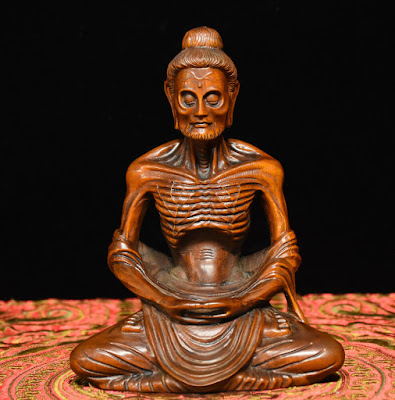
Shakyamuni as an ascetic, before he found the middle way between extremes

Looking at these features of sutric training, it seems very odd that so many of these traditional forms of sutric buddhism forget Shakyamuni Buddha's example. He didn't become awakened through ascetic practices but by taking a good care of his body, after he realised that the ascetic approach was just postponing solving his existential issues, while physically killing him.

Tantra is not based on the view of renunciation, so on tantric retreats for laypeople one can usually talk with others, get enough sleep and more options for food. Tantric retreats for professional practitioners is a different matter but that's a whole different context. Tantra is about transformation which means that one doesn't necessarily need to change one's lifestyle at all. One illuminates one's mind within the life and lifestyle one has. For this reason, I feel that tantra is much better suited for Western laypeople. It is not part of the tantric view to renounce family, work or anything else. Sutra renounces the world and keeps distance to it, tantra embraces and embodies it.

I've heard of many people who had emotional trauma come up in sutric training without receiving fitting instructions from their teachers and therefore having no way to deal with it. In Japan, I knew a zen monk with few years of monastic practice under his belt, who hit a rough patch. As the master in charge of the training (apparently) didn't have extensive enough understanding what the student was experiencing, and had no other tools in his toolbox other than the ones transmitted by the tradition, eventually, as the anxiousness grew, the monk ended up leaving the monastery and in fact, his whole career as an ordained monk. With correct know-how the monk's dark night would have been entirely manageable and possible to overcome. It is a classic example where the tradition failed the teacher, and the teacher failed the student. It is crucial to realise that the student did not fail.

That this happens in one way or the other all the time, is one of the reasons why I am a fan of the Western innovation of combining sutric methods with Western psychology. However, as I have written before, I do not think buddha dharma lacks anything. Rather, it is the fixedness of traditions and level of expertise and open-mindedness of teachers that are lacking. I say lack of open-mindedness because commonly, traditionalists do not seek answers outside of their tradition. They trust that as their lineage is historically authentic (although in many cases this has been debunked by scholars) and time-tested, it couldn't lack anything. Whether training systems can be perfected is highly questionable. Excessive self-sufficiency of buddhists is an issue. This has been discussed in this blog here: Jetsunma Tenzin Palmo & Kim Katami: About Awakening

In 2017, we heard the sad news of a young American lady, who committed a suicide after a Goenka retreat, apparently because she experienced what I describe above, sutric practice without proper support. This is the only dharma practice-related suicide I've ever heard of. It is one too many but at the same time considering the amount of anxiety, depression, trauma and suicidal thoughts practitioners I have wondered why the number is not higher. Perhaps this has something to do with subtle protection coming from Three Jewels: Buddha, Dharma and Sangha. Needless to say if people went killing themselves after retreats, there wouldn't be any sort of buddhist tradition existing.
So, dark nights are periods when dark corners of the mind are revealed, and just like when cleaning a dusty storage room, in the process of cleaning, the dust momentarily fills the air and blocks one's airways. That is not a comfortable experience but it is an unavoidable part of cleaning. Since all buddhist paths are about cleaning, there is no buddhist path entirely without discomfort. The sooner one becomes comfortable with the idea that at times practice stings, the easier it becomes. Suffering and discomfort (dukkha) is typical for existentially confused mind, and so any path that aims to sort it out, must go through it, rather than around it. Buddhist meditation is not about bypassing suffering. It is about suffering voluntarily, not for the sake of enduring suffering but for the sake of releasing the root cause of suffering which is always, without exception, in selfing. To accomplish this we need to, as Mr. Jung suggests, go in the midst of darkness. That's what the path is.

I tell my students to prepare for the worst when it comes to dark nights. I once heard of a Danish practitioner who got depressed for 15 years after his awakening. It took so long to sort out itself because he had no access to suitable yogic knowhow. I recently wrote, ”What is Depression and How to Heal It”.

Types of Mental Illness

Psychosis and schitzophrenia prevent the person from distinquishing between reality and fantasy. One can still practice with these illnesses, but close supervision of both a skilled dharma teacher and doctor are required. As long as the illness persists, I do not think it is a good idea for a person with these illnesses to practice without the supervision of both professionals. Depression and anxiety do not make one lose sight of the reality and for this reason people with these predicaments, expect in severe cases, require no medical supervision, when practicing meditation.

As a tantric teacher, I have the requirement that those with any mental illness need to discuss with me before learning Open Heart Yoga, the main tantric practice of the Open Heart-system.

Yogic Take On Causes Behind Mental Illnesses

All mental illnesses are in the mind. Although there is evidence that genetics (typically associated with the physical body) play a part in some mental illnesses, these are conditions that prevail in the mind. For this reason they have to do with energetic circulation and karmic records stored in the energy body. This means that like all other states of mind, such as trance and concentration (skt. samadhi), mental illnesses have to do with the state of one's energy body. This means that, since all beings have buddhanature as their ground of being, all states of mind are momentary and are necessarily caused by life force (skt. prana, tib. lung) flowing through certain kinds of karmic records, hence creating some momentary bubble of illness.

Lifestyle without responsibilities, as often in the case of young people with no jobs, study or regular sleeping times can induce depression. One's lifestyle momentarily creates a certain kind of way how the energy circulates in the bodymind. Use of intoxicating substances, such as alcohol and various types of drugs can induce depression, anxiety and psychosis.

I have myself, for brief moments (up to 1 hour in duration), experienced psychosis caused by mixed use of alcohol and cannabis (1), physical overtraining (2) and overtraining in pranayama (3), or yogic breathing practices. In all three, the mental state was same or similar. In all of them life force circulated in same or similar manner, strangely and unnaturally, producing convincing ideas and thoughts that afterwards, when normal circulation was returned through rest, healthy food and healthy lifestyle, were seen as weird and unrational. These are examples of momentary mental illnesses caused by lifestyle.

Sometimes practitioners of buddhist meditation, both sutra and tantra, come up with psychotic illnesses that persist. In my limited understanding, these are caused by one's harmful actions in the past. In this connection it is logical for one to question if it is the practice that causes it but like stated above, correct dharma practice based on ethics, does not increase bad karma. Because our mental states are directly related to our karma, it is actually the seeds of karma, revealed through practice, that causes it. We really need to understand that practice brings stuff up. To nullify negative karma, one really needs to exercise ethics, wisdom and compassion, through whatever instructions one's teacher gives. Needless, to say students should only choose and learn from teachers who they trust and respect for these is no point learning from bad teachers. It is common for tantric teachers, including myself, to give specific advice and practices when problems arise to quicken their resolve.

That one might reveal karmic seeds that cause psychotic illness is of course an unexpected and unpleasant surprise. However, we can also look at this in the expanded timeframe longer than a single life and understand that perhaps one is fortunate to have these outbreaks as a dharma practitioner, being guided and protected by the Three Jewels, which are the common source of refuge for all buddhists, as well as Guru, who is the main refuge for tantrics. The other option would be to suffer of one's bad karma without this protection and without any guidance. That these negative karmic causes are brought into the open in the context of dharma practice, is good in the long run, although it might ruin one's plans in this life. In such situation one should find a tantric lama who has some realisation and is able to give specific instructions for sorting it out. If one has very bad karma without guidance and protection of the Guru and the Three Jewels, we could end up being insane for many lifetimes.

The history of humanity is horrible and very dark. In this samsaric realm of human beings, good people have turned into killers, murderers, rapists, robbers and tyrants. We have done extremely bad things to other people, animals and the planet. We are deluded if we think that we couldn't do what people at their worst, in deep distress have done. To see what people do to other people, all we need is today's newspaper. Dharma is a way out of this.

Going Round and Round in the Wonder Wheel of Pain

Samsara is hell of a pressure cooker, abound with immense pain and suffering. Here countless beings inflict harm on themselves and others, not even knowing the difference between honesty and lying or violence and non-harming. For this reason, for those who understand the theory of reincarnation, it is logical to expect that we, now having the extremely fortunate opportunity to practice the dharma, have in the past caused tremendous hurt and pain for others. If not because of genes, because of our past actions, we are deluded, lost and ill.

When sorting out our karma, we don't get to choose what our karma is because it is already recorded in our subconscious mind. For this reason, if by ”safety” we think of the path as something comfy without much psychological challenges, I'm sorry to say that such a buddhist path doesn't exist. Whether we choose to do the big cleaning with sutra or tantra, or combination of both approaches, is up to us. But again, whatever path we choose or don't choose, or if we choose to not practice at all, it is best to be prepared for great hardship. From there we do our practice and little by little bring the dark corners to light.

Vajrayana For The Masses?

Recently Mr. Brad Warner published a wonderful short video discussing big dharma organisations vs. small ones, in the context of abuse in buddhism. I highly recommend watching it.

I think that vajrayana or tantric vehicle, explained in common sensical, de-mystifying, down-to-earth, practice-related manner with solid basic pedagogical skills from the teacher's side, is the best option for the people of our time. The tantric study also includes sutric study and yogic psychology, so it makes a profound path. The reason why I think that tantra, combined with teachings of the natural state (skt. atiyoga, tib. dzogchen) is the best of paths, is because tantric practices accomplish more with less effort. Sutrayana is slow because the practitioner has to do so much more heavy lifting by her- or himself. Plus, I think sutra is unsuitable for laypeople because of the view of renunciation, as discussed above.

In tantra, students are empowered by the guru or guru's representative. It is because of these empowerments and one's personal practice afterwards what makes it so much more easier. By cultivating an enlightened archetype of the mind, i.e. deity or deities, the practitioner automatically and inevitably recognises the nature of mind correctly and returns to the basic state of wakefulness on daily basis. Again, I wish I didn't need to say this but I think it is questionable whether sutric practices actually enable practitioners to recognise their true being because in sutra-teachings distinction between substrate conciousness (skt. alaya vijnana, tib. kun gzhi) is almost never made. In consequence, most followers of sutrayana confuse the samsaric state of subtle dullness with the natural state of wakefulness. It is incorrect. If you cultivate a dull blank stare for a lifetime, where do you think you're heading next? Incorrect cultivation also creates karmic causes.

As an additional point, I personally think that all paths that do not discuss knowing awareness (tib. rigpa, skt. vidya) from the beginning and start with concentration practices (skt. shamatha), have it backwards. Besides, those who have their hair on fire wishing to wake up, they don't have much if any use for shamatha training.

Buddhist practitioners really need to begin to correctly distinquish between liberated (skt. nirvana) and confused (skt. samsara) states from the beginning because if they don't, they'll just make their paths unnecessarily longer, numerous lifetimes longer. For those who are seeking complete liberation, this matter is very very serious. Buddhists trust their ”time-tested” traditions way too blindly. I did too, until I started realising that most traditions and teachers don't have the full picture or methods from deluded to fully liberated state. Traditions, like everything else in the world, age and when they do, they loose their essential message and meaning.

Despite of trust towards my gurus and their teachings, I don't think tantra is suitable to be taught through big organisations. Both teachers and students need to know each other personally and have one-on-one access. That's impossible if retreats are attended by more than few dozen people, not to mention hundreds or thousands. If you never even had a chat with the lama, you are not a student, though you can be a follower of a certain system. Sure, it is possible to disseminate teachings of tantra and dzogchen in mass events but it is far fetched to say that people would really get the essential meaning that way. Tantra and dzogchen are best transmitted in intimate setting.

My answer to your first question is that, yes, tantra is suitable for masses but it is not suitable for one teacher to teach masses for other purpose than very basics which is coincidentally what is taught at mass events. A lot of beneficial points can be shared, of course. Both mahayana and vajrayana paths of sutra and tantra are aiming at full enlightenment or buddhahood, though, so this is important to keep in mind.

Hope this helps. Thanks again for asking.

-Kim Katami, 14.7.2019
Open Heart Sangha,