Näytetään tekstit, joissa on tunniste kundalini. Näytä kaikki tekstit

lauantai 2. syyskuuta 2023

Holy Trinity as Our Own Identity


Holy Trinity as Our Own Identity


Since 37 years ago I have studied Eastern methods and practices. For over 20 years I have spent my life in full time practice and the past 15 years teaching professionally. I have understood and figured out everything there is to know about buddhist and hindu practices and paths and none of it is no longer a mystery to me.


Recently I have felt the calling of God, not christianity but God and the Holy Trinity. I feel and hear this calling because just like buddhism and hinduism there is much mistaken in christianity that has spread into people's minds and lives with the outcome that they don't really get relief and spiritual benefits from the christian religion.


I know it from my own experience. I was baptized into orthodox christian church as a baby, went to church as a child, went to literally at 14 and discussed the doubts and questions I had about life and existence with priests, church workers and teachers of religion but was left with same doubts, and actually even added contradiction because of the way some priests talked about God and Jesus. Those unanswered questions and contradicted atmosphere lead me to look into Eastern ways and so I have spent my life practicing.


Through those years of studying and practicing buddhism and hinduism, and becoming more and more awake, I intuitively understood that Jesus was a yogi and that he has been greatly misunderstood and misinterpreted for the past two thousand years. I learned from some fine works from christian contemplatives, supported by my own experience of yogic meditation, that there are basic mistakes in the way christianity and its practices are presented and taught. This is the main problem that has created the gap between people and church and thus also between people and God and Jesus which is greatly regrettable. Because of this people, whole nations and cultures, have lost the light of their very own life and being so disillusioned about religion they want nothing to do with it. This is only understandable to me because the way how God, Jesus and prayer is taught feels so wrong.


About the Holy Trinity


God is the spirit in all beings. God is the spirit which is always pure and good. God is our own heart and soul. There is no God sitting somewhere on the clouds commanding people to eternal damnation and hellfire. God neither judges us. God is the pure good in everyone of us. This is no different what awakened nature or buddhanature is. God is purity, love and utter kindness in us. If you asked me to choose a pronoun for God, I'd call Him "He". From analytical perspective when you pray to God and feel Him in your body and bone marrow, He feels exactly the same as the masculine principle and archetypal deities of buddhism and hinduism, namely Samantabhadra (lit. basic goodness) and Shiva. I've spent more than 30 000 hours in meditation analyzing these things so I know, and I teach people practices how they can verify these things for themselves. That's what I've always done.


Holy Spirit is the pure energy of God. When you pray for God to bless, heal or come to you, He himself comes as pure presence but also as Holy Spirit, as pure energy that flushes through your mind and body to shift your energies from confusion and pain to clarity and ease. Holy Spirit is God's active side and if I had to choose a pronoun for Her, it's be "She". Again, the same principle applies to both buddhism and hinduism, through Samantabhadri (lit. feminine basic goodness) and Shakti (lit. feminine power). Alternative way to adress Holy Spirit is to call Her the Divine Mother.


Son of God is embodied by Jesus Christ in the christian doctrine and he is presented as the only one who is the son of God but to think that way is incorrect because all of us has been made in the image of God, meaning that each one of us has the same potential of God, Holy Spirit and Divine Child in us, it just hasn't been tapped yet. Jesus is just one example, one embodied person and a master who tapped His innate potential.


One big problem with christian doctrine that affects countless people of the world is that with its basic views it condemns us to stay deluded and in pain, though it tells us to turn to God. The thing is that the closer one gets to Holy Trinity, the clearer it becomes that the Trinity is in us and is us. Through direct experience we can and need to grow to understand that God and the Trinity are not separate things, that we are not in dualistic position with it. Actually, we can realize and experience without any weird ideas or weird features that the Spirit of God is our very own essence and that there is no separation between oneself and God.


Again, there are very weird views about God that he judges and condemns sinners but we should forget all these and start fresh,accompanied by our first hand experience. Union of oneself with God means that one is no longer bound by the delusional belief of believing oneself as a separately existing entity called "me" or "I" but understands that the original purity, kindness and love which is selfless is what and who God is. It is the selfless pure nature of God that flows through our whole being which is what God and God's nature is.


May the Pure Spirit of God descend on you to show you the light that is in you,


Baba, 2 9 23

Amrita Mandala


sunnuntai 11. huhtikuuta 2021

Advice to Someone with Fear and Anxiety About Energy and Kundalini


Advice to Someone with Fear and Anxiety About Energy and Kundalini


Kim: Hello,

I read your email, all of it. I understand your problem/s. You've gone a long way with these issues and unfortunately you haven't met anyone before who could help you out with your problems. I am looking at your past and present experiences as a whole, and even if to you it might look like an endless mess that you cannot get out of or make sense, it is actually not that complex or difficult.


What you need is 1) a clear view of the path and its experiences, incl. energetics and 2) practices that help you to remove and pacify your fears, anxieties and whatever mental-emotional issues are there. You do not have psychotic features so all this is actually easy to manage, if you have the right tools and view. I've had similar issues myself back in the day and have students who have had similar things as you, so nothing what you have experienced is unique to your case. Perhaps you can feel some relief knowing this.


*


-You are over-concerned about sensations. If and when there is nothing wrong with you medically, it means that 1. it's all energetic and 2. you are just anxious and paranoid about it. It is common to different types of subtle sensations. None of what you describe is uncommon. They are not dangerous or weird in themselves. They are just sensations and energetic events. It is only when you don't know this simple fact is because you get anxious and scared about them. The only thing to pay attention to is the fear and anxiety, which are a form of self. Your problem is your "you" that gets scared and anxious. With this point we enter the world of buddhist meditation. I don't know if you practiced buddhism before but my impression is that you didn't, and that's part of the problem because you don't have clear view of these things. -We have three types of bodies: 1. physical, 2. energetic/mind and 3. awareness/buddhanature. Main part of your problem is that you are disconnected from your awareness/buddhanature and this makes you get extra-lost in that prana/energy/fear/anxiety stuff. So you should establish clear awareness in your being. This is actually very easy to do by tantric means. Read this and do the practice described in it: https://www.pemakobuddhism.com/111


The practice uses guru mantras that are explained. In tantra we turn to gurus who are fully enlightened masters for help. All we need to do is to be sincere in our request to receive their help that come in the form of blessings. This is guru yoga and it is the heart and soul of all tantric methods. You will notice that when you chant the mantra, your mind becomes clear and fearless, while you feel a warm soothing and pleasant energy fill you up. Don't worry, none of this is strange or scary. You can trust it, relax and just enjoy the ride. Try. You are also welcome to join any of the guided sessions lead by our acharya's or retreats taught by myself: https://www.facebook.com/groups/pemakobuddhism/events


These will solve your problems for good. You will see the positive benefit from your first session. Then you just keep taking the medicine. If you need advice, I'm here. * You either didn't listen or understand what I wrote to you before, so please go back and read my previous messages. When I say that it is safe, I mean it. When I say that energetic experiences are normal and that you do not need to be alarmed of them, I mean it.


You do not need to take a "leap of faith into the unknown" or anything like that but if you keep following the habits of fear and anxiety like before, it will take unnecessarily long time to sort this out. So!


Take it easy. Relax. When I give this simple instruction to relax, it means that you really need to relax. Relax your body, take a few deep breaths and let your breathing become relaxed. Your mind will calm down also. Within this relaxation you say a prayer request in your own words and invite Guru Rinpoche to you, or you can use his mantra to invite him over to you. Either way, he comes to you in person. A fully enlightened master actually comes to you in nonphysical form. There is no greater healer than that so please take advantage of that to your own great benefit! Little by little you learn to know him and trust him. Everytime you feel his presence, you can ask yourself whether it feels safe or not. He will give you great help to pacify your mind and its many fears and anxieties. This helps you to grow up spiritually.


sunnuntai 14. heinäkuuta 2019

Tantric Yoga: Safe or Dangerous?

Tantric Yoga: Safe or Dangerous?

Question: Do you think tantra is “safe” for mass practice? I would imagine it could induce states of mania or psychosis and confuse many.
The clinical definition of mania is not sleeping for seven days (hypomania is four days), experiencing heightened energy that is often directed toward a multitude of tasks that are not finished, having rapid speech that cannot be interrupted, having flight of ideas of rapidly evolving tangential thoughts, sometimes self-grandiosity, and usually accompanied by a feeling of euphoria. Mania is part of the bipolar spectrum disorders but can be drug induced or accompany psychotic episodes.
I would define safe parameters for the masses as that which requires the least experience in order to practice without risking undue harm or confusion. My sense is that concentration meditation or shamatha is relatively safe with few “side effects” whereas tantric technology can offer immense progress but may not be suitable for everyone to manage “safely.” What are your thoughts and experiences regarding this?

Kim: Thank you for asking. It is a very good and interesting question, since tantra is quite often described as a ”dangerous” path. First, we have to hit a few reset buttons, to get the basic view of samsara and the purpose of practice right.

Dharma and its various teachings are paths to liberation or enlightenment. Liberation of what? Self-delusion, duality and confusion. Teachings of dharma, through ethical guidelines and yogic practices, help us to get out from confusion. They do not take us into confusion or increase it, unless there is something very wrong with the teaching or practice. Since buddhism is very clear with what is correct and incorrect this is not really a problem in buddhism, despite of its great variety. So, by definition, practice does not increase confusion, pain or misery because when correctly applied it doesn't increase our self-based habits and patterns but decreases them. This means that through steady practice, one's mind becomes more and more liberated, or in common terms, less attached, less selfish, more alive and more spacious, that is, natural and sane. Terms such as basic sanity and basic goodness are often used as synonyms for our innate buddhanature.

The Process and Dark Nights

Fortunately, it is becoming better known that all paths include rough patches, or the so-called dark nights. We can define dark nights as periods of emotional or depressive hardship. In the world of meditation, buddhist or otherwise, dark nights are too little discussed about. Meditation practices are sold to people with peacefulness and happiness, without explaining that serenity and increased mental freedom doesn't come without hardship. There should be a warning sign on the first page of every dharma book available.

From the first page of Garchen Rinpoche's Vajrakilaya-training manual

Carl Jung, one of the historical key figures of Western psychology, hit the nail on the head by saying,

One does not become enlightened by imagining figures of light, but by making the darkness conscious.”

Jung wasn't buddhist but it is evident that he understood the basic mechanism of human liberation well.

So, the main idea of buddhist meditation is to seek and look into all and any dark corner of one's bodymind where the light of awareness doesn't yet shine. It is in these dark corners where the fuel for successful practice is hiding. However, if one doesn't have a basic understanding what it is that buddhist practice sets out to do, there is a chance of becoming more confused and overwhelmed. When learning how to drive a car, we first have to have a solid theoretical understanding about what driving is and how a car works. Without it, it is not intelligent to jump behind the wheel and hit the gas. Anyone with common sense can understand that that's potentially harmful and dangerous, and yet this is exactly what happens in the world of meditation.

It is known that unexpectedly challenging silent meditation training can trigger strong anxiety and outbursts of psychosis in people who are perfectly healthy and stable. People end up sinking down into the mud of their minds but are not told that this could happen and are offered no means for digging themselves out. Commonly, when such difficulties arise, students are simply told to continue the practice without teachers' explaining (or understanding) what is happening to them. In a sense this is correct but this is also highly insufficient on behalf of teachers. Consequentially, some people end up becoming mentally ill, instead of psychologically and spiritually illuminated. Such accounts are many.

To prevent beginners from getting into trouble, many (not all) teachers have a policy of not accepting beginners for long and intensive retreats. This is because one is required to have some familiarity with practice, some sparring experience, if you will, to do many hours of daily sitting. In Open Heart, we have a rule that if people with mental illness wish to join teachings they are required to give a detailed outline of their condition, medication and ongoing treatments beforehand. As the head teacher, I also want to have some sense of newcomers; their life situation, prior practice and social relationships, before accepting them for retreats. Open Heart-retreats are very versatile and contain recitation, musical singing, various physical exercises such as walking and dancing meditations indoors and outdoors on top of sitting meditation. At our retreats, people are also encouraged to talk with others, and eat and rest well.

It seems that it is somewhat common for people to have psychological trouble on vipassana, specifically Goenka-style, and zen buddhist retreats. There are many accounts indicating this. This also happens in tantric practice but the numbers are a lot less. I am aware of less than five people who had some sort of mental illness for an extended period of time. One of these cases was mentioned by Culadasa John Yates, a well known author and buddhist teacher, in his webcast in 2018 (sorry, no link available). He stated that, 40 years prior, his ex-girlfriend became ill with schitzophrenia when she practiced Tibetan buddhist tantric preliminary practices (tib. ngondro). He also stated that she suffers of this illness up to this day. I do not know any specifics of her case, about the type of practices she did and how severe her illness is but this is the most severe case of mental illness related to tantric practices I am aware of.

Sutric and tantric methods are very different by nature. Both emphasize practice and, should I say, deep forging but I would say that the tantric approach is much more relaxed in terms of effort because one doesn't need to generate the practice on one's own. Blessings from one's guru, lineage and the deities make the practice much easier and relaxed. As discussed above (dark nights), this doesn't mean that it's always easy, just that it is easier. That has certainly been my personal experience.

Sutric meditation retreats, incl. Goenka and zen, put a lot of emphasis on silent sitting, with limited rest and sleep, simplified vegetarian diet and have very little, if any, social interaction with others. Reason behind these features come from the sutric view of renunciation which in many ways looks exactly like asceticism. Tolerating physical pain or sitting through pain, for example, is a common instruction in zen buddhism. You don't move, even if you have great physical pains. In some training halls you get scolded or even physically hit, if you move during periods of sitting.
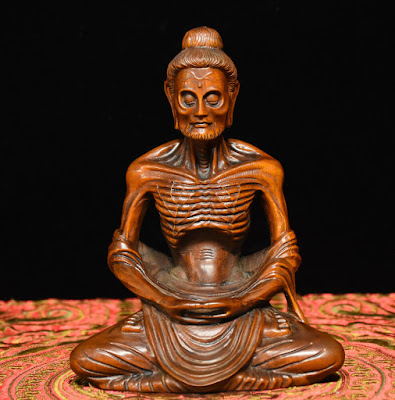
Shakyamuni as an ascetic, before he found the middle way between extremes

Looking at these features of sutric training, it seems very odd that so many of these traditional forms of sutric buddhism forget Shakyamuni Buddha's example. He didn't become awakened through ascetic practices but by taking a good care of his body, after he realised that the ascetic approach was just postponing solving his existential issues, while physically killing him.

Tantra is not based on the view of renunciation, so on tantric retreats for laypeople one can usually talk with others, get enough sleep and more options for food. Tantric retreats for professional practitioners is a different matter but that's a whole different context. Tantra is about transformation which means that one doesn't necessarily need to change one's lifestyle at all. One illuminates one's mind within the life and lifestyle one has. For this reason, I feel that tantra is much better suited for Western laypeople. It is not part of the tantric view to renounce family, work or anything else. Sutra renounces the world and keeps distance to it, tantra embraces and embodies it.

I've heard of many people who had emotional trauma come up in sutric training without receiving fitting instructions from their teachers and therefore having no way to deal with it. In Japan, I knew a zen monk with few years of monastic practice under his belt, who hit a rough patch. As the master in charge of the training (apparently) didn't have extensive enough understanding what the student was experiencing, and had no other tools in his toolbox other than the ones transmitted by the tradition, eventually, as the anxiousness grew, the monk ended up leaving the monastery and in fact, his whole career as an ordained monk. With correct know-how the monk's dark night would have been entirely manageable and possible to overcome. It is a classic example where the tradition failed the teacher, and the teacher failed the student. It is crucial to realise that the student did not fail.

That this happens in one way or the other all the time, is one of the reasons why I am a fan of the Western innovation of combining sutric methods with Western psychology. However, as I have written before, I do not think buddha dharma lacks anything. Rather, it is the fixedness of traditions and level of expertise and open-mindedness of teachers that are lacking. I say lack of open-mindedness because commonly, traditionalists do not seek answers outside of their tradition. They trust that as their lineage is historically authentic (although in many cases this has been debunked by scholars) and time-tested, it couldn't lack anything. Whether training systems can be perfected is highly questionable. Excessive self-sufficiency of buddhists is an issue. This has been discussed in this blog here: Jetsunma Tenzin Palmo & Kim Katami: About Awakening

In 2017, we heard the sad news of a young American lady, who committed a suicide after a Goenka retreat, apparently because she experienced what I describe above, sutric practice without proper support. This is the only dharma practice-related suicide I've ever heard of. It is one too many but at the same time considering the amount of anxiety, depression, trauma and suicidal thoughts practitioners I have wondered why the number is not higher. Perhaps this has something to do with subtle protection coming from Three Jewels: Buddha, Dharma and Sangha. Needless to say if people went killing themselves after retreats, there wouldn't be any sort of buddhist tradition existing.
So, dark nights are periods when dark corners of the mind are revealed, and just like when cleaning a dusty storage room, in the process of cleaning, the dust momentarily fills the air and blocks one's airways. That is not a comfortable experience but it is an unavoidable part of cleaning. Since all buddhist paths are about cleaning, there is no buddhist path entirely without discomfort. The sooner one becomes comfortable with the idea that at times practice stings, the easier it becomes. Suffering and discomfort (dukkha) is typical for existentially confused mind, and so any path that aims to sort it out, must go through it, rather than around it. Buddhist meditation is not about bypassing suffering. It is about suffering voluntarily, not for the sake of enduring suffering but for the sake of releasing the root cause of suffering which is always, without exception, in selfing. To accomplish this we need to, as Mr. Jung suggests, go in the midst of darkness. That's what the path is.

I tell my students to prepare for the worst when it comes to dark nights. I once heard of a Danish practitioner who got depressed for 15 years after his awakening. It took so long to sort out itself because he had no access to suitable yogic knowhow. I recently wrote, ”What is Depression and How to Heal It”.

Types of Mental Illness

Psychosis and schitzophrenia prevent the person from distinquishing between reality and fantasy. One can still practice with these illnesses, but close supervision of both a skilled dharma teacher and doctor are required. As long as the illness persists, I do not think it is a good idea for a person with these illnesses to practice without the supervision of both professionals. Depression and anxiety do not make one lose sight of the reality and for this reason people with these predicaments, expect in severe cases, require no medical supervision, when practicing meditation.

As a tantric teacher, I have the requirement that those with any mental illness need to discuss with me before learning Open Heart Yoga, the main tantric practice of the Open Heart-system.

Yogic Take On Causes Behind Mental Illnesses

All mental illnesses are in the mind. Although there is evidence that genetics (typically associated with the physical body) play a part in some mental illnesses, these are conditions that prevail in the mind. For this reason they have to do with energetic circulation and karmic records stored in the energy body. This means that like all other states of mind, such as trance and concentration (skt. samadhi), mental illnesses have to do with the state of one's energy body. This means that, since all beings have buddhanature as their ground of being, all states of mind are momentary and are necessarily caused by life force (skt. prana, tib. lung) flowing through certain kinds of karmic records, hence creating some momentary bubble of illness.

Lifestyle without responsibilities, as often in the case of young people with no jobs, study or regular sleeping times can induce depression. One's lifestyle momentarily creates a certain kind of way how the energy circulates in the bodymind. Use of intoxicating substances, such as alcohol and various types of drugs can induce depression, anxiety and psychosis.

I have myself, for brief moments (up to 1 hour in duration), experienced psychosis caused by mixed use of alcohol and cannabis (1), physical overtraining (2) and overtraining in pranayama (3), or yogic breathing practices. In all three, the mental state was same or similar. In all of them life force circulated in same or similar manner, strangely and unnaturally, producing convincing ideas and thoughts that afterwards, when normal circulation was returned through rest, healthy food and healthy lifestyle, were seen as weird and unrational. These are examples of momentary mental illnesses caused by lifestyle.

Sometimes practitioners of buddhist meditation, both sutra and tantra, come up with psychotic illnesses that persist. In my limited understanding, these are caused by one's harmful actions in the past. In this connection it is logical for one to question if it is the practice that causes it but like stated above, correct dharma practice based on ethics, does not increase bad karma. Because our mental states are directly related to our karma, it is actually the seeds of karma, revealed through practice, that causes it. We really need to understand that practice brings stuff up. To nullify negative karma, one really needs to exercise ethics, wisdom and compassion, through whatever instructions one's teacher gives. Needless, to say students should only choose and learn from teachers who they trust and respect for these is no point learning from bad teachers. It is common for tantric teachers, including myself, to give specific advice and practices when problems arise to quicken their resolve.

That one might reveal karmic seeds that cause psychotic illness is of course an unexpected and unpleasant surprise. However, we can also look at this in the expanded timeframe longer than a single life and understand that perhaps one is fortunate to have these outbreaks as a dharma practitioner, being guided and protected by the Three Jewels, which are the common source of refuge for all buddhists, as well as Guru, who is the main refuge for tantrics. The other option would be to suffer of one's bad karma without this protection and without any guidance. That these negative karmic causes are brought into the open in the context of dharma practice, is good in the long run, although it might ruin one's plans in this life. In such situation one should find a tantric lama who has some realisation and is able to give specific instructions for sorting it out. If one has very bad karma without guidance and protection of the Guru and the Three Jewels, we could end up being insane for many lifetimes.

The history of humanity is horrible and very dark. In this samsaric realm of human beings, good people have turned into killers, murderers, rapists, robbers and tyrants. We have done extremely bad things to other people, animals and the planet. We are deluded if we think that we couldn't do what people at their worst, in deep distress have done. To see what people do to other people, all we need is today's newspaper. Dharma is a way out of this.

Going Round and Round in the Wonder Wheel of Pain

Samsara is hell of a pressure cooker, abound with immense pain and suffering. Here countless beings inflict harm on themselves and others, not even knowing the difference between honesty and lying or violence and non-harming. For this reason, for those who understand the theory of reincarnation, it is logical to expect that we, now having the extremely fortunate opportunity to practice the dharma, have in the past caused tremendous hurt and pain for others. If not because of genes, because of our past actions, we are deluded, lost and ill.

When sorting out our karma, we don't get to choose what our karma is because it is already recorded in our subconscious mind. For this reason, if by ”safety” we think of the path as something comfy without much psychological challenges, I'm sorry to say that such a buddhist path doesn't exist. Whether we choose to do the big cleaning with sutra or tantra, or combination of both approaches, is up to us. But again, whatever path we choose or don't choose, or if we choose to not practice at all, it is best to be prepared for great hardship. From there we do our practice and little by little bring the dark corners to light.

Vajrayana For The Masses?

Recently Mr. Brad Warner published a wonderful short video discussing big dharma organisations vs. small ones, in the context of abuse in buddhism. I highly recommend watching it.

I think that vajrayana or tantric vehicle, explained in common sensical, de-mystifying, down-to-earth, practice-related manner with solid basic pedagogical skills from the teacher's side, is the best option for the people of our time. The tantric study also includes sutric study and yogic psychology, so it makes a profound path. The reason why I think that tantra, combined with teachings of the natural state (skt. atiyoga, tib. dzogchen) is the best of paths, is because tantric practices accomplish more with less effort. Sutrayana is slow because the practitioner has to do so much more heavy lifting by her- or himself. Plus, I think sutra is unsuitable for laypeople because of the view of renunciation, as discussed above.

In tantra, students are empowered by the guru or guru's representative. It is because of these empowerments and one's personal practice afterwards what makes it so much more easier. By cultivating an enlightened archetype of the mind, i.e. deity or deities, the practitioner automatically and inevitably recognises the nature of mind correctly and returns to the basic state of wakefulness on daily basis. Again, I wish I didn't need to say this but I think it is questionable whether sutric practices actually enable practitioners to recognise their true being because in sutra-teachings distinction between substrate conciousness (skt. alaya vijnana, tib. kun gzhi) is almost never made. In consequence, most followers of sutrayana confuse the samsaric state of subtle dullness with the natural state of wakefulness. It is incorrect. If you cultivate a dull blank stare for a lifetime, where do you think you're heading next? Incorrect cultivation also creates karmic causes.

As an additional point, I personally think that all paths that do not discuss knowing awareness (tib. rigpa, skt. vidya) from the beginning and start with concentration practices (skt. shamatha), have it backwards. Besides, those who have their hair on fire wishing to wake up, they don't have much if any use for shamatha training.

Buddhist practitioners really need to begin to correctly distinquish between liberated (skt. nirvana) and confused (skt. samsara) states from the beginning because if they don't, they'll just make their paths unnecessarily longer, numerous lifetimes longer. For those who are seeking complete liberation, this matter is very very serious. Buddhists trust their ”time-tested” traditions way too blindly. I did too, until I started realising that most traditions and teachers don't have the full picture or methods from deluded to fully liberated state. Traditions, like everything else in the world, age and when they do, they loose their essential message and meaning.

Despite of trust towards my gurus and their teachings, I don't think tantra is suitable to be taught through big organisations. Both teachers and students need to know each other personally and have one-on-one access. That's impossible if retreats are attended by more than few dozen people, not to mention hundreds or thousands. If you never even had a chat with the lama, you are not a student, though you can be a follower of a certain system. Sure, it is possible to disseminate teachings of tantra and dzogchen in mass events but it is far fetched to say that people would really get the essential meaning that way. Tantra and dzogchen are best transmitted in intimate setting.

My answer to your first question is that, yes, tantra is suitable for masses but it is not suitable for one teacher to teach masses for other purpose than very basics which is coincidentally what is taught at mass events. A lot of beneficial points can be shared, of course. Both mahayana and vajrayana paths of sutra and tantra are aiming at full enlightenment or buddhahood, though, so this is important to keep in mind.

Hope this helps. Thanks again for asking.

-Kim Katami, 14.7.2019
Open Heart Sangha,


torstai 20. kesäkuuta 2019

Becoming a Master of Pranayama or Tsa Lung

Becoming a Master of Pranayama
or Tsa Lung

Our mind is like an engine that runs on the fuel of prana (tib. lung), through the numerous pipes and bits of machinery, or channels (skt. nadi, tib. tsa) and centers (skt. chakra). Obstructions (skt. klesha) and karmic files are stored on the inner walls of channels and centers, like dirt and grease sticks to the kitchen drain. This dirt is the impulsive self-based reactions we experience in our everyday mind. Me this, me that, on and on, round and round.

Buddhist meditation adresses the existential confusion (skt. dukkha) created by this with emptiness meditation which means removing the sense of self from all and any dirt that arises. The dirt from the inner walls of the pipes is removed and in this way the fuel or prana that courses through the system becomes a manifestation of wisdom and natural liberation.

It is a somewhat common belief in the world of yoga, that this could be achieved through breathing practices, that is, pranayama or tsalung. That is not the case. In fact, anyone who has tried solving existential confusion mainly with breathing practices of any sort, knows that it simple cannot achieve that. Actually, increasing the amount of prana in the system can make one's confusion even worse, even physically and mentally ill. Imagine a greater quantity of prana coursing through the system without the reduction of selfing... That's a recipe for disaster. For this reason, in all old yogic systems I am aware of, breathing practices were never practiced separately from prayers, mantras, guru yoga and deity yoga, that cultivate energy subtler than prana, that is, energy of awareness. Energy of awareness keeps prana in check, so one who follows this principle never ends up having health problems because of pranic overload, although problems can arise from one's karma.


As a principle, mastery of prana is mastery of the mind. In other words, mastery of prana is the mastery of samsara. Only fully liberated ones have complete mastery of prana. Others don't.

Mastery of the yogic practice of pranayama or tsalung, on the other hand, I would say, is when the mind and the prana coursing through it makes no surprises anymore. By surprises I mean not having entirely new experiences, positive or negative, anymore.

In the context of Open Heart practice and Open Heart Bhumi Model, this comes about around opening of all bhumis and perfecting few of them.

Thank you,
  • Kim, 20.6.2019
Open Heart, www.en.openheart.fi


tiistai 15. tammikuuta 2019

Rushen, Part 1: Spontaneous Origins of Yoga, Tantra and Art

Rushen, Part 1:
Spontaneous Origins of Yoga,
Tantra and Art

First watch this fine presentation by Mr. Igor Kufayev, where he discusses Spontaneous Origins of Yoga.

This phenomena of spontaneous physical movement is known by names such as kundalini kriya, kriya or Trauma Releasing Exercises (TRE). It is very common and happens to many people, whether they know what it is or not. In Open Heart, as well as in traditional dzogchen, it is called rushen. Rushen means to separate between confusion (samsara) and liberation (nirvana). This basically means to recognise one's true nature.


Traditionally, rushen is taught in the following way: Think of various kinds of beings of the six realms, as taught in buddhism, and then in a spontaneous and playful fashion, without planning it, start acting out these beings. You might begin to act like a scared animal or angry demon, for example, and by doing so shed a lot of psychological and physical tensions.

In Open Heart we basically do the same thing. I encourage students to let it all come out spontaneously, without any planning. When they are new to the exercise, they usually start with small and shy movements but when they get out of their heads, the natural stress release mechanism takes over and they start shaking, trembling and moving in dramatic ways, often combined with moaning, grunting, laughing or yelling sounds. Rushen movements expand to different areas of the body or encompass the whole body, several muscle groups, at once. In the beginning it is chaotic, just like samsara, but eventually it starts to sort itself out.

In the short video, Mr. Kufayev discusses how spontaneous movements can develop to yogic postures and breathing exercises, which are known as pranayama.

To add to this, rushen can develop into
tai chi, chi gong, dances of different kinds, including temple dance, as practiced in buddhism, hinduism and shintoism. Also, if the student is a tantric practitioner, mudras (hand gestures) and mantras (sacred sounds and vocalisations) can come out. From there visions of oneself as a guru or as a specific deity, any of those one is familiar with or others, can take place. All of this can happen spontaneously, without no planning or conscious effort whatsoever.

This indicates how thorough this exercise is. One can sort out one's confusion through rushen, reveal the sacred aspects of one's own mind (deities), while expressing it externally through dance and song. This is what it rushen means, to go beyond the six realms and actualize one's wakeful nature. 

- Kim Katami, 15.1.2019
Open Heart Sangha

tiistai 5. joulukuuta 2017

Shane's Awakening

Shane's Awakening


See Shane's before and after photos below.
 
"Before I discovered the Two-Part Formula I hadn’t much experience in meditation, in fact, for reasons that I am not entirely sure of, I hadn’t meditated for nearly 10 years.

My brother introduced me to meditation about 12 years ago and the first method I learned was a breathing awareness meditation. This seemed to have a very positive effect on me so I made a commitment to practice everyday, even though the idea of awakening or enlightenment was completely unknown to me at this stage. Around this time I also took part in a small number of retreats that were focused mainly on the practice of pure awareness. I stuck with this meditation for a while but found it
hard to stay committed. My daily practice became less and less frequent until
eventually I stopped.

During the 10 years of not meditating I had considered returning to a daily practice but could never find the inspiration that I needed. One day my
brother mentioned to me that he had discovered a new meditation technique that was awakening nearly everybody who tried it. As you can imagine I found this quite hard to believe but simply hearing about it was enough to reignite a spark in me. I didn’t go to the 2PF straight away, there was definitely something in me that was resisting it. It took a few months before I eventually decided to give it a go.

The 2PF felt strange at first and was quite unlike any meditation technique I had tried before. I certainly wasn’t one of those individuals who awakens
after one or two days. In fact, it took several weeks to break through the illusion. The 2PF never felt like it was having a very strong effect on me. I found it difficult to trigger any strong sensations of self, but I was committed and eventually it worked.

My awakening happened early on a Saturday morning, but since the afternoon of the previous day I had felt like a shift had occurred. I went out that evening to meet friends and go to a concert and throughout this whole time I felt unusually peaceful. So content and relaxed, yet energised. Socialising was much easier than usual. I often had difficulty relaxing in large groups and would usually resort to excessive drinking as a way of dealing with the tension. While cycling home I decided to try out the affirmation. Saying the words out loud and in my head, I couldn’t help but notice how the words had lost some of the meaning that they previously had. Almost to the point where they felt like they weren’t bouncing off anything, like they weren’t triggering anything in me. I went to bed when I got home and as I lay there, already after 4 am at this point, I couldn’t stop thinking to myself that something was missing. This couldn’t be awakening. My experience lacked heart, lacked warmth and love.

While lying there I became increasingly aware of a glow between my eyes. I had felt something like this before during meditation, but it had previously felt more like tension, like a clenched fist, or a rock, or a knot in my forehead. Now it felt like it was coming to life , growing warmer, and pulsing with energy. I decided to focus my entire being on it and as I did so it started to expand. The more it expanded the warmer and freer I felt. Suddenly I realised something that I had known before, but there was a sudden shock realisation of what it truly meant. For the first time in my life I realised I can be me now, really me. I said this to myself out loud. “Oh my God, I can be me now”. Nothing to be scared of anymore, nothing to chase, no-one to be, except me.
These words had such profound meaning to me that I needed to repeat them several times, completely shocked by the realisation. Suddenly I started crying
and the warm glow that was expanding across my forehead suddenly exploded, releasing a massive wave of energy across my entire body. The feeling was so indescribably intense that I broke down in completely uncontrollable tears.

My body was shaking. It felt like a huge amount of dark energy was bursting out of my body through this point in my forehead. I’m not sure how long the tears lasted but as they calmed down they were replaced by laughter and a feeling of lightness and energy like nothing I’d felt before. Even though it was 5 am I felt like getting dressed and running down the road telling everybody I met what had happened to me and how much I loved them! Crazy! I did go for a walk but you can imagine what the few people around would be like at that time on a Saturday morning, so I kept it to myself.

My awakening was such an intense experience that it took several days to recover from. The whole experience had rattled me so much that I could do
very little for those few days. But as my life gradually returned to normality reality started to sink in. The sights, the sounds, I no longer feel separated from them as I did before. I feel so connected with everything and everyone around me. Such a strange but beautiful feeling. My self could never have experienced life in this way." 

Before

After


For more info and instructions of the Two-Part Formula:

maanantai 21. elokuuta 2017

Bringing Joy Back to Buddhism

Bringing Joy Back to Buddhism

Every now and then I feel like writing reviews about what has been going on with Open Heart. This is one of those reports. I'll be talking about Guru Rinpoche's recent instructions and guidelines along with how our method is taking new (actually old) steps in it's evolution.

Several years ago a dear friend and one of my gurus, mahasiddha Babaji, told me:

This is one and the same yoga. There is no this or that yoga. There is only that which is according to the great tradition of yoga and that which is outside of it. At the moment much yogic knowledge is scattered around the world. It is your work to bring it all together.”

For the last 3-4 years Open Heart has taken a very buddhist tone. Along with studying scriptural sources and lectures, Pau and I received a long list of empowerments of buddhist deities, pointing out instructions and practices that has been the main cause to increase my understanding about the basic principles of sutra, tantra and dzogchen. During this time I have sometimes looked back into earlier times with hindu deities, Shaivite tantras, kundalini kriya yoga and bhakti yoga, feeling that those days have passed while wondering whether some of that, greatly powerful and beneficial style of practice will ever be integrated into Open Heart. For a long time I couldn't see how this could be done.

Head

Buddhism is a wisdom (skt. prajna) and knowledge tradition. By wisdom and knowledge I refer to the principles of seeing, knowing, thinking, analysing and understanding. Buddhism and it's many schools from theravada to mahayana and vajrayana are known for it's detailed analyses and maps. I think that having a clear and understandable map is an essential requirement in seeking our way out of cyclical existence. Without a map and direction it's very difficult to find a way out from a foreign place.

Having said that, I feel that buddhism overemphasises the masculine feature of analysis and wisdom with the expense of intuition and heartfulness, which corresponds to the feminine principle. As buddhism has mostly been transmitted and molded by men, especially monastics, it is no surprise that this is the case. This gives buddhism a very distinct feel and energy. I completely understand why some people are not attracted by buddhism because of this and choose other approaches, my teacher Sivakami was one of them.

If we look at the way buddhist practices and training systems from the vast majority of it's schools are formulated and how they are cultivated, we can see that they are the creations of men. To exaggerate it, we can observe formality, seriousness, emotional coldness, hardness, rigidity and desire to be utterly transparent. If we consider these features according to our psychology, we can see that they relate to the head space. Wisdom of the head without heart is like this. We can be very sharp, clear and discriminative in our thoughts and actions but if we lack warmth and openness of the heart, we will not feel well. Any system created by men, like buddhism, can be very lopsided and this of course, is a problem.

I have often asked the challenging question: If vajrayana's potential is to fully liberate it's practitioners in this life and body, where are all the living buddhas? It is a legitimate question. I think a great part of the problem, that extremely few buddhists of all schools actually attain full enlightenment, lies in this question.

Heart

Being heartful, open minded, a receiver (instead of a transmitter) and being intuitive are feminine features. When we become ”open minded” or are in the receiving mode, we can feel that our heart space opens and softens up, and the mind shuts down very thoroughly. We become kind and mother-like, and it is wonderful. If we overdo feminine features, for example follow our intuition without thinking what we intuit, we become onesided. If we only follow our hearts and leave the head out of the picture, we become unrealistic dreamers. Both clarity and warmth are needed because, after all, we all have heads and hearts.

As a side note I would like to add something about lack of intuition among buddhists in relation to OHBM. For a couple of years I've tried to tell buddhists of various schools about it and how wonderful and exceptional tool it is. Potentially it could solve a lot of problems in buddhism today.

I have wondered why most buddhists have hard time accepting that attainments, closed, opened or perfected bhumis, could be sensed from other person whether present physically or from distance. Although mahayana buddhism talks about bhumis and attainments, they do not have another way to measure attainments except through long term relationship and verbal exchange between a teacher and student. Of course, there is nothing wrong in this but this leaves us utterly ignorant about the attainments of others, and actually often ourselves too. Verbal communication can never be as precise as direct exchange of living experience.

I have heard buddhist teachers say that one's attainment can be detected from the gaze but it never gets more specific than that. Why not? At some point it dawned on me that while for some who consider themselves buddhists understanding OHBM is easy, to most it is hard because they lack intuition. A buddhist who follows a system that is said to have worked for generations, has no need for intuition and hence might not even know what it is. Anyway.

Misleading Joy

While blissful and ecstatic states can also be relatively helpful, from the point of view of dzogchen, the ultimate nonduality, exalted states are pitfalls. This is very common in religions other than buddhism, namely hinduism and christianity in their many forms. I have talked about this here.

Intoxicating states are caused by 1. kundalini movements in the energybody of an unawakened person and/or 2. mental-emotional impurities, i.e. karmic traces stored in the subtle body. As far as I am aware only buddhism has a clear view and ways of dealing with both of these factors, so that the practitioners don't get stuck with heavenly experiences and realms.

In short, kundalini is resolved by awakening and all the many karmic traces are purified through distinct sutra or tantra methods that cover the full scope of human psychology. In the calm state, it is the deep subconscious mind (skt. alaya vijnana), in it's self-deluded mode, that causes strong bliss and ecstasy. Therefore thinking that exalted bliss is ”the” thing, is false.

It is interesting to note that great yogis and mahasiddhas who have greatly or fully nullified their deep mind, do not get intoxicated by over-emotional bhakti yoga, drugs or alcohol. A few glasses of whiskey, an easy way to test (some) one's attainment.

Joy

To know true joy, we first need to recognise and integrate it's basis which is awareness (tib. rigpa) or ”nature of mind”. While many traditions of nondualism point to this basis, as a rule in the history only tantric buddhists and dzogchenpas seem to be the only ones who manage to neutralise all karmas and hence attain the first stage of full enlightenment (OHBM, perfection of bhumis 1-10) or buddhahood.

The main point is that if we know how to avoid and remove the common pitfalls of the devotional approach, the feminine way of using emotional opening and loving surrender, it can be faster and more powerful way for getting into the natural state in it's profoundest meaning. Through emotional opening, the natural state is easily accessed and more pronounced than through mental or analytical means. That is my experience. True joy comes through uniting clarity of awareness of the head and warmth-aliveness of the heart. Together they make a whole.

Pure Land Buddhists

Recently I have corresponded with Pure Land Buddhists who have a wonderfully light and carefree spirit. Their main practice is remembrance and devotion towards Amitabha Buddha, through singing his name. This makes their apporach unique among buddhist schools because their main principle is devotion and surrender, instead of willpower and analysis.

Dharmavidya David Brazier, Pure Land Buddhist teacher:

It does seem that traditionally in India there was a strong buddhist tradition of buddhist music until quite late on. Much of the music which style you now associate with hinduism, like Hare Krishna chanting, that sort of tambourine banging: Haa-ree Raa-maa!, that sort of thing was buddhist originally. It was a buddhist style. As India became hindu rather than buddhist again, the music continued.” (link to video)

Fujita Kotatsu in Genshi Jodo Shiso No Kenkyu about sound use of emotion in Pure Land Buddhism:

In Hinduism, the idea of faith is expressed as bhakti. Bhakti is regarded as the highest path of interface with the gods and also implies the deepest reverence for gods. On the other hand, Pure Land prasada differs in that it appears less emotional and more serene and subtle due to its relation to prajna (wisdom) and samadhi (concentration).” (copied from here)

So it is also important to have wisdom because it naturally combines with emotional warmth.

Guidance of the masters

A few months ago Guru Rinpoche told me to,

Bring joy back to buddhism”.

When he told me this I knew it would be another task and challenge in my work. An obvious point about his request is that I cannot bring joy back into all of buddhism, just to Pemako Buddhism, bring another bit of yogic knowledge to make our path whole and balanced. After having pondered the question of over-masculinity and emotional coldness of buddhism for some time, I understood master's request and agreed. At that point I remembered what I had heard David Brazier say in his talk quoted above and started remembering the ways and melodies we used to sing and chant back in the kriya yoga days. Those sessions were a blast!

After this year's annual Summer Retreat, in early July, Guru Rinpoche and mahasiddha Thirumular, started to introduce me to further options.

To inform those who do not know of Thirumular, he was the main guru of Open Heart before. He is one of the main founders of tantric Shaivism and a great mahasiddha who attained light body many centuries ago. A wonderful, jolly and joyful persona whose presence is felt in the physical body and it's tissues very palpably and concretely, not merely as plain awareness and subtle aliveness of the energy body, as is the case with the vast majority of buddhist masters. You can invite him over to feel him yourself. I am sure he is happy to come.

The further option they introduced me to was the option that ”the practitioner can dissolve his or her body into the Light Body (Tib. འོད་སྐུ་, ö ku), where the body transforms into light and disappears completely into space. This was done by Garab Dorje, Manjushrimitra, Shri Singha, Jnanasutra and Vairotsana.” (from RigpaWiki)

My understanding is that also Jesus and Ramalinga from Tamil Nadu attained this option of the light bodies. Interestingly, both Jesus and Ramalinga, who I consider to be reincarnations of the same person, greatly emphasised love and devotion, the feminine approach of the heart, towards the highest ideal.

Easiest Way to the Light Body

Guru Rinpoche and Thirumular asked me how I felt about mixing these two approaches, 1. emptiness/selflessness and 2. devotion of the heart to strike at the light body attainment of great perfection (tib. dzogchen). Since thogal-practices require a lot of time and specific practice circumstances for attaining light body and therefore is not a reasonable option for householders, I instantly felt this was a good and creative idea, as well as an interesting way to join different approaches, so I agreed.

Since Padmasambhava's attainment, his presence and vibration, emphasises transparency (emptiness) and subtle aliveness (and therefore doesn't concretely connect with the physical tissues), they demonstrated to me how both of their vibrations could be joined together. For this reason the vibration and transmission through Namo Guru Rinpoche-mantra has been different for a few weeks now. Now, it is very different compared to the common buddhist vibe. One can easily feel joy and lightness, together with penetrativeness (emptiness) through chanting it. Such a delight!

In case someone is new to this mantra, it does not require an empowerment, you can just start using it and plug into Guru Padmasambhava directly, he will take care of the rest. If you used this mantra before or if you have done other Guru Rinpoche'mantras from other lineages, you can easily feel that the charge reaches your physical body, soft and hard tissues, in a solid manner. This is a huge blessing from the gurus, so cherish it with sincerity and love. This guru yoga is one of the two ways to activate this particular vibration.

Another way to do this is through a particular mantra which is the seed mantra (skt. bija) of the 13th bhumi within ones own bodymind. It corresponds to the light body attainment and when used, starts to make it a reality. According to Guru Rinpoche's will, there is no need for an empowerment of this mantra either but you can ask him a blessing for it and you will receive it.

This mantra is HU. English speakers can get the correct pronounciation by considering ”Whooo?”. It can be chanted a few times or longer duration-wise, according to the situation and it will do the trick.

Bringing Joy Back

Beautiful and unique developments. I invite anyone to try out the mentioned mantras. That's how we will bring joy back to buddhism, at least to Pemako Buddhism.

Thank you for reading.
Yours in dharma.

  • Orgyen Pema, 21.8.2017

Open Heart, www.openheart.fi