torstai 8. elokuuta 2019

Becoming Vajrasattva, Practitioner's Account

Becoming Vajrasattva,
Practitioner's Account

The following is written by Ben, Open Heart-practitioner who describes his experiences with Vajrasattva-practice, one of the tantric preliminary practices described in Open Heart Preliminary Practices-book.


Preamble


All of us have a yard, a small plot of land in our name. It is a place that collects many things. And sometimes we forget to tend to this yard, allowing it to become overgrown with numerous weeds.
Broken promises, lies, cringey and regretful moments of the past, half-finished projects, habitual beliefs, all sorts of energetic dead ends can become tied up in this inner field. 
Tantra and Bodhicitta remind me of the activity of the farmer. Cultivating fruit with its roots in the deep grounded soil. So when we decide to take ourselves upon this tantric bodhicitta-farmer path, we need to start with a solid plot of land with which to raise our crops.
This is where the Vajrasattva practice comes in. Toss the energetic dead ends in the trash, uproot the weeds, and till the soil until its hidden fresh nutrients are brought to the surface. Creating fertile soil. 
In this sense, I can understand why repeating the Vajrasattva mantra 10,000 times is a preliminary exercise. It prepares the practitioner with a fertile soil ground upon which to start sewing the seeds of and tending to their practice. At the same time, there is nothing to improve upon the basic ground that the Vajrasattva practice reveals. 
 
One way of visualization for Vajrasattva practice.

The Practice

 
The technique is touched upon in the Preliminaries book. After receiving the Vajrasattva practice empowerment from Kim Rinpoche, I chose to repeat 324 mantras per day while visualizing myself as Vajrasattva and then rest in his basic indestructible purity. The 10,000 repetitions were completed in 31 days. Aside from accomplishing what I have described above, this practice also gave me an insight into some of the technology behind tantric practice. 
Vajrasattva embodies the basic indestructible purity of all Buddhas. This basic purity is within us all, always. But due to our own mental-emotional-physical wounds and scars, it can be difficult for us to experientially realize this for ourselves. A sutric approach would be working hard at this project over time. Examining yourself, noticing all the different patterns of confusion, practicing various meditations, and trying to heal while rediscovering your stainless naturalness. 
The tantric is approach is different. It says, “Okay you feel so shitty about yourself that in this instant you cannot feel your own indestructible purity. No problem. Instead you’re going to dissolve and reform as Vajrasattva for a little while. And as Vajrasattva, the very embodiment of the diamond-like purity of all buddhas, you can feel what that purity is like.” And thus you effectively take a shortcut. Instead of undergoing the illusion of change during the sutric route, you undergo the illusion of becoming Vajrasattva. Both bring you to basic purity but in different ways and in different timelines. 
Of course as this whole practice is unfolding, it is having an effect on your karmic and energy bodies. That is the purifying effect. So it both reveals the knowing of purity even as it has purifying activity. 

Results

 
I began the practice the week after my 4th bhumi opening. It really helped digest and move through the dark night elements that followed the opening. Being in contact with primordial purity even as all that stirred up shit swirled around and through the mind-body was massively beneficial by keeping me oriented even as the loss of previous imprints created disorientation. If anything, it emphasized that which was reliable and constant regardless of the rhythm of bhumi openings and dark nights. 
During that month of practice, I also had my 5th and 6th bhumi openings. 
From the very beginning, the practice reminded me of what it felt like to be a child. There is a freshness, a whole-someness, an effervescent wakefulness. Like getting out of a swimming pool on a beautiful summer day. 
I felt that the Vajrasattva practice did a lot with my energy body too. The space of my arms, head, torso and legs began feeling seamless and non-divided. 
And with all of this also arose a sense of pride. Not in a boastful way but in a grateful way, a non-self-referencing way. Nothing held back or hidden, wearing naked simple presence. 

Conclusions


I am truly grateful for the empowerment and the opportunity to have done this practice. It is clear that I will continue to engage Vajrasattva in deity yoga in my spiritual practice. 
I expect this to be helpful in a variety of circumstances.
  1. Post-bhumi openings. I will likely do a few days of 3x10⁸ Vajrasattva mantras after each opening to help with the transition.
  2. Liberating tied up energies. Sometimes we begin things we don’t finish, whether that be due to a change in direction or a lack of commitment. Instead of allowing those energetic intentions to linger out there half-baked, Vajrasattva practice will help free up those energetic dead ends. 
  3. Letting go of past transgressions. When we’ve done something wrong, much of the focus often goes to how to fix it externally. And rightly so. But that can also mean we might neglect to move on internally and the memory still causes us to cringe and contract. Vajrasattva practice will help to forgive as surrender and it is probably why it was used to mend broken vows. 
And I am sure more applications will become clear along the way.

Solidifying Bodhicitta

Solidifying Bodhicitta

Cultivation of bodhicitta, or the heartmind of enlightenment, happens in stages. In the beginning it might be completely artificial, just saying the prayers without meaning them because one doesn't yet feel it. One doesn't get it in the beginning because one does not have much understanding of reality but it changes with practice, like everything does. Through efforts towards greater clarity and peace of mind within oneself, even doing lip service of prayers of compassion leads to accumulation of experiences which in turn brings about transformation. Then we begin to say those prayers and thinking all sentient beings with some care and concern, with some personal involvement. Through reflection of one's and others' inner state*, our world view begins to change and we actually begin to care for others. It doesn't necessarily mean that we come to like people, because people are not easy to like, but we become concerned where the whole human operation is heading towards. We realize the value of dharma for humans and all sentient beings and understand how deeply screwed we all are. From there arises compassion and it is curious that it does. It does because under all the bullshit and deceit, shines basic goodness, (tib. kuntuzangpo). The truth of our being is positive and life-affirming, not negative and life-denying. So, after some time, we start feeling something, a bit compassionate. Bodhicitta keeps growing like a sapling, getting bigger and bigger year by year.


Something that I have observed in my students who have opened all their bhumis, who therefore have no need to search for knowing awareness or rigpa, is that for many of them it takes a while after the shifts to display compassion. Even when one has a direct and constant connection to the buddha within, it apparently takes time for the dynamic aspect of it, bodhicitta, to grow on the person. At one point I was actually very worried about this because many students had opened their bhumis but I wasn't seeing any initiative and action for the existential wellfare of others. They just bathed in their own clarity and bliss. I spent sleepless nights over this. I was stressed whether I had created some sort of a perverted path that lead to clear awareness but is not compassionate, for that'd be awful. Without compassion, Open Heart would not be a path to great accomplishment, that is, mahasiddhi or buddhahood. But then, to my great relief, they became more active and started showing their concern. Colour returned on my face! 
 
Avalokiteshvara - Bodhisattva of Compassion. The name literally means "The Lord who hears the cries from below".

When I started practicing I didn't have all the toys and know-how my students have, so my path was largely just relying on bodhicitta and letting that lead me. Nevertheless, it appears that with or without shifts in perception (bhumi openings), bodhicitta takes time to develop. Stabilizing rigpa is one thing, something very meaningful to any sentient being and on top of that, becoming one with bodhicitta is another. It ensures correct direction of one's practice until full enlightenment is attained. What does becoming one with bodhicitta mean?

As sentient beings we are tied to our self-centered views and thoughts. From there we start loosening the knots of me, me, me and begin to think in terms of us all, us all, us all. That can be scary in the beginning. ”What do you mean 'taking the suffering of others into my heart'!? Fuck that! No! I don't want that!” Despite of initial self-based reactions such as panic, we come to see that it works, if we have had enough of confusion. Those who are ready, i.e. have merit, take their practice like ancient masters have, very seriously. This puts us inside a machine of sorts that takes us beyond duration and location. By going through our pain tirelessly like a warrior, we reach the other shore that is beyond and better than all states and achievements. Para sam gate bodhi svaha - gone completely beyond to reach natural perfection.

In this process, we become unified with compassion. Our mind starts thinking in ways that are aligned with the very message of ”may all beings be free” and ”I vow to liberate all sentient beings”. Our mind becomes united with bodhicitta, which means that it becomes the heartmind of enlightenment. We become that and when we do, we embody the fully enlightened potential we all have.

When we take the Bodhisattva Vow, it puts us into this engine that peels off the layers of self-confusion bit by bit. This can be scary and unpleasant at times. When the samsaric pus comes out, it hurts and stinks for a moment but in the long run gets better.

That we can exercise, contemplate, pray, chant, act and meditate on bodhisattvic compassion is the greatest gift given by the buddha within. I highly recommend receiving it. I am not aware of a better way of solving internal and external conflicts, and since the world is burning, this is the time when it is needed the most.

-Kim Katami, 8th of August 2019
Open Heart Sangha

See also Playlist of Bodhicitta workshops at YouTube.


keskiviikko 7. elokuuta 2019

Jarin herääminen

Jarin herääminen

Seuraava dialogi käytiin elokuussa 2019, ”Jarin” (nimi muutettu) kanssa.

Jari:
Hei. Haluaisin osallistua Heräämisohjaukseen. Vähän taustaa itsestäni: Olen 34-vuotias mies. Viime vuosina etenkin työelämään liittyvä stressi on saanut minut tutustumaan Eckhart Tollen opetuksiin sekä muihinkin vastaavan tyyppisiin henkisiin opetuksiin.
Olen joskus ennenkin eksinyt netissä Open Heart-sivustolle ja kokeillut Kaksiosaista ohjetta, mutta silloin en huomannut sillä suurempaa vaikutusta. Viime lauantaina se palautui mieleeni ja menin Open Heart-sivustolle lukemaan ohjeita ja e-kirjaa. Päätin kokeilla kohtia 1 ja 2, ensin itsenäisesti, sitten Youtube-videon kanssa.
Tämän jälkeen minulla on ollut poikkeuksellisen vapautunut ja rento olotila, enkä onnistunut kadottamaan sitä tänään töissäkään. Näyttäisi, että ajatukset ja tunteet nousevat samalla tavalla kuin ennenkin, mutta heti "savujen hälvettyä", olotila on taas tyyni. Pitkän stressikauden jälkeen tämä tuntuu hyvin kummalliselta.
Jotta en alkaisi kuvittelemaan omiani tilanteestani, niin päätin ottaa sinuun yhteyttä. Miten kannattaa edetä?

Kim:
Mukava kun pitkästä aikaa joku kirjoittelee Suomestakin.
Kertoisitko miltä kokemusmaailma ja ajatus minästä nyt tuntuu? Ja miltä minä-affirmaatio tuntuu?
Kyllähän tuo vähän heräämiseltä vaikuttaa. Voisin katsoa kuvasi tässä kohtaa. Laita tulemaan. Ohjeet kuvaa varten löydät täältä.

Jari:
Ollessani vapaa-ajalla - tai tilanteessa, jossa minua ei haasteta millään tavalla - olotila on pääasiassa rauhallinen, levollinen, usein jopa riemuisa. Silloin kun haastetaan, olen rauhallisempi ja rennompi kuin aiemmin vastaavissa tilanteissa. Kun pudotin tänään kännykän jalkakäytävälle ja osat levisivät ympäriinsä, minä vain rauhallisesti keräsin ne, enkä häpeillyt ohikulkijoiden katseita. Normaalisti siitä olisi riittänyt häpeiltävää ja mielessä kerrattavaa ainakin pariksi tunniksi.
Aiemmin minulla on ollut vapaa-ajallakin taipumuksena murehtia ja projisoida esimerkiksi seuraavan päivän työasioita tai kerrata mielessä jotain, mitä olisi tänään pitänyt tehdä eri tavalla. Tämä taipumus on ollut kateissa viimeiset 3-4 päivää. Vaikuttaa siltä, että alitajunnastani on romahtanut pois jokin rakennelma, joka on sitä ylläpitänyt. Arkipäiväisiin tapahtumiin liittyvät ajatukset ja tunteet nousevat samalla tavalla kuin ennenkin, mutta en reagoi niihin yhtä voimakkaasti, enkä jälkeenpäin kertaile asioita mielessäni niin paljon kuin ennen.
Toki kyllä minulla on edelleen minään liittyviä ajatuksia ja reaktioita, tässäkin viestissä olen käyttänyt minä-sanaa jo monta kertaa. Ajattelen edelleen melko paljon turhuuksia ja mieleni on turhankin innoissani tästä "uudesta olotilasta". Minään liittyvä taakka on kuitenkin kevyempi kuin ennen.
Minä-affirmaatiolla en saa aikaiseksi kovinkaan kummoista minä-tunteen vahvistumista. Ensimmäisessä moodissa sisäisen kehon skannailu tuntuu aina hyvin miellyttävältä, minkä jälkeen minä-affirmointi, jos se jotain vaikuttaa, niin tuntuu lähinnä vahvistavan ensimmäisen vaiheen tunnetta.
Kim:
(Valokuvien analysoinnin jälkeen)
Kiitos kuvauksesta ja kuvista. Herääminen on tapahtunut. Tämä on selvä homma, ei epäilystäkään.

Sinulla on jo selvä käsitys tapahtuneesta muutoksesta. Tulevina päivinä ja viikkoina se tulee vielä tutummaksi ja sitä kautta ymmärrät paremmin mitä herääminen on ja mitä se ei ole. Se mitä se ei ole, voikin olla mielenkiintoista varsinkin jos olet saanut heräämisestä lennokkaan ja epärealistisen kuvan.

Lukaise What's Next-kirjani, jos vaan englanti sujuu. Se kertoo Open Heart Bhumi Modelista, joka on meidän harjoitustapamme maastokartta (engl. path map). Herääminen on ns. 1. bhumin avautuminen. Tämän jälkeen on vielä liuta heräämisiä jo heränneen mielen sisällä kunnes ns. mielen luonnon tai tietoisen mielen tila vakiintuu. Se tapahtuu 11. bhumin avautuessa. Tämä kaikki on selitetty kirjassa yksityiskohtaisesti.

Jos olet kiinnostunut jatkoharjoituksista niin suosittelen Open Heart Joogaa. Siitä löytyy jotain tietoa suomenkielisiltä sivuilta mutta niitä ei ole päivitetty vähään aikaan. Englanninkieliseltä löytyy enemmän. Elokuun lopulla on mahdollista oppia OH-joogaa netin kautta seuraavan kerran, pvm löytyy kalenterista.

Onnittelut vielä! Se kävi sinulta helposti. Jotkut puurtavat viikkokausia.


lauantai 3. elokuuta 2019

Jack Kornfield and Shinzen Young on Shamanism

Jack Kornfield and Shinzen Young on Shamanism

"Shamanism has been misunderstood in the modern times because it is associated with antiquated ways of thinking and superstition but the reality is that it was shut down primarily by colonialism and by organised religion. One of the great Catholic mystics of our time who I talked to said that the Catholic Church for example had hidden all their mystical practices after Martin Luther and the reformation because they didn't people to talk directly to God. They needed people to go through the intermediaries of the priests and the church. So the church was the one that could intermediate between the higher world and lower world and sell indulgences but nobody else could. The truth is that shamans and shamanism has always existed in cultures. They are the healers, the sages, the ones who live in between the two worlds and can open them to you and it's scaring people but now we need them more than ever". - Jack Kornfield, buddhist teacher and author, https://vimeo.com/220889134

It blew my mind to learn that shamanism has been the original religion or way of life since ancient times, literally for tens of thousands of years. World religions such as buddhism, christianity and islam are lightweight compared to shamanism, in terms of history. Shamans have existed in all native cultures, everywhere in the world.

I haven't studied shamanism per se but through healing practices and tantra, I instantly see many similarities with shamanism. Of course many practices and rituals of tantric yoga have shamanic origins, or perhaps I should say presence? It was also news to me that, according to Shinzen Young, another pioneering buddhist teacher, in shamanism there are two branches: 1. the style that is concerned with powers and 2. the style that is concerned with knowing oneself. Apparently Mr. Young has been a practicing shamanist for 40 years. See video: https://www.youtube.com/watch?v=33u14OjeHpE

I do not subscribe to the secular, nonmystical worldview and I think that while rationalisation and common senseness needs to be a solid foundation of any type of path, the nonmystical and secular worldview is insufficient to people because it removes wonder and fascination. By wonder and fascination, I refer to a way of seeing human beings in a greater way than just as a sack of muscles and bones, brain and nervous system which is the view of modern science. To see human being purely as a physical-material organism is precisely what prevents understanding our humanness in a profound way, with all its nonmaterial depth and potential for self-healing and self-empowerment in psychological and spiritual ways.

-Kim, 3.8.2019

sunnuntai 14. heinäkuuta 2019

Tantric Yoga: Safe or Dangerous?

Tantric Yoga: Safe or Dangerous?

Question: Do you think tantra is “safe” for mass practice? I would imagine it could induce states of mania or psychosis and confuse many.
The clinical definition of mania is not sleeping for seven days (hypomania is four days), experiencing heightened energy that is often directed toward a multitude of tasks that are not finished, having rapid speech that cannot be interrupted, having flight of ideas of rapidly evolving tangential thoughts, sometimes self-grandiosity, and usually accompanied by a feeling of euphoria. Mania is part of the bipolar spectrum disorders but can be drug induced or accompany psychotic episodes.
I would define safe parameters for the masses as that which requires the least experience in order to practice without risking undue harm or confusion. My sense is that concentration meditation or shamatha is relatively safe with few “side effects” whereas tantric technology can offer immense progress but may not be suitable for everyone to manage “safely.” What are your thoughts and experiences regarding this?

Kim: Thank you for asking. It is a very good and interesting question, since tantra is quite often described as a ”dangerous” path. First, we have to hit a few reset buttons, to get the basic view of samsara and the purpose of practice right.

Dharma and its various teachings are paths to liberation or enlightenment. Liberation of what? Self-delusion, duality and confusion. Teachings of dharma, through ethical guidelines and yogic practices, help us to get out from confusion. They do not take us into confusion or increase it, unless there is something very wrong with the teaching or practice. Since buddhism is very clear with what is correct and incorrect this is not really a problem in buddhism, despite of its great variety. So, by definition, practice does not increase confusion, pain or misery because when correctly applied it doesn't increase our self-based habits and patterns but decreases them. This means that through steady practice, one's mind becomes more and more liberated, or in common terms, less attached, less selfish, more alive and more spacious, that is, natural and sane. Terms such as basic sanity and basic goodness are often used as synonyms for our innate buddhanature.

The Process and Dark Nights

Fortunately, it is becoming better known that all paths include rough patches, or the so-called dark nights. We can define dark nights as periods of emotional or depressive hardship. In the world of meditation, buddhist or otherwise, dark nights are too little discussed about. Meditation practices are sold to people with peacefulness and happiness, without explaining that serenity and increased mental freedom doesn't come without hardship. There should be a warning sign on the first page of every dharma book available.

From the first page of Garchen Rinpoche's Vajrakilaya-training manual

Carl Jung, one of the historical key figures of Western psychology, hit the nail on the head by saying,

One does not become enlightened by imagining figures of light, but by making the darkness conscious.”

Jung wasn't buddhist but it is evident that he understood the basic mechanism of human liberation well.

So, the main idea of buddhist meditation is to seek and look into all and any dark corner of one's bodymind where the light of awareness doesn't yet shine. It is in these dark corners where the fuel for successful practice is hiding. However, if one doesn't have a basic understanding what it is that buddhist practice sets out to do, there is a chance of becoming more confused and overwhelmed. When learning how to drive a car, we first have to have a solid theoretical understanding about what driving is and how a car works. Without it, it is not intelligent to jump behind the wheel and hit the gas. Anyone with common sense can understand that that's potentially harmful and dangerous, and yet this is exactly what happens in the world of meditation.

It is known that unexpectedly challenging silent meditation training can trigger strong anxiety and outbursts of psychosis in people who are perfectly healthy and stable. People end up sinking down into the mud of their minds but are not told that this could happen and are offered no means for digging themselves out. Commonly, when such difficulties arise, students are simply told to continue the practice without teachers' explaining (or understanding) what is happening to them. In a sense this is correct but this is also highly insufficient on behalf of teachers. Consequentially, some people end up becoming mentally ill, instead of psychologically and spiritually illuminated. Such accounts are many.

To prevent beginners from getting into trouble, many (not all) teachers have a policy of not accepting beginners for long and intensive retreats. This is because one is required to have some familiarity with practice, some sparring experience, if you will, to do many hours of daily sitting. In Open Heart, we have a rule that if people with mental illness wish to join teachings they are required to give a detailed outline of their condition, medication and ongoing treatments beforehand. As the head teacher, I also want to have some sense of newcomers; their life situation, prior practice and social relationships, before accepting them for retreats. Open Heart-retreats are very versatile and contain recitation, musical singing, various physical exercises such as walking and dancing meditations indoors and outdoors on top of sitting meditation. At our retreats, people are also encouraged to talk with others, and eat and rest well.

It seems that it is somewhat common for people to have psychological trouble on vipassana, specifically Goenka-style, and zen buddhist retreats. There are many accounts indicating this. This also happens in tantric practice but the numbers are a lot less. I am aware of less than five people who had some sort of mental illness for an extended period of time. One of these cases was mentioned by Culadasa John Yates, a well known author and buddhist teacher, in his webcast in 2018 (sorry, no link available). He stated that, 40 years prior, his ex-girlfriend became ill with schitzophrenia when she practiced Tibetan buddhist tantric preliminary practices (tib. ngondro). He also stated that she suffers of this illness up to this day. I do not know any specifics of her case, about the type of practices she did and how severe her illness is but this is the most severe case of mental illness related to tantric practices I am aware of.

Sutric and tantric methods are very different by nature. Both emphasize practice and, should I say, deep forging but I would say that the tantric approach is much more relaxed in terms of effort because one doesn't need to generate the practice on one's own. Blessings from one's guru, lineage and the deities make the practice much easier and relaxed. As discussed above (dark nights), this doesn't mean that it's always easy, just that it is easier. That has certainly been my personal experience.

Sutric meditation retreats, incl. Goenka and zen, put a lot of emphasis on silent sitting, with limited rest and sleep, simplified vegetarian diet and have very little, if any, social interaction with others. Reason behind these features come from the sutric view of renunciation which in many ways looks exactly like asceticism. Tolerating physical pain or sitting through pain, for example, is a common instruction in zen buddhism. You don't move, even if you have great physical pains. In some training halls you get scolded or even physically hit, if you move during periods of sitting.
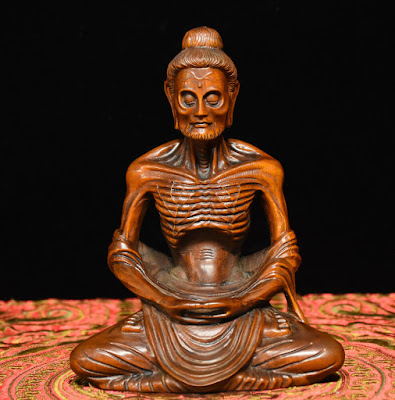
Shakyamuni as an ascetic, before he found the middle way between extremes

Looking at these features of sutric training, it seems very odd that so many of these traditional forms of sutric buddhism forget Shakyamuni Buddha's example. He didn't become awakened through ascetic practices but by taking a good care of his body, after he realised that the ascetic approach was just postponing solving his existential issues, while physically killing him.

Tantra is not based on the view of renunciation, so on tantric retreats for laypeople one can usually talk with others, get enough sleep and more options for food. Tantric retreats for professional practitioners is a different matter but that's a whole different context. Tantra is about transformation which means that one doesn't necessarily need to change one's lifestyle at all. One illuminates one's mind within the life and lifestyle one has. For this reason, I feel that tantra is much better suited for Western laypeople. It is not part of the tantric view to renounce family, work or anything else. Sutra renounces the world and keeps distance to it, tantra embraces and embodies it.

I've heard of many people who had emotional trauma come up in sutric training without receiving fitting instructions from their teachers and therefore having no way to deal with it. In Japan, I knew a zen monk with few years of monastic practice under his belt, who hit a rough patch. As the master in charge of the training (apparently) didn't have extensive enough understanding what the student was experiencing, and had no other tools in his toolbox other than the ones transmitted by the tradition, eventually, as the anxiousness grew, the monk ended up leaving the monastery and in fact, his whole career as an ordained monk. With correct know-how the monk's dark night would have been entirely manageable and possible to overcome. It is a classic example where the tradition failed the teacher, and the teacher failed the student. It is crucial to realise that the student did not fail.

That this happens in one way or the other all the time, is one of the reasons why I am a fan of the Western innovation of combining sutric methods with Western psychology. However, as I have written before, I do not think buddha dharma lacks anything. Rather, it is the fixedness of traditions and level of expertise and open-mindedness of teachers that are lacking. I say lack of open-mindedness because commonly, traditionalists do not seek answers outside of their tradition. They trust that as their lineage is historically authentic (although in many cases this has been debunked by scholars) and time-tested, it couldn't lack anything. Whether training systems can be perfected is highly questionable. Excessive self-sufficiency of buddhists is an issue. This has been discussed in this blog here: Jetsunma Tenzin Palmo & Kim Katami: About Awakening

In 2017, we heard the sad news of a young American lady, who committed a suicide after a Goenka retreat, apparently because she experienced what I describe above, sutric practice without proper support. This is the only dharma practice-related suicide I've ever heard of. It is one too many but at the same time considering the amount of anxiety, depression, trauma and suicidal thoughts practitioners I have wondered why the number is not higher. Perhaps this has something to do with subtle protection coming from Three Jewels: Buddha, Dharma and Sangha. Needless to say if people went killing themselves after retreats, there wouldn't be any sort of buddhist tradition existing.
So, dark nights are periods when dark corners of the mind are revealed, and just like when cleaning a dusty storage room, in the process of cleaning, the dust momentarily fills the air and blocks one's airways. That is not a comfortable experience but it is an unavoidable part of cleaning. Since all buddhist paths are about cleaning, there is no buddhist path entirely without discomfort. The sooner one becomes comfortable with the idea that at times practice stings, the easier it becomes. Suffering and discomfort (dukkha) is typical for existentially confused mind, and so any path that aims to sort it out, must go through it, rather than around it. Buddhist meditation is not about bypassing suffering. It is about suffering voluntarily, not for the sake of enduring suffering but for the sake of releasing the root cause of suffering which is always, without exception, in selfing. To accomplish this we need to, as Mr. Jung suggests, go in the midst of darkness. That's what the path is.

I tell my students to prepare for the worst when it comes to dark nights. I once heard of a Danish practitioner who got depressed for 15 years after his awakening. It took so long to sort out itself because he had no access to suitable yogic knowhow. I recently wrote, ”What is Depression and How to Heal It”.

Types of Mental Illness

Psychosis and schitzophrenia prevent the person from distinquishing between reality and fantasy. One can still practice with these illnesses, but close supervision of both a skilled dharma teacher and doctor are required. As long as the illness persists, I do not think it is a good idea for a person with these illnesses to practice without the supervision of both professionals. Depression and anxiety do not make one lose sight of the reality and for this reason people with these predicaments, expect in severe cases, require no medical supervision, when practicing meditation.

As a tantric teacher, I have the requirement that those with any mental illness need to discuss with me before learning Open Heart Yoga, the main tantric practice of the Open Heart-system.

Yogic Take On Causes Behind Mental Illnesses

All mental illnesses are in the mind. Although there is evidence that genetics (typically associated with the physical body) play a part in some mental illnesses, these are conditions that prevail in the mind. For this reason they have to do with energetic circulation and karmic records stored in the energy body. This means that like all other states of mind, such as trance and concentration (skt. samadhi), mental illnesses have to do with the state of one's energy body. This means that, since all beings have buddhanature as their ground of being, all states of mind are momentary and are necessarily caused by life force (skt. prana, tib. lung) flowing through certain kinds of karmic records, hence creating some momentary bubble of illness.

Lifestyle without responsibilities, as often in the case of young people with no jobs, study or regular sleeping times can induce depression. One's lifestyle momentarily creates a certain kind of way how the energy circulates in the bodymind. Use of intoxicating substances, such as alcohol and various types of drugs can induce depression, anxiety and psychosis.

I have myself, for brief moments (up to 1 hour in duration), experienced psychosis caused by mixed use of alcohol and cannabis (1), physical overtraining (2) and overtraining in pranayama (3), or yogic breathing practices. In all three, the mental state was same or similar. In all of them life force circulated in same or similar manner, strangely and unnaturally, producing convincing ideas and thoughts that afterwards, when normal circulation was returned through rest, healthy food and healthy lifestyle, were seen as weird and unrational. These are examples of momentary mental illnesses caused by lifestyle.

Sometimes practitioners of buddhist meditation, both sutra and tantra, come up with psychotic illnesses that persist. In my limited understanding, these are caused by one's harmful actions in the past. In this connection it is logical for one to question if it is the practice that causes it but like stated above, correct dharma practice based on ethics, does not increase bad karma. Because our mental states are directly related to our karma, it is actually the seeds of karma, revealed through practice, that causes it. We really need to understand that practice brings stuff up. To nullify negative karma, one really needs to exercise ethics, wisdom and compassion, through whatever instructions one's teacher gives. Needless, to say students should only choose and learn from teachers who they trust and respect for these is no point learning from bad teachers. It is common for tantric teachers, including myself, to give specific advice and practices when problems arise to quicken their resolve.

That one might reveal karmic seeds that cause psychotic illness is of course an unexpected and unpleasant surprise. However, we can also look at this in the expanded timeframe longer than a single life and understand that perhaps one is fortunate to have these outbreaks as a dharma practitioner, being guided and protected by the Three Jewels, which are the common source of refuge for all buddhists, as well as Guru, who is the main refuge for tantrics. The other option would be to suffer of one's bad karma without this protection and without any guidance. That these negative karmic causes are brought into the open in the context of dharma practice, is good in the long run, although it might ruin one's plans in this life. In such situation one should find a tantric lama who has some realisation and is able to give specific instructions for sorting it out. If one has very bad karma without guidance and protection of the Guru and the Three Jewels, we could end up being insane for many lifetimes.

The history of humanity is horrible and very dark. In this samsaric realm of human beings, good people have turned into killers, murderers, rapists, robbers and tyrants. We have done extremely bad things to other people, animals and the planet. We are deluded if we think that we couldn't do what people at their worst, in deep distress have done. To see what people do to other people, all we need is today's newspaper. Dharma is a way out of this.

Going Round and Round in the Wonder Wheel of Pain

Samsara is hell of a pressure cooker, abound with immense pain and suffering. Here countless beings inflict harm on themselves and others, not even knowing the difference between honesty and lying or violence and non-harming. For this reason, for those who understand the theory of reincarnation, it is logical to expect that we, now having the extremely fortunate opportunity to practice the dharma, have in the past caused tremendous hurt and pain for others. If not because of genes, because of our past actions, we are deluded, lost and ill.

When sorting out our karma, we don't get to choose what our karma is because it is already recorded in our subconscious mind. For this reason, if by ”safety” we think of the path as something comfy without much psychological challenges, I'm sorry to say that such a buddhist path doesn't exist. Whether we choose to do the big cleaning with sutra or tantra, or combination of both approaches, is up to us. But again, whatever path we choose or don't choose, or if we choose to not practice at all, it is best to be prepared for great hardship. From there we do our practice and little by little bring the dark corners to light.

Vajrayana For The Masses?

Recently Mr. Brad Warner published a wonderful short video discussing big dharma organisations vs. small ones, in the context of abuse in buddhism. I highly recommend watching it.

I think that vajrayana or tantric vehicle, explained in common sensical, de-mystifying, down-to-earth, practice-related manner with solid basic pedagogical skills from the teacher's side, is the best option for the people of our time. The tantric study also includes sutric study and yogic psychology, so it makes a profound path. The reason why I think that tantra, combined with teachings of the natural state (skt. atiyoga, tib. dzogchen) is the best of paths, is because tantric practices accomplish more with less effort. Sutrayana is slow because the practitioner has to do so much more heavy lifting by her- or himself. Plus, I think sutra is unsuitable for laypeople because of the view of renunciation, as discussed above.

In tantra, students are empowered by the guru or guru's representative. It is because of these empowerments and one's personal practice afterwards what makes it so much more easier. By cultivating an enlightened archetype of the mind, i.e. deity or deities, the practitioner automatically and inevitably recognises the nature of mind correctly and returns to the basic state of wakefulness on daily basis. Again, I wish I didn't need to say this but I think it is questionable whether sutric practices actually enable practitioners to recognise their true being because in sutra-teachings distinction between substrate conciousness (skt. alaya vijnana, tib. kun gzhi) is almost never made. In consequence, most followers of sutrayana confuse the samsaric state of subtle dullness with the natural state of wakefulness. It is incorrect. If you cultivate a dull blank stare for a lifetime, where do you think you're heading next? Incorrect cultivation also creates karmic causes.

As an additional point, I personally think that all paths that do not discuss knowing awareness (tib. rigpa, skt. vidya) from the beginning and start with concentration practices (skt. shamatha), have it backwards. Besides, those who have their hair on fire wishing to wake up, they don't have much if any use for shamatha training.

Buddhist practitioners really need to begin to correctly distinquish between liberated (skt. nirvana) and confused (skt. samsara) states from the beginning because if they don't, they'll just make their paths unnecessarily longer, numerous lifetimes longer. For those who are seeking complete liberation, this matter is very very serious. Buddhists trust their ”time-tested” traditions way too blindly. I did too, until I started realising that most traditions and teachers don't have the full picture or methods from deluded to fully liberated state. Traditions, like everything else in the world, age and when they do, they loose their essential message and meaning.

Despite of trust towards my gurus and their teachings, I don't think tantra is suitable to be taught through big organisations. Both teachers and students need to know each other personally and have one-on-one access. That's impossible if retreats are attended by more than few dozen people, not to mention hundreds or thousands. If you never even had a chat with the lama, you are not a student, though you can be a follower of a certain system. Sure, it is possible to disseminate teachings of tantra and dzogchen in mass events but it is far fetched to say that people would really get the essential meaning that way. Tantra and dzogchen are best transmitted in intimate setting.

My answer to your first question is that, yes, tantra is suitable for masses but it is not suitable for one teacher to teach masses for other purpose than very basics which is coincidentally what is taught at mass events. A lot of beneficial points can be shared, of course. Both mahayana and vajrayana paths of sutra and tantra are aiming at full enlightenment or buddhahood, though, so this is important to keep in mind.

Hope this helps. Thanks again for asking.

-Kim Katami, 14.7.2019
Open Heart Sangha,


torstai 11. heinäkuuta 2019

Christine's Account of Stabilising the Natural State Without Tantra

Christine's Account
of Stabilising the Natural State 
Without Tantra

In May of 2019, I was contacted by Christine from Canada, who told me of her positive experiences with some core Pemako Buddhist-practices that she had learned through the internet. She was quite confident that she had in fact opened all of her 13 bhumis as taught in Open Heart Bhumi Model. She sent me a photo for bhumi analysis that I used to verify that her analysis was correct.

Christine's case is a historic one because she is the first person who got this far with Pemako Buddhist-practices without any tantric empowerments. She, no less than, stabilized natural state or knowing awareness (tib. rigpa) as her default mode of being. I have waited for a while to get a message like her's. All of our core practices have been openly available through the internet for a few years now, so anyone can and could use them for their benefit. Find more written accounts by practitioners from What's Next? On Post-Awakening Practice.

-Kim Katami, 11.7.2019
Pemako Buddhist Sangha,
www.pemakobuddhism.com

Find Christine's first post here:

Christine's Account


I am 48 years old, single and work as a lab tech in a hospital lab. About fifteen years ago, the stresses of the job, plus having to work with some "difficult" people led me to look into meditation as a way to cope, as well as to help get rid of the anxiety I have suffered with for most of my life. I took a one-day introductory class in meditation taught by a former Theravadan monk who introduced the class to basic mindfulness of the breath. From this experience I tried to develop a daily practice with limited success. Fortunately, the teacher gave us a list of local resources in our area to help us continue our practice, primarily there was insight meditation society that sponsored teachers from around North America to come teach at monthly weekend non-residential retreats. I started to attend these and had exposure to a variety of Theravadan Vipassana teachers. I learned a lot about Buddha’s teaching, and mindfulness practices at this time, but was still trying to establish a consistent meditation practice and was still struggling with the stress and anxiety in my life.

I also started to attend about two residential retreats (one to two weeks in length) per year. I found that these residential retreats really boosted my meditation practice. Yet, despite being able to sustain my concentration on the breath and experienced states of calm and tranquillity, as soon as I was off the cushion or returned home from a retreat I went back to normal, the stress and anxiety came back and even though I tried to maintain mindfulness in my daily activities once things got rough or I was triggered I went back to my reactive self.

My teachers did often talk about enlightenment as the ultimate goal of the practice, it wasn't clear how mindfulness led to that nor where the insight part of fit in. They also made it seem as though enlightenment was some far-off thing to happen in another life or if you became a monastic. I was still waiting to see a reduction in the suffering I experience, or have some hope of this ever happening.

Something changed in May of 2015, a day before the end of a two-week retreat, I was attending. In the middle of the night I experienced, which in hindsight I realized was crossing the Arising and Passing. This is a threshold moment in the Theravadan progress of the insight path which leads to the dukkha nanas (dark night) and potentially stream entry. I was fortunate that I had an interview with one of the assistant teachers the next day as I described my experience to her, she became very happy for me and said that this was a good thing and had something to do with the “progress of insight”. This was all she would say. Leaving the interview, I was rather confused and when I tried to continue the practice schedule my sits were plagued by restlessness and irritability. Before the retreat ended on the last day, I was able to get an interview with the primary teacher and as I described my experience again the teacher said she wouldn't confirm or deny whether anything significant had happened nor elaborate on the progress of insight the other teacher mentioned.

I left the retreat confused and frustrated, and I fell into a full-blown dark night, it was rough and I had no idea what was going on. I was highly irritable, had bouts of anxiety and depression, I was a mess. As I was going through this, I remember what the assistant teacher said about the “Progress of Insight”. This led me to an internet search where I came across Dharma Overground-discussion forum.

This site was a lifesaver for me, I was able to understand why I felt the way I did and suggested the best practice to do to find my way out of it by reaching stream entry. With this knowledge I practice with great determination and intensity and was able to reach stream entry by August 2015. I continued doing this practice, known as Mahasi Sayadaw noting and the following May in 2016 I reached what was called second path in the Theravadan map. Though I had noticed definitive changes in my sense of self, the way I perceived the world and was better able to deal with stressors, I knew I had more work to do.

I again continued with this practice with the aim of reaching third path, but over time I found that it wasn't really working for me anymore. The intense noting often left me tense, very irritable and more sensitive to external stimuli. I was constantly cycling in and out of the dark night, although it was never as bad as my initial experience with it, it never seemed to lead anywhere. This also created a lot of striving, efforting and comparing, which I felt was not conducive to good practice. I tried switching to a broader awareness but this often led to dullness, and sleepiness. I read several books on different practice techniques, some felt overly conceptual or analytical, or too hard for me to get into and none that I really enjoyed doing.

I was still frequenting the Dharma Overground-website and noticed a number of posts by Kim Katami about Pemako Buddhist-teachings. I checked out the website and read his first book "Awake! Handbook to Awakening." I was hesitant at first because it mentioned Guru Yoga and Dzogchen practices which I was unfamiliar with.

In October 2018, I had a week long self-retreat (with no teacher) coming up. Just the previous month, Kim Katami had released his second book, "What's Next? On Post-Awakening Practice". Intrigued, I downloaded and read it, I liked what it had to say. I noticed the website had a link to a YouTube channel so I used some of those guided practices on my retreat.

I really enjoyed these practices and when I came home, I meditated daily using the guided mediations from the PemakoBuddhism.com-channel at YouTube. Primarily the “Introduction to Open Heart Yoga: Guided Practice” and the “Dynamic Concentration: Buddha, Dharma, Sangha”, as well as a number of other guided mediations to add some variety to my practice. I found that, compared to my previous mediation practices they were more relaxed, I didn’t suffer from dullness and sleepiness, and didn’t lead to irritability. I also felt like there was much less striving and efforting, it was though I could just listen to the guidances and the practice does itself.

I also like the idea that you can check for your own bhumi openings. At first, I wasn’t able to do this myself, but the more I did the practice the more I was able to notice subtle energies and tensions in my body. I believe I was able to detect the opening of the 5th bhumi, and I was more certain about the 6th. I noticed cycles between bhumis openings were there would be a build up of tension or pressure, then dark night and then I would often see a bright light and feeling of euphoria as the bhumi opens, with the subtle euphoria lasting a few days then it would repeat. I was detecting steady bhumi openings about 2-3 weeks apart. This increased my confidence in the practice, and as these openings occurred, I also noticed changes in myself. I was becoming more resilient to stress and less reactive to triggers. I became less concerned about what others thought about me (I have always been very self-conscious) and less prone to overthinking everything, as well as a general reduction in social anxiety and my general ‘day to day’ anxiety (yes, I had a lot of anxiety).

In May 2019, I had another week long self-retreat coming up and I had opened the 10th bhumi a few weeks prior. Again, I had my mobile phone along with the PemakoBuddhism.com -YouTube-channel bookmarked, so I could listen to the guided practices. A few days into the retreat I woke up at night with some intense fear, a fear of losing my "self", a fear that I would disappear or die. I struggled against this fear telling myself that it will be okay. Then something shifted. I felt bliss and an incredible sense of peace, aliveness and clarity. The natural state seemed easily accessible as though it had become a default state. I eventually fell asleep, and when I awoke in the morning these experiences persisted. I checked my bhumis and it felt like I had opened my 11th, the first mahasiddha bhumi. The 12th and 13th bhumi openings followed not long afterward and I was starting to get used to and appreciating my new baseline experience.

Now I have a more spacious awareness at all sense doors, and a feeling that there are no boundaries between my physical body and what is around me, like there is no separation between me and what I am observing. Before Pemako-practices I only had brief glimpses of this. Also prior to Pemako Buddhism, I used to be identified with my thoughts and emotions, be attached to views, and continued to have bouts of anxiety, but that has eased considerably. Along with access to the natural state there is a sense of stillness and bliss that I can easily tap into. I also found that at work, even though we are currently understaffed, I am much better able to handle the pressure which would normally make me feel overwhelmed. I think my coworkers are starting to notice this too.

Knowing that bhumi openings were not the end of the line, that I still needed to perfect them, I decided to learn Rainbow Body Yoga. I had the first empowerment in June 2019, and am really enjoying the new meditation techniques.

Update 8/2020: The shifts I experienced are stable, the natural state still feels readily available and the improvements to my mental health have persisted, such as the reduction in anxiety. I also feel that this is deepening as I continue to practice.


-Christine

keskiviikko 3. heinäkuuta 2019

A Brief (and Funny) Note About The Primitive Behaviour of Human Animals

A Brief (and Funny) Note About
The Primitive Behaviour of
Human Animals

Human behaviour is more primitive than we might want to admit. We are capable of creating art and show compassion for strangers but at the same time we also act like undeveloped simpletons, blindly following drives and needs such as survival, procreation, eating and sleeping in our daily life. When our most basic needs are not met, our animalistic nature is shown. In untrained and ethically poorly defined mind, greater potential and subtleties are nonexistent.

We look and measure other people, just like animals do and label them safe or unsafe, desirable or undesirable, attractive or unattractive. Here's a funny story.

Several years ago I used to go to a restaurant that was attached to a gas station. I frequented that place every day, as did about a dozen of male manual labourers. I used an entrance that was just next to the dining area. I opened the door and stepped in. Hearing the noise of the door and seeing someone come in, these guys always raised their heads from their plates to see who came in. At first, I didn't think much of it until I figured, that them probably not realising it, they were measuring me to find out whether I was alpha, someone tough and potentially dangerous or if I was weak and no threat to them. For few months, every day that I went there, I stepped onto their territory in a relaxed manner, wiping my shoes gently into the door mat, not making a number about myself. As I came in appearing like someone who didn't have much power, the guys just shrugged their shoulders, maybe even chuckled at me. Then one day I came up with a social experiment to test whether my perception of the situation was correct or not. The next day when I stepped in, I hit my boots strongly against the mat, pretending to shake snow off of them, and coughed loudly with chest broadly opened chest. With my strong masculine habitus I sent these guys a message that I was not someone they could fuck with and their reaction about me was instantly different. They put their heads down quickly, instead of taking a long judgemental look at me. They quickly returned to mind their own business, instead of passing a judgement of my inferiority. I was amused. I thought of pushing my experiment further, by walking to someone's table, looking them straight into their eyeball and taking their plate. This is a pronounced example but similar things happen every day. My point is that animal behaviour is very much part of our human life. I recall another example.

Even a neanderthal finds it funny.

Once I was travelling from Helsinki to Northern Norway to do a retreat there and had to change planes at Oslo airport. I had time, so I went to a cafe to have lunch. I sat down and noticed that there was a gentleman, dressed up in a very fancy suit on the table in front of me. I overheard from conversation he was having with his friend that his name was Frank. Funny thing about Frank was that even when he clearly was someone who had money and taste, and therefore likely life and lifestyle that reflected his wealth and class, everytime he took a bite of his food, he hunched over it and in a strange, bit of aggressive way glanced at his surroundings, as if someone was after his sandwich. I was looking at this man, probably in his 60's, with a stylish haircut, dressed in what might have been a 2000 dollar suite, act like an aggressive lion over its prey. It was both absurd and extremely funny! I played with a thought of going over and grabbing that sandwich but I think Frank had bitten me in the neck, if I had! I had never before seen human being act exactly like an animal.
-Kim, 3.7.2019